 Stock Trading
Now trade in ₹9 Per Order or ₹ 999 Per Month Plans.
 Future & Options
Access F&O contracts with advanced tools for hedging and speculation.
 Currency Trading
Trade in major currency pairs and manage forex exposure efficiently.
 Commodity Trading
Diversify Trading with MCX & NCDEX by Trading in Gold, Silver, Base Metals, Energy, and Agri
Products.
 Margin Trading Funding
Boost your buying power with upto 5X, Buy now Pay Later
 Algo Trading
Back test, Paper Trade your logic & Automate your strategies with low-latency APIs.
 Trading View
Leverage Trading View charts and indicators integrated into your trading platform.
 Advanced Options Trading
Execute multi-leg option strategies with precision and insights.
 Stock Lending & Borrowing
Earn passive income by lending stocks securely through SLB.
 Foreign Portfolio Investment
Enable NRIs and FPIs to invest in Indian markets with ease and compliance.
 IPO
Invest in upcoming IPOs online with real-time tracking and instant allotment updates.
 Direct Mutual Funds
0% Commissions by investing in more than +3500 Direct Mutual Fund Scheme.
 Corporate FDRs
Earn fixed returns with low-risk investments in high-rated corporate fixed deposits.
 Stocks SIPs
Build long-term wealth with systematic investment plans in top-performing stocks.
 Bonds & NCDs
Access secure, fixed-income investments through government and corporate bond offerings.
 Depository Services
Safely hold and manage your securities with seamless Demat and DP services with CDSL.
 RMoney Quick
Fast, hassle-free trading in one tap.
 RMoney Rocket
Power-packed platform for active traders.
 Rocket API
Lightning-fast trading API for developers advanced algo traders.
 XTS Algo
Smart algo trading software for precision trades.
 Journey
Tracing our growth and milestones over time.
 Mission & Vision
Guided by purpose, driven by long-term vision.
 Why RMoney Platform
Smart, reliable platform for all investors' needs.
 Management
Experienced leadership driving strategic financial excellence.
 Credentials
Certified expertise with trusted industry recognition.
 Press Release
Latest company news, updates, and announcements.
 Testimonials
Real client stories sharing their success journeys.
 7 Reasons to Invest
Top benefits that make investing with us smart.
 SEBI Registered Research
Trusted insights backed by SEBI-compliant research.
 Our Technology
Advanced tools enabling efficient online trading.
 Blog
Stay updated with expert insights, market trends, and trading strategies through our
informative blogs.
 Video
Learn visually with easy-to-understand videos covering trading concepts, tips, and market
analysis.
 Podcast
Tune in to insightful discussions and expert opinions anytime, anywhere.
 Telegram Community
Be part of an active trader community sharing ideas, updates, and market opportunities in
real-time.
 WhatsApp Updates
Get instant alerts, key market updates, and important notifications directly on WhatsApp.
 Financial Calculators
Plan your trades, margins, and returns efficiently with our smart calculation tools.
 Marketplace
Discover curated tools, strategies, and services designed to enhance your trading
experience.
 Daily Research Reports
Stay ahead with timely market insights, trends, and actionable analysis delivered every day.
 Dedicated Advisory
Get personalized guidance and expert recommendations tailored to your trading goals.
 Research Team
Backed by experienced analysts delivering data-driven insights and market expertise.
 Research Reports
Access in-depth reports covering stocks, commodities, and market movements to support
informed decisions.
 Feedback
Share your suggestions or concerns to help us improve your experience.
 Downloads
Access important forms, software, and documents in one place.
 Locate Us
Find the nearest RMoney branch or service center quickly.
 Escalation Matrix
Resolve issues faster with our structured support escalation process.
 Back Office
Log in to view trade reports, ledger, and portfolio statements anytime.
 Account Modification
Update personal or bank details linked to your trading account.
 Fund Transfer
Transfer funds instantly online with quick limit updation to your trading account.
 Bank Details
View our registered bank account details for seamless transactions by NEFT, RTGS or IMPS.
 RMoney Rocket Web Version
Experience powerful web-based trading with advanced tools for algo traders.
 Refer & Earn
Invite friends and earn rewards every time they trade with us.



Charges: AMC, Pledge & DP Fees Explained
By: Shailly Saxena | Date : Nov 20, 26

Pledge ₹5 lakh of one stock for margin and you pay ₹23.60. Pledge the same ₹5 lakh spread across ten stocks and you pay ₹236. Unpledge next week and it doubles. Same collateral, ten times the fee.
Think of your demat account as a locker for your shares. Brokerage is what you pay each time you trade. The AMC is the rent on the locker. Pledge and unpledge charges are the handling fees whenever you open it to use what’s inside.
None of these charges look particularly large on their own. The interesting part is what happens when you add them up.
Why am I paying demat charges when I already pay brokerage?
Because brokerage and demat charges cover different things. One relates to executing trades; the other covers maintaining your account and handling certain services involving your securities.
At Rmoney, the first year is free. After that, the regular annual maintenance charge (AMC) is ₹299 plus GST, billed quarterly.
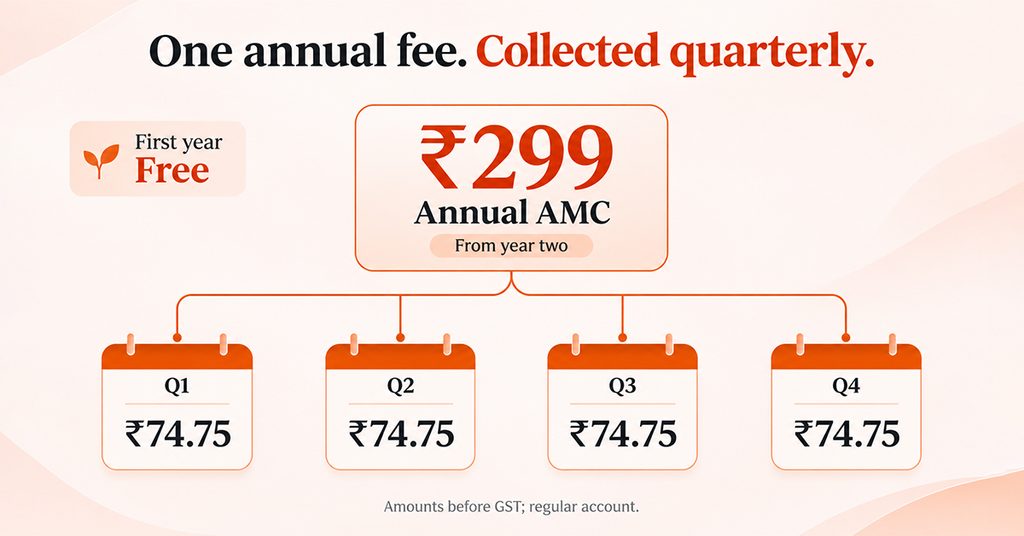
Here is how that works out at 18% GST:
| AMC | Amount |
| Annual charge before GST | ₹299.00 |
| Quarterly instalment before GST | ₹74.75 |
| Quarterly instalment including GST | ₹88.21 |
| Annual AMC including GST | ₹352.82 |
The quarterly debit can catch people off guard, especially if they opened their account under a first-year-free offer and haven’t been keeping track of the renewal date.
Say you opened your account in January and paid no AMC during the first year. When a debit appears the following year, it may feel like an unexpected charge. In reality, the annual fee is being collected in four installments.
It is worth checking your account statement and billing date before assuming something has gone wrong.
Can my holdings change what I pay for the account?
They can if you qualify for a Basic Services Demat Account (BSDA).
BSDA exists to cut maintenance costs for eligible investors with smaller holdings. Going by Rmoney’s stated fee structure, holdings up to ₹4 lakh pay no AMC. Holdings above ₹4 lakh and up to ₹10 lakh pay ₹100 plus GST.
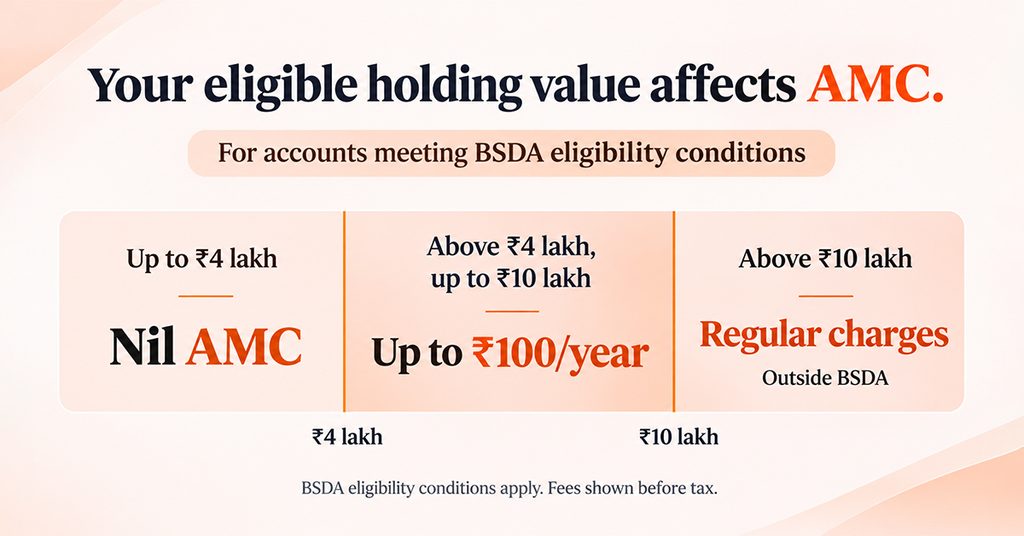
That works out to ₹118 a year at 18% GST, compared with ₹352.82 for a regular account. The difference is ₹234.82 annually.
But here is something worth remembering if your portfolio sits close to a threshold: market movements can change the value of your holdings even when you haven’t placed a single order.
For instance, your holdings might be worth ₹9.7 lakh near a review date. A market rally pushes them above ₹10 lakh. You haven’t added any new shares, yet the value of your portfolio has changed. Depending on the applicable rules and eligibility assessment, that could affect the AMC you pay.
BSDA isn’t only about portfolio value either. Account-holder conditions matter too. Look up the latest SEBI guidance and Rmoney’s current charges before you count on the lower fee.
Why does pledging ten stocks cost more than pledging one expensive stock?
This is where the calculation gets interesting.
Rmoney’s stated pledge and unpledge charge is ₹20 plus GST per ISIN for each request, whatever the quantity. An ISIN is just the unique ID code of a security.
Imagine pledging shares worth ₹5 lakh in one company. Now imagine spreading that same ₹5 lakh across ten companies, with ₹50,000 invested in each. The collateral value is identical, but the number of securities is different.
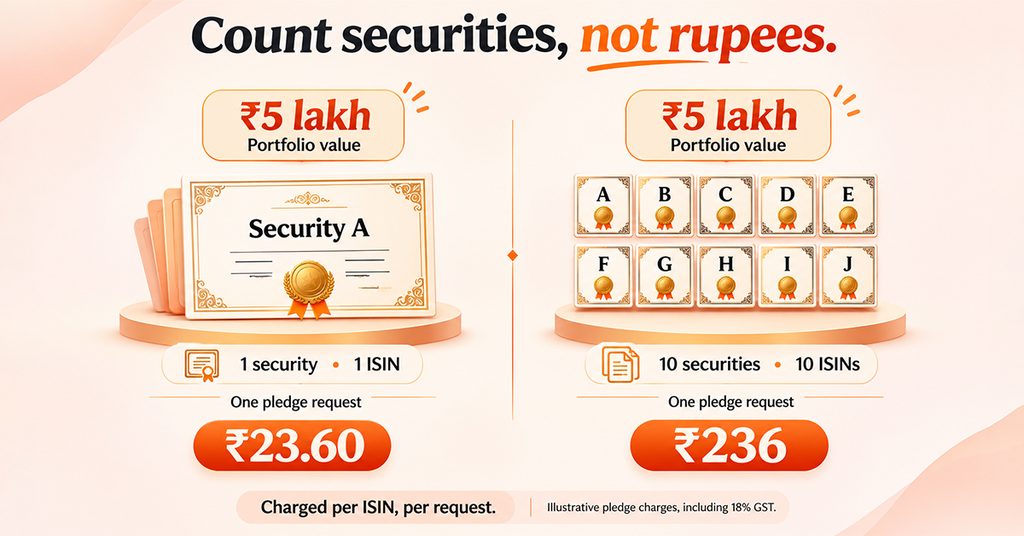
At 18% GST, the charge works out to ₹23.60 per ISIN for each chargeable request.
| Securities involved | One pledge | One unpledge | Both actions |
| 1 ISIN | ₹23.60 | ₹23.60 | ₹47.20 |
| 5 ISINs | ₹118 | ₹118 | ₹236 |
| 10 ISINs | ₹236 | ₹236 | ₹472 |
| 20 ISINs | ₹472 | ₹472 | ₹944 |
These figures assume the stated fee applies to every ISIN involved in each request.
So, if you pledge ten securities and later unpledge them, the combined cost is ₹472. Do that four times in a year, and the bill reaches ₹1,888.
The collateral may be worth the same amount each time. The number of chargeable actions is what changes the cost.
Does it matter if I split a pledge into several requests?
It can. If separate requests are charged individually, breaking up a transaction may mean paying the fee more than once for the same security.
For example, three separately chargeable requests involving the same ISIN could cost ₹70.80, including GST, compared with ₹23.60 for one request under the same assumptions.
If you know how much collateral you need, it may be worth reviewing your basket before submitting requests. That doesn’t mean delaying a necessary margin action to save a few rupees; it simply means understanding when charges repeat.
Check the current schedule on Rmoney’s account charges page to see how each action is treated. Selling pledged shares or an automatic unpledge may follow their own charging rules, so don’t assume one process fits every case.
What could these charges add up to over a year?
Take a regular account where ten securities are pledged and unpledged twice during the year.
The AMC comes to ₹352.82, including GST. Each complete pledge-and-unpledge cycle across ten ISINs costs ₹472, so two cycles add ₹944.
Together, those charges total ₹1,296.82 for the year.
That covers only the AMC and the pledge and unpledge activity in this example. It is not your total cost of trading. Brokerage, exchange charges, statutory levies, and other fees come on top, and Rmoney’s brokerage calculator helps you size those.
Whether ₹1,296.82 is big or small isn’t really the question. The AMC repeats every year no matter what. Pledge charges follow how often you use the service and how many securities you touch.
For someone who rarely pledges shares, the AMC may account for most of these expenses. For a trader who regularly changes collateral, pledge and unpledge charges can become the larger component.
What should I check before my next debit?
Start with your account statement:
- Check the AMC amount.
- Note how often it is billed.
- Confirm when any first-year-free offer ends.
- If your holdings sit near a BSDA threshold, review your eligibility instead of leaning on the portfolio value from a few months back.
Then go through your pledge activity. Count the securities involved and the number of chargeable requests. That shows you where the money actually goes.
Rmoney’s account charges page has the applicable fee schedule, and the brokerage calculator estimates trading costs separately. Electronic statements, where they’re free under the applicable terms, make reconciling easier.
Locker rent is easy to spot. The handling fees are what slip past, because each debit looks small. A quick look at both tells you more about what your trading setup really costs than brokerage alone.
FAQs
Why is AMC deducted from my demat account every quarter?
The annual fee is collected in four installments, not one. At the stated ₹299 plus GST, each quarterly debit is ₹88.21 with 18% GST, which adds up to ₹352.82 a year. Check your statement for the billing date.
Are pledge charges per share or per ISIN?
Per ISIN, not per share or per rupee. Under Rmoney’s stated fee, a pledge costs ₹20 plus GST for each ISIN in a request, whatever the quantity. That’s ₹23.60 at 18% GST, so ten securities in one request cost ₹236.
Is unpledging charged separately?
Yes. Under the stated fee, an unpledge carries the same ₹20 plus GST per ISIN as a pledge. One ISIN pledged and then unpledged costs ₹47.20 with GST. Check the current schedule for special cases like selling pledged shares or an automatic unpledge.
Does splitting a pledge into several requests cost more?
It can, because the fee applies to each chargeable request. Three separate requests on the same ISIN could cost ₹70.80 with GST, against ₹23.60 for one. Review your basket first, but never delay a needed margin action just to save a fee.
What is a BSDA and who can use it?
A Basic Services Demat Account is a lower-cost account for eligible investors with smaller holdings. In Rmoney’s fee structure, holdings up to ₹4 lakh attract no AMC, and ₹4 lakh to ₹10 lakh attract ₹100 plus GST. Eligibility conditions apply, so check SEBI’s guidance.
What are DP charges on a demat account?
DP stands for depository participant, which is your broker. DP charges broadly cover running the account and handling your securities, and that includes the AMC and the pledge and unpledge fees covered here. Other per-transaction charges are on Rmoney’s account charges page.
Is the AMC the total cost of running a demat account?
No. The AMC is only the yearly maintenance fee. Pledge and unpledge charges depend on your activity, and brokerage, exchange charges, and statutory levies sit separately. Estimate trading costs with the brokerage calculator, and read your statement for what you’ve already paid.
Disclaimer: Charges and eligibility rules may change. The figures above use the stated fee assumptions and 18% GST for illustration. Verify the latest Rmoney charges, applicable BSDA conditions and taxes against official sources before making decisions.
Table of content
Categories
Open Demat Account 

Related Posts
-

Valiant Laboratories Limited IPO – Upcoming IPO in India 2023
The Valiant Laboratories IPO is a book-built issue with a total value of Rs 152.46...
-
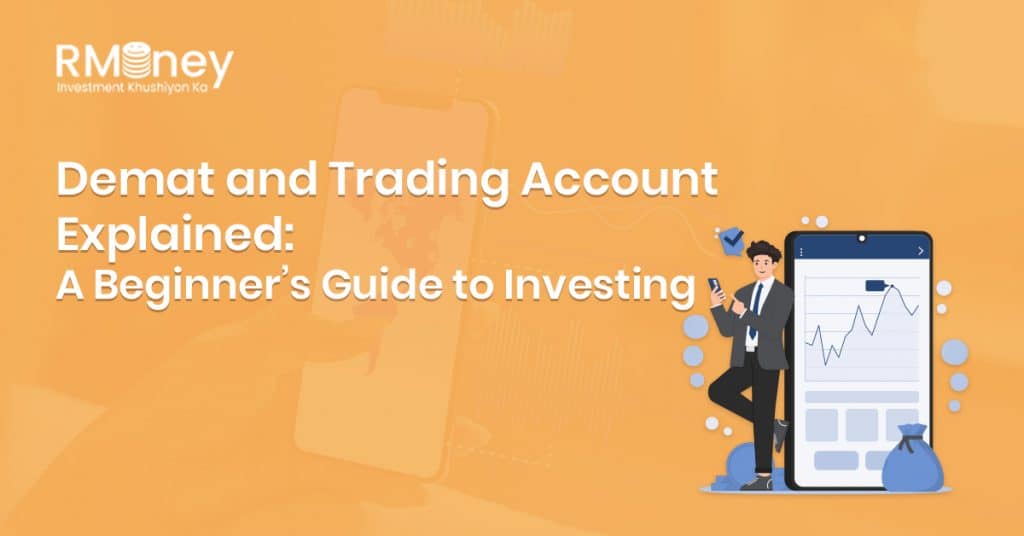
Demat and Trading Account Explained: A Beginner’s Guide to Investing
When Rohan began investing, his first obstacle wasn’t market risk. It was understanding Demat and...
-

How to pick a right kind of money market mutual fund schemes for your portfolio?
Money market mutual fund schemes in India comes under debt instruments. It is also loosely...
-

Transrail Lighting Limited IPO (Transrail Lighting Limited IPO)
Founded in February 2008, Transrail Lighting Limited is a prominent engineering and construction company with...





Filing Complaints on SCORES (SEBI) – Easy & Quick
- Register on SCORES Portal (SEBI)
- Mandatory details for filing complaints on SCORES:
- Name, PAN, Address, Mobile Number, E-mail ID
- Benefits:
- Effective Communication
- Speedy redressal of the grieva`nces


IT'S TIME TO HAVE SOME FUN!
Your family deserves this time more than we do.
Share happiness with your family today & come back soon. We will be right here.
Investment to ek bahana hai,
humein to khushiyon ko badhana hai.
E-mail
askus@rmoneyindia.com
Customer Care
+91-9568654321



Trade Endlessly with
RMoney
Deep Discount Brokerage Plan
At 999/Monthly
- Dedicated round the clock Advisory Support
- High performance in depth research
- Save more than ₹10,000 brokerage Per Month
- Ultra fast trading app