 Stock Trading
Now trade in ₹9 Per Order or ₹ 999 Per Month Plans.
Stock Trading
Now trade in ₹9 Per Order or ₹ 999 Per Month Plans.
 Future & Options
Access F&O contracts with advanced tools for hedging and speculation.
Future & Options
Access F&O contracts with advanced tools for hedging and speculation.
 Currency Trading
Trade in major currency pairs and manage forex exposure efficiently.
Currency Trading
Trade in major currency pairs and manage forex exposure efficiently.
 Commodity Trading
Diversify Trading with MCX & NCDEX by Trading in Gold, Silver, Base Metals, Energy, and Agri Products.
Commodity Trading
Diversify Trading with MCX & NCDEX by Trading in Gold, Silver, Base Metals, Energy, and Agri Products.
 Margin Trading Funding
Boost your buying power with upto 5X, Buy now Pay Later
Margin Trading Funding
Boost your buying power with upto 5X, Buy now Pay Later
 Algo Trading
Back test, Paper Trade your logic & Automate your strategies with low-latency APIs.
Algo Trading
Back test, Paper Trade your logic & Automate your strategies with low-latency APIs.
 Trading View
Leverage Trading View charts and indicators integrated into your trading platform.
Trading View
Leverage Trading View charts and indicators integrated into your trading platform.
 Advanced Options Trading
Execute multi-leg option strategies with precision and insights.
Advanced Options Trading
Execute multi-leg option strategies with precision and insights.
 Stock Lending & Borrowing
Earn passive income by lending stocks securely through SLB.
Stock Lending & Borrowing
Earn passive income by lending stocks securely through SLB.
 Foreign Portfolio Investment
Enable NRIs and FPIs to invest in Indian markets with ease and compliance.
Foreign Portfolio Investment
Enable NRIs and FPIs to invest in Indian markets with ease and compliance.
 IPO
Invest in upcoming IPOs online with real-time tracking and instant allotment updates.
IPO
Invest in upcoming IPOs online with real-time tracking and instant allotment updates.
 Direct Mutual Funds
0% Commissions by investing in more than +3500 Direct Mutual Fund Scheme.
Direct Mutual Funds
0% Commissions by investing in more than +3500 Direct Mutual Fund Scheme.
 Corporate FDRs
Earn fixed returns with low-risk investments in high-rated corporate fixed deposits.
Corporate FDRs
Earn fixed returns with low-risk investments in high-rated corporate fixed deposits.
 Stocks SIPs
Build long-term wealth with systematic investment plans in top-performing stocks.
Stocks SIPs
Build long-term wealth with systematic investment plans in top-performing stocks.
 Bonds & NCDs
Access secure, fixed-income investments through government and corporate bond offerings.
Bonds & NCDs
Access secure, fixed-income investments through government and corporate bond offerings.
 Depository Services
Safely hold and manage your securities with seamless Demat and DP services with CDSL.
Depository Services
Safely hold and manage your securities with seamless Demat and DP services with CDSL.
 RMoney Quick
Fast, hassle-free trading in one tap.
RMoney Quick
Fast, hassle-free trading in one tap.
 RMoney Rocket
Power-packed platform for active traders.
RMoney Rocket
Power-packed platform for active traders.
 Rocket API
Lightning-fast trading API for developers advanced algo traders.
Rocket API
Lightning-fast trading API for developers advanced algo traders.
 XTS Algo
Smart algo trading software for precision trades.
XTS Algo
Smart algo trading software for precision trades.
 Journey
Tracing our growth and milestones over time.
Journey
Tracing our growth and milestones over time.
 Mission & Vision
Guided by purpose, driven by long-term vision.
Mission & Vision
Guided by purpose, driven by long-term vision.
 Why RMoney Platform
Smart, reliable platform for all investors' needs.
Why RMoney Platform
Smart, reliable platform for all investors' needs.
 Management
Experienced leadership driving strategic financial excellence.
Management
Experienced leadership driving strategic financial excellence.
 Credentials
Certified expertise with trusted industry recognition.
Credentials
Certified expertise with trusted industry recognition.
 Press Release
Latest company news, updates, and announcements.
Press Release
Latest company news, updates, and announcements.
 Testimonials
Real client stories sharing their success journeys.
Testimonials
Real client stories sharing their success journeys.
 7 Reasons to Invest
Top benefits that make investing with us smart.
7 Reasons to Invest
Top benefits that make investing with us smart.
 SEBI Registered Research
Trusted insights backed by SEBI-compliant research.
SEBI Registered Research
Trusted insights backed by SEBI-compliant research.
 Our Technology
Advanced tools enabling efficient online trading.
Our Technology
Advanced tools enabling efficient online trading.
 Blog
Stay updated with expert insights, market trends, and trading strategies through our informative blogs.
Blog
Stay updated with expert insights, market trends, and trading strategies through our informative blogs.
 Video
Learn visually with easy-to-understand videos covering trading concepts, tips, and market analysis.
Video
Learn visually with easy-to-understand videos covering trading concepts, tips, and market analysis.
 Podcast
Tune in to insightful discussions and expert opinions anytime, anywhere.
Podcast
Tune in to insightful discussions and expert opinions anytime, anywhere.
 Telegram Community
Be part of an active trader community sharing ideas, updates, and market opportunities in real-time.
Telegram Community
Be part of an active trader community sharing ideas, updates, and market opportunities in real-time.
 WhatsApp Updates
Get instant alerts, key market updates, and important notifications directly on WhatsApp.
WhatsApp Updates
Get instant alerts, key market updates, and important notifications directly on WhatsApp.
 Financial Calculators
Plan your trades, margins, and returns efficiently with our smart calculation tools.
Financial Calculators
Plan your trades, margins, and returns efficiently with our smart calculation tools.
 Marketplace
Discover curated tools, strategies, and services designed to enhance your trading experience.
Marketplace
Discover curated tools, strategies, and services designed to enhance your trading experience.
 Daily Research Reports
Stay ahead with timely market insights, trends, and actionable analysis delivered every day.
Daily Research Reports
Stay ahead with timely market insights, trends, and actionable analysis delivered every day.
 Dedicated Advisory
Get personalized guidance and expert recommendations tailored to your trading goals.
Dedicated Advisory
Get personalized guidance and expert recommendations tailored to your trading goals.
 Research Team
Backed by experienced analysts delivering data-driven insights and market expertise.
Research Team
Backed by experienced analysts delivering data-driven insights and market expertise.
 Research Reports
Access in-depth reports covering stocks, commodities, and market movements to support informed decisions.
Research Reports
Access in-depth reports covering stocks, commodities, and market movements to support informed decisions.
 Feedback
Share your suggestions or concerns to help us improve your experience.
Feedback
Share your suggestions or concerns to help us improve your experience.
 Downloads
Access important forms, software, and documents in one place.
Downloads
Access important forms, software, and documents in one place.
 Locate Us
Find the nearest RMoney branch or service center quickly.
Locate Us
Find the nearest RMoney branch or service center quickly.
 Escalation Matrix
Resolve issues faster with our structured support escalation process.
Escalation Matrix
Resolve issues faster with our structured support escalation process.
 Back Office
Log in to view trade reports, ledger, and portfolio statements anytime.
Back Office
Log in to view trade reports, ledger, and portfolio statements anytime.
 Account Modification
Update personal or bank details linked to your trading account.
Account Modification
Update personal or bank details linked to your trading account.
 Fund Transfer
Transfer funds instantly online with quick limit updation to your trading account.
Fund Transfer
Transfer funds instantly online with quick limit updation to your trading account.
 Bank Details
View our registered bank account details for seamless transactions by NEFT, RTGS or IMPS.
Bank Details
View our registered bank account details for seamless transactions by NEFT, RTGS or IMPS.
 RMoney Rocket Web Version
Experience powerful web-based trading with advanced tools for algo traders.
RMoney Rocket Web Version
Experience powerful web-based trading with advanced tools for algo traders.
 Refer & Earn
Invite friends and earn rewards every time they trade with us.
Refer & Earn
Invite friends and earn rewards every time they trade with us.

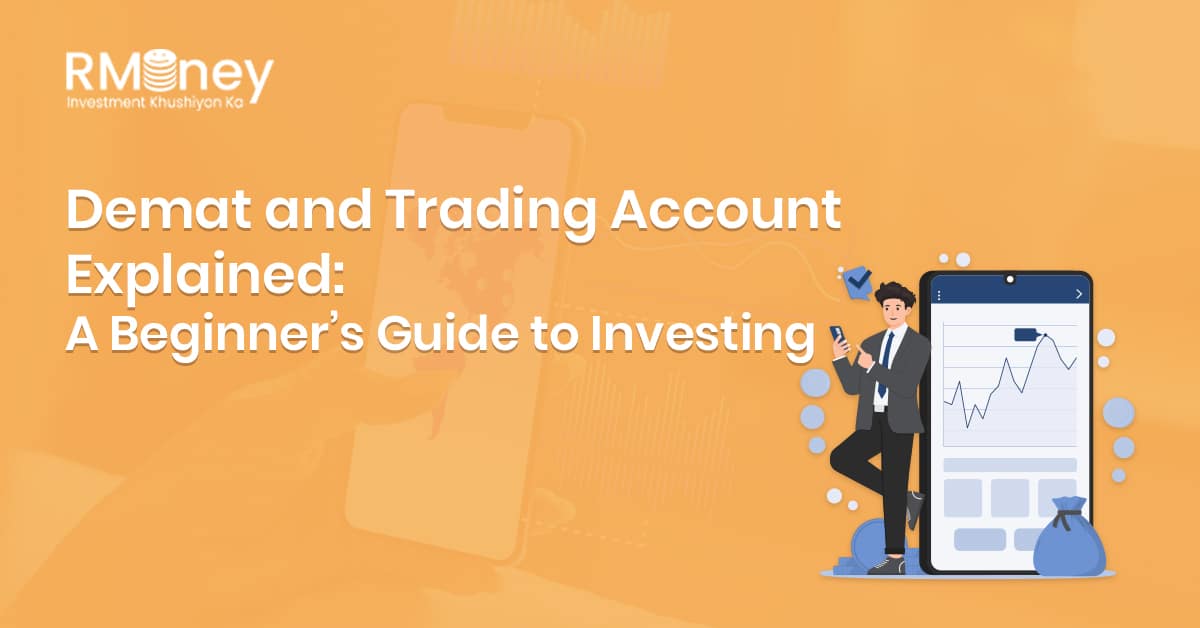
Demat and Trading Account Explained: A Beginner’s Guide to Investing
By: Amit Chauhan | Date : Jan 9, 26
When Rohan began investing, his first obstacle wasn’t market risk. It was understanding Demat and Trading Account Explained during the account setup process. Like many first time investors, he assumed both served the same purpose. They don’t.
In simple terms, a demat account holds your shares electronically, while a trading account is used to buy and sell them on the stock exchange. This distinction matters more than ever as India crosses 20 crore demat accounts, driven largely by young, app first investors entering the market.
Speedy onboarding has expanded access, but it has also widened a knowledge gap. When investors confuse these two accounts, the result is often failed orders, settlement delays, and early frustration.
Getting Demat and Trading Account Explained clearly at the outset creates structure, confidence, and a smoother investing experience,especially for those exploring the market for the first time.
Why Understanding Demat and Trading Accounts Matters
For a first time investor, the stock market can feel overwhelming. Charts, brokers, exchanges, and apps all seem complex. At its core, investing begins with just two essential tools:
- A Demat Account : stores your investments electronically
- A Trading Account : executes your buy and sell transactions
Think of them as two sides of the same coin. Confusing one for the other can quickly lead to practical problems:
- Wrong broker choice : focusing on fees alone can overlook execution quality or account features
- Incorrect account expectations : assuming a demat account can directly place trades often causes failed orders
- Fear driven exits : operational confusion can trigger unnecessary panic selling
By understanding how the different types of accounts work together, investors can avoid costly mistakes, select an appropriate broker, and invest for the long term with confidence instead of fear of short term volatility.
What Is Demat Account for Beginners?
A Demat (Dematerialised) account holds your financial securities in electronic form, replacing paper share certificates. This makes your investments safer, easier to manage, and faster to transfer.
Before demat accounts, physical certificates were prone to loss, theft, forgery, and damage. Today, all demat accounts in India are maintained with depositories such as NSDL and CDSL through SEBI registered intermediaries, ensuring regulatory oversight and security.
In Simple Terms
Your Demat account keeps your shares in a digital form, just like a bank account holds your money. This means you don’t need paper certificates anymore because all your investments are stored electronically. A Demat Account is like a secure storage for your investments, where you can also keep track of how they are doing.
What Can a Demat Account Hold?
- Equity shares
- Mutual fund units
- Exchange Traded Funds (ETFs)
- Bonds and debentures
- Government securities
Key Features of a Demat Account
- Store your securities digitally in a secure manner.
- Get rid of or minimize paperwork and manual processes.
- Reduce or minimize counterparty risk through faster trade settlement.
- Track your investment portfolio with ease.
- Have a clear and verifiable history of all of your investments.
Key Insight for Beginners:
A demat account is meant for holding securities, not trading them. All buying and selling happens through a trading account.
What Is a Trading Account?
You can use a Trading Account to trade and sell stocks on the exchange. It helps you execute your order as you would expect (in real time) while the demat account stores all of your stocks.
All traders and investors can use the trading account for either of the two purposes (investment: delivery, intraday trades).
- Delivery Trades will buy shares from the exchange and keep those shares in a demat account; however, the shares will not be held for an extended period (1 week to 3 months, depending on market conditions).
- Intraday trades, on the other hand, may be undertaken on the same trading day; therefore, an incursion into a share does not require that the share be held overnight, but must be closed on the same trading day.
To act on NSE or BSE markets, an investor must open a trading account (the trading account is aligned with the demat account as part of the overall transaction).
How It Works
Placing an order: You place a buy or sell order through your trading account on NSE or BSE.
Order execution: The trading account communicates your order to the exchange, where it is matched with a counterparty.
Trade confirmation: When your trade is executed, it confirms your transaction in your trading account.
Settlement: In the case of delivery trades, the securities will appear as a credit to your demat account two days after the date of trade (T + 2) and the money will have been deducted from your bank account. For intraday trades, positions will be liquidated on the same day.
Portfolio update: In addition, your demat account will reflect your current holdings so you have a complete view of your portfolio.
This process assists with efficient operations, timely trade settlement and proof of the transaction history. It also reduces the operational risks faced by the Investor in the event that there is a problem with either of these two items.
Key Features of a Trading Account
- Executes buy and sell orders on NSE, BSE, and other exchanges
- Supports delivery and intraday trades for flexibility in investment strategy
- Provides real time market access and portfolio updates
- Enables faster settlement by linking with your demat and bank accounts
- Supports leverage based products (where applicable), which carry higher risk, ensuring investors are aware of potential exposure
Difference Between Demat and Trading Account
| Feature | Demat Account | Trading Account |
| Purpose | Holds securities | Buys & sells securities |
| Key Role | Safe storage | Order execution |
| Regulatory Oversight | NSDL/CDSL, SEBI registered intermediaries | Linked to demat & bank account |
| Trade Types | N/A | Delivery, Intraday |
| Risk Level | Low | Higher for leverage based products (where applicable) |
| Used Without the Other? | No | No |
Simplified Analogy
- Trading Account = Shopping cart (you place orders here)
- Demat Account = Storage cupboard (your investments are kept here)
Both are mandatory and interconnected.

Why You Need Both Accounts to Invest
A Demat Account stores the investor’s securities electronically. A Trading Account executes buy and sell orders of an investor at the Exchange.
The Registered Accounts are required by the Indian Stock Market Laws to ensure that investors are well informed and that they properly settle trades. Without these two accounts, an investor cannot execute a trade; a trading account cannot hold any of the investor’s securities and a demat account cannot place any orders.
Having both accounts ensures:
- Safe storage of investments
- Seamless order execution
- Regulatory compliance under SEBI guidelines
- Reduced operational risk and faster settlement
Together, these accounts provide a secure, structured, and efficient framework for investing in India’s stock markets.
How Demat, Trading, and Bank Accounts Work Together
To invest in the stock market, it is important to set up three accounts that connect together: Your Demat Account, Trading Account, and Bank Account. Each type of account has its own function to facilitate the ease and security of your investment activity.
Roles of Each Account:
- Bank Account: Provides funds for purchases and receives proceeds from sales
- Trading Account: Sends buy or sell orders to the exchange in real time
- Demat Account: Holds purchased securities electronically until you sell
Use Case: Buying Shares
- Place a buy order through your trading account
- Funds are debited from your bank account
- Shares are credited to your demat account
- Settlement completes, typically within T+1 days
This design provides a safe environment where transactions can be processed accurately and quickly without the risk of creating an inefficient or insecure way of investing for both beginners as well as experienced investors.
Types of Demat Accounts
For beginners, it’s useful to know that demat accounts come in different types:
- Regular Demat Account
- For resident Indian investors
- Most commonly used
- Note: Most first time investors open a regular demat account
- For resident Indian investors
- Repatriable NRI Demat Account
- For NRIs who want funds transferable abroad
- For NRIs who want funds transferable abroad
- Non Repatriable NRI Demat Account
- For NRIs investing in India without repatriating funds
- For NRIs investing in India without repatriating funds
Each type serves a specific purpose, helping investors choose the account that fits their residency status and investment needs.
Costs Associated with Demat and Trading Accounts
While opening demat or trading accounts is often free, investors should be aware of some common charges:
- Account opening fee (often zero)
- Annual Maintenance Charges (AMC)
- Brokerage per trade
- Transaction and statutory charges
Beginner Tip: Always look beyond “zero brokerage” marketing. Evaluate overall costs, platform reliability, and service quality before choosing a broker.
Common Myths First Time Investors Have
- Myth 1: To make money from trading, you need to be a frequent trader.
Reality: Newbie investors do better by focusing on long term investment strategies than they do by actively trading on a consistent basis. - Myth 2: There are no costs when using zero brokerage.
Reality: You are still required to pay all additional fees for things like AMC, Transaction, and Statutory Fees. - Myth 3:You will receive automatic profit from your demat account.
Reality: A demat account does not automatically generate profits for you but is the location in which your investments will exist.
Key Takeaways for First Time Investors
- Know the roles: One account stores investments, the other executes trades.
- Digital holdings: Your securities are safe and easily trackable in a demat account.
- Order execution: A trading account allows smooth buying and selling of securities.
- Compliance matters: Both accounts are required under Indian market regulations.
- Reduce mistakes: Understanding how these accounts work together prevents confusion and operational errors, helping you invest confidently.
Who Should Open These Accounts?
You should consider opening a demat and trading account if you are:
- A first time stock market investor
- A long term wealth builder
- A mutual fund or ETF investor
- Someone moving from traditional savings to market linked instruments
Timing Tip: Setting up your account(s) prior to investing over the next 6 to 12 months is key to achieving a smooth transition.
Beginning investors should focus on “understanding the basics of investing” rather than trying to “time the market”. The first step in becoming an investor is to open a Demat (Dematerialized) account and a trading account so you can open and manage your own stock portfolio.
Having a clear understanding of the tools you have available can build confidence while making informed decisions about your investments. It allows you to track the performance of your stocks while maintaining an eye toward the long term potential for appreciation.
Knowing how to use these foundational accounts early on helps you avoid many of the common pitfalls that new investors tend to fall into while enabling you to invest with greater clarity and control.
Let RMoney be your guide
RMoney offers a standout Zero Brokerage Plan with free fund transfers and dedicated support for beginners, earning rave reviews for its unmatched advisory services and reliable referrals that pay real rewards.
- Zero brokerage trading in equity, commodities, mutual funds, and insurance
- Lightning-fast order execution with live data and simple APIs for custom tools
- Flexible limits, evening support, and handholding for new investors
Join RMoney today, unlock zero brokerage trading, and start your confident investing journey with expert support!
Disclaimer: This article is for educational purposes only and does not constitute investment advice. Market investments are subject to risk. Please consult a SEBI registered advisor before investing.
Table of content
Categories
Open Demat Account 

Related Posts
-

Key Factors Affecting The Indian Stock Market
The volatility in the stock prices is what makes investing risky for the majority of...
-
The Advanced Guide to start Commodity Trading
Commodity trading has been popular in India for very long time. The cotton trade association...
-

What are the uses of the RBI exchange rate – a brief discussion
The rupee reference rate published by the Reserve Bank of India has a special place...
-
How to Start SIPs in 2025: A Beginner’s Complete Guide
If you were to ask 10 traders or investors in India “What are your biggest...





Filing Complaints on SCORES (SEBI) – Easy & Quick
- Register on SCORES Portal (SEBI)
- Mandatory details for filing complaints on SCORES:
- Name, PAN, Address, Mobile Number, E-mail ID
- Benefits:
- Effective Communication
- Speedy redressal of the grieva`nces


IT'S TIME TO HAVE SOME FUN!
Your family deserves this time more than we do.
Share happiness with your family today & come back soon. We will be right here.
Investment to ek bahana hai,
humein to khushiyon ko badhana hai.
E-mail
askus@rmoneyindia.com
Customer Care
+91-9568654321



Trade Endlessly with
RMoney
Deep Discount Brokerage Plan
At 999/Monthly
- Dedicated round the clock Advisory Support
- High performance in depth research
- Save more than ₹10,000 brokerage Per Month
- Ultra fast trading app