 Stock Trading
Now trade in ₹9 Per Order or ₹ 999 Per Month Plans.
Stock Trading
Now trade in ₹9 Per Order or ₹ 999 Per Month Plans.
 Future & Options
Access F&O contracts with advanced tools for hedging and speculation.
Future & Options
Access F&O contracts with advanced tools for hedging and speculation.
 Currency Trading
Trade in major currency pairs and manage forex exposure efficiently.
Currency Trading
Trade in major currency pairs and manage forex exposure efficiently.
 Commodity Trading
Diversify Trading with MCX & NCDEX by Trading in Gold, Silver, Base Metals, Energy, and Agri Products.
Commodity Trading
Diversify Trading with MCX & NCDEX by Trading in Gold, Silver, Base Metals, Energy, and Agri Products.
 Margin Trading Funding
Boost your buying power with upto 5X, Buy now Pay Later
Margin Trading Funding
Boost your buying power with upto 5X, Buy now Pay Later
 Algo Trading
Back test, Paper Trade your logic & Automate your strategies with low-latency APIs.
Algo Trading
Back test, Paper Trade your logic & Automate your strategies with low-latency APIs.
 Trading View
Leverage Trading View charts and indicators integrated into your trading platform.
Trading View
Leverage Trading View charts and indicators integrated into your trading platform.
 Advanced Options Trading
Execute multi-leg option strategies with precision and insights.
Advanced Options Trading
Execute multi-leg option strategies with precision and insights.
 Stock Lending & Borrowing
Earn passive income by lending stocks securely through SLB.
Stock Lending & Borrowing
Earn passive income by lending stocks securely through SLB.
 Foreign Portfolio Investment
Enable NRIs and FPIs to invest in Indian markets with ease and compliance.
Foreign Portfolio Investment
Enable NRIs and FPIs to invest in Indian markets with ease and compliance.
 IPO
Invest in upcoming IPOs online with real-time tracking and instant allotment updates.
IPO
Invest in upcoming IPOs online with real-time tracking and instant allotment updates.
 Direct Mutual Funds
0% Commissions by investing in more than +3500 Direct Mutual Fund Scheme.
Direct Mutual Funds
0% Commissions by investing in more than +3500 Direct Mutual Fund Scheme.
 Corporate FDRs
Earn fixed returns with low-risk investments in high-rated corporate fixed deposits.
Corporate FDRs
Earn fixed returns with low-risk investments in high-rated corporate fixed deposits.
 Stocks SIPs
Build long-term wealth with systematic investment plans in top-performing stocks.
Stocks SIPs
Build long-term wealth with systematic investment plans in top-performing stocks.
 Bonds & NCDs
Access secure, fixed-income investments through government and corporate bond offerings.
Bonds & NCDs
Access secure, fixed-income investments through government and corporate bond offerings.
 Depository Services
Safely hold and manage your securities with seamless Demat and DP services with CDSL.
Depository Services
Safely hold and manage your securities with seamless Demat and DP services with CDSL.
 RMoney Quick
Fast, hassle-free trading in one tap.
RMoney Quick
Fast, hassle-free trading in one tap.
 RMoney Rocket
Power-packed platform for active traders.
RMoney Rocket
Power-packed platform for active traders.
 Rocket API
Lightning-fast trading API for developers advanced algo traders.
Rocket API
Lightning-fast trading API for developers advanced algo traders.
 XTS Algo
Smart algo trading software for precision trades.
XTS Algo
Smart algo trading software for precision trades.
 Journey
Tracing our growth and milestones over time.
Journey
Tracing our growth and milestones over time.
 Mission & Vision
Guided by purpose, driven by long-term vision.
Mission & Vision
Guided by purpose, driven by long-term vision.
 Why RMoney Platform
Smart, reliable platform for all investors' needs.
Why RMoney Platform
Smart, reliable platform for all investors' needs.
 Management
Experienced leadership driving strategic financial excellence.
Management
Experienced leadership driving strategic financial excellence.
 Credentials
Certified expertise with trusted industry recognition.
Credentials
Certified expertise with trusted industry recognition.
 Press Release
Latest company news, updates, and announcements.
Press Release
Latest company news, updates, and announcements.
 Testimonials
Real client stories sharing their success journeys.
Testimonials
Real client stories sharing their success journeys.
 7 Reasons to Invest
Top benefits that make investing with us smart.
7 Reasons to Invest
Top benefits that make investing with us smart.
 SEBI Registered Research
Trusted insights backed by SEBI-compliant research.
SEBI Registered Research
Trusted insights backed by SEBI-compliant research.
 Our Technology
Advanced tools enabling efficient online trading.
Our Technology
Advanced tools enabling efficient online trading.
 Blog
Stay updated with expert insights, market trends, and trading strategies through our informative blogs.
Blog
Stay updated with expert insights, market trends, and trading strategies through our informative blogs.
 Video
Learn visually with easy-to-understand videos covering trading concepts, tips, and market analysis.
Video
Learn visually with easy-to-understand videos covering trading concepts, tips, and market analysis.
 Podcast
Tune in to insightful discussions and expert opinions anytime, anywhere.
Podcast
Tune in to insightful discussions and expert opinions anytime, anywhere.
 Telegram Community
Be part of an active trader community sharing ideas, updates, and market opportunities in real-time.
Telegram Community
Be part of an active trader community sharing ideas, updates, and market opportunities in real-time.
 WhatsApp Updates
Get instant alerts, key market updates, and important notifications directly on WhatsApp.
WhatsApp Updates
Get instant alerts, key market updates, and important notifications directly on WhatsApp.
 Financial Calculators
Plan your trades, margins, and returns efficiently with our smart calculation tools.
Financial Calculators
Plan your trades, margins, and returns efficiently with our smart calculation tools.
 Marketplace
Discover curated tools, strategies, and services designed to enhance your trading experience.
Marketplace
Discover curated tools, strategies, and services designed to enhance your trading experience.
 Daily Research Reports
Stay ahead with timely market insights, trends, and actionable analysis delivered every day.
Daily Research Reports
Stay ahead with timely market insights, trends, and actionable analysis delivered every day.
 Dedicated Advisory
Get personalized guidance and expert recommendations tailored to your trading goals.
Dedicated Advisory
Get personalized guidance and expert recommendations tailored to your trading goals.
 Research Team
Backed by experienced analysts delivering data-driven insights and market expertise.
Research Team
Backed by experienced analysts delivering data-driven insights and market expertise.
 Research Reports
Access in-depth reports covering stocks, commodities, and market movements to support informed decisions.
Research Reports
Access in-depth reports covering stocks, commodities, and market movements to support informed decisions.
 Feedback
Share your suggestions or concerns to help us improve your experience.
Feedback
Share your suggestions or concerns to help us improve your experience.
 Downloads
Access important forms, software, and documents in one place.
Downloads
Access important forms, software, and documents in one place.
 Locate Us
Find the nearest RMoney branch or service center quickly.
Locate Us
Find the nearest RMoney branch or service center quickly.
 Escalation Matrix
Resolve issues faster with our structured support escalation process.
Escalation Matrix
Resolve issues faster with our structured support escalation process.
 Back Office
Log in to view trade reports, ledger, and portfolio statements anytime.
Back Office
Log in to view trade reports, ledger, and portfolio statements anytime.
 Account Modification
Update personal or bank details linked to your trading account.
Account Modification
Update personal or bank details linked to your trading account.
 Fund Transfer
Transfer funds instantly online with quick limit updation to your trading account.
Fund Transfer
Transfer funds instantly online with quick limit updation to your trading account.
 Bank Details
View our registered bank account details for seamless transactions by NEFT, RTGS or IMPS.
Bank Details
View our registered bank account details for seamless transactions by NEFT, RTGS or IMPS.
 RMoney Rocket Web Version
Experience powerful web-based trading with advanced tools for algo traders.
RMoney Rocket Web Version
Experience powerful web-based trading with advanced tools for algo traders.
 Refer & Earn
Invite friends and earn rewards every time they trade with us.
Refer & Earn
Invite friends and earn rewards every time they trade with us.


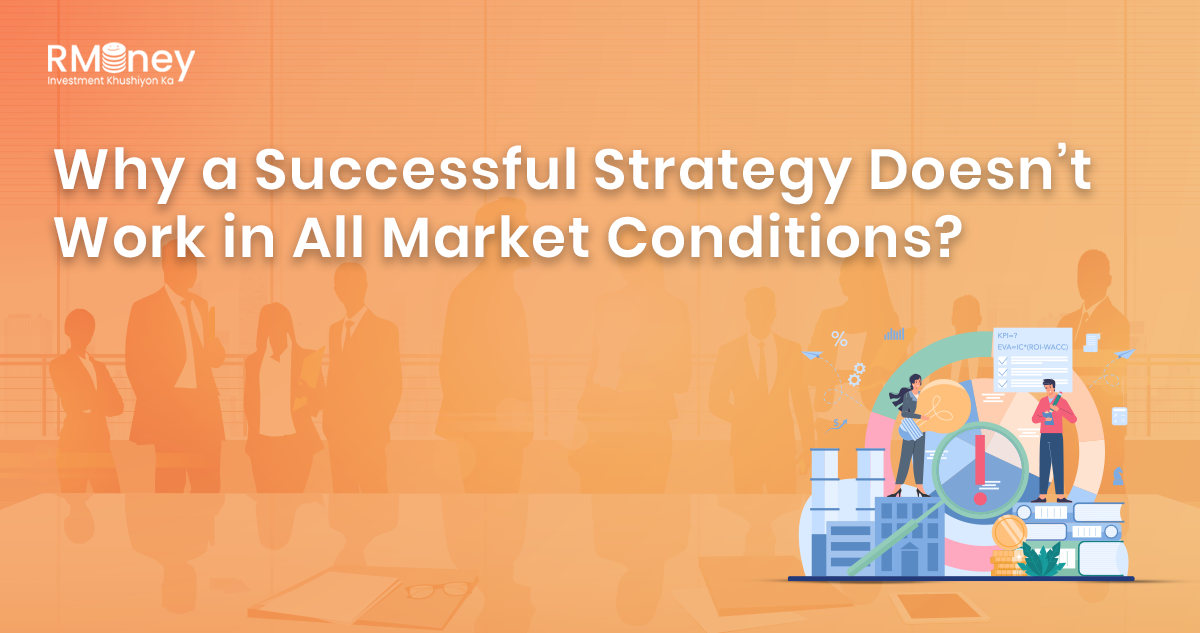
Why a Successful Strategy Doesn’t Work in All Market Conditions?
By: Raj Kumar | Date : Nov 1, 25
Many retail traders believe that once they discover a profitable strategy, they have found the “holy grail” of trading. The expectation is simple: if it works once, it should always work. Unfortunately, markets don’t function this way.
The reality is that no strategy in the world works in every market condition. Even the most successful institutions deploy multiple trading models, constantly monitor them, and switch strategies depending on market behavior. For retail traders, understanding this concept is critical to avoid frustration and losses.
In this article, we’ll explain why strategies fail in certain conditions, how to adapt, and what practical lessons traders can learn.
The Ever-Changing Nature of Markets
Markets move in phases, sometimes trending, sometimes consolidating, and sometimes extremely volatile. A strategy that is profitable in one environment may bleed capital in another. Let’s look at the common market conditions:
1. Trending Markets (Uptrend or Downtrend)
o Prices move consistently in one direction.
o Trend-following strategies like Moving Average Crossovers or Breakouts perform well.
o Risk: Sudden reversals or false breakouts can lead to quick losses.
2. Sideways or Range-Bound Markets
o Prices fluctuate within a range without clear direction.
o Mean-reversion strategies, Bollinger Band trades, or VWAP reversals can be effective.
o Risk: breakout traders face repeated stop-loss hits as price doesn’t follow through.
3. High Volatility Markets
o Sharp swings up and down, often around events like RBI policy, Union Budget, or global news.
o Option-selling strategies with stop-loss (like Short Strangles) often struggle here, while hedged positions (like Iron Condors) can help.
o Risk: gap openings and unexpected news can wipe out gains.
Why a Single Strategy Fails?
1. Built-in Assumptions Break Down
Every strategy is designed on certain assumptions. For example, an options straddle assumes that the market will stay within a range to capture theta decay. If volatility unexpectedly spikes, both legs hit stop-losses.
2. Market Structure Evolves
Earlier, it took hours or days for news to impact stock prices. Today, with algo trading and global liquidity, markets react within seconds. A strategy that worked smoothly in the past may not adapt well now without modifications.
3. Over-Optimization
Many traders backtest strategies only on a trending phase and assume it will always deliver. This curve-fitting gives false confidence, and the system fails in real sideways conditions.
4. Psychology and Overconfidence
Success in one phase often leads to traders over-leveraging. When the same strategy starts failing in a different phase, capital erosion happens much faster.
Let’s Understand with an Example
Take a Moving Average Crossover (9 EMA crossing 21 EMA):
- Trending Phase: In a strong uptrend, the crossover gives early entry and captures large moves.
- Sideways Phase: Prices keep crossing above and below the averages, generating false signals. A trader could hit 6–7 stop-losses in a single month, eroding profits from the trending phase.
This simple case highlights why adaptability is crucial.
Why Professionals Use Multiple Strategies
Large institutions, hedge funds, and prop trading firms never rely on one method. They maintain:
- Trend-following models for directional moves.
- Mean-reversion setups for range-bound markets.
- Options spread for capturing volatility or hedging risks.
- Event-driven systems for days when news flow dominates.
They also employ teams of analysts to monitor conditions and decide which playbook to deploy. Retail traders can borrow this mindset by maintaining a few diversified strategies instead of depending on one “magic formula.”
Strategy Suitability Across Market Conditions
| Market Condition | Works Best | Fails Often |
| Trending (Up/Down) | Moving Average Crossovers, Breakouts | Bollinger Band Mean Reversion |
| Sideways/Range-bound | Bollinger Bands, VWAP Reversal, RSI-based mean reversion | Trend-following breakouts |
| High Volatility | Hedged option strategies (Iron Condor, Spreads) | Naked option selling, Tight-stop scalps |
| Event-driven | News-based or event-driven setups with hedges | Passive straddles without stop-loss |
Key Takeaways for Traders
1. No Universal Strategy Exists – Every system has strengths and weaknesses.
2. Identify Market Phase First – Before deploying a strategy, ask: “Is the market trending, sideways, or volatile?”
3. Maintain a Playbook of Strategies – Have at least one strategy for trend, one for sideways, and one for volatility.
4. Test in Different Environments – Always backtest across multiple market conditions, not just trending ones.
5. Risk Management is Non-Negotiable – Stop-losses, position sizing, and capital allocation matter more than the strategy itself.
6. Stay Flexible and Adaptive – Even institutions readjust models. Retail traders should too.
Conclusion
The idea that one strategy can make you consistently profitable in all markets is a myth. Successful trading is about matching the right strategy to the right market condition.
Just as a doctor uses different treatments for different illnesses, a trader must use different strategies for changing markets. Flexibility, risk management, and continuous learning are the real edges that separate successful traders from struggling ones.
Disclaimer: The strategies discussed above are for educational purposes only. Past performance of any strategy does not guarantee future results. Trading in securities and derivatives involves risk of loss, and investors should carefully evaluate their financial position, risk appetite, and consult with a financial advisor before deploying any strategy.
Table of content
Categories
Open Demat Account 

Related Posts
-
How to Start SIPs in 2025: A Beginner’s Complete Guide
If you were to ask 10 traders or investors in India “What are your biggest...
-
How to Identify False Breakouts while Trading?
How to Identify False Breakouts while Trading? In trading, one of the most frustrating situations...
-

Do exchange rate fluctuations helps determine the stocks market trend in India?
An economy moves in a cycle, also the stock market obeys similar kind of pattern....
-

AI Trading Strategies and Tools: Navigating the Future of Smart Investing
Markets in the financial world are evolving at a very high rate. AI is transforming...





Filing Complaints on SCORES (SEBI) – Easy & Quick
- Register on SCORES Portal (SEBI)
- Mandatory details for filing complaints on SCORES:
- Name, PAN, Address, Mobile Number, E-mail ID
- Benefits:
- Effective Communication
- Speedy redressal of the grieva`nces


IT'S TIME TO HAVE SOME FUN!
Your family deserves this time more than we do.
Share happiness with your family today & come back soon. We will be right here.
Investment to ek bahana hai,
humein to khushiyon ko badhana hai.
E-mail
askus@rmoneyindia.com
Customer Care
+91-9568654321



Trade Endlessly with
RMoney
Deep Discount Brokerage Plan
At 999/Monthly
- Dedicated round the clock Advisory Support
- High performance in depth research
- Save more than ₹10,000 brokerage Per Month
- Ultra fast trading app