 Stock Trading
Now trade in ₹9 Per Order or ₹ 999 Per Month Plans.
Stock Trading
Now trade in ₹9 Per Order or ₹ 999 Per Month Plans.
 Future & Options
Access F&O contracts with advanced tools for hedging and speculation.
Future & Options
Access F&O contracts with advanced tools for hedging and speculation.
 Currency Trading
Trade in major currency pairs and manage forex exposure efficiently.
Currency Trading
Trade in major currency pairs and manage forex exposure efficiently.
 Commodity Trading
Diversify Trading with MCX & NCDEX by Trading in Gold, Silver, Base Metals, Energy, and Agri Products.
Commodity Trading
Diversify Trading with MCX & NCDEX by Trading in Gold, Silver, Base Metals, Energy, and Agri Products.
 Margin Trading Funding
Boost your buying power with upto 5X, Buy now Pay Later
Margin Trading Funding
Boost your buying power with upto 5X, Buy now Pay Later
 Algo Trading
Back test, Paper Trade your logic & Automate your strategies with low-latency APIs.
Algo Trading
Back test, Paper Trade your logic & Automate your strategies with low-latency APIs.
 Trading View
Leverage Trading View charts and indicators integrated into your trading platform.
Trading View
Leverage Trading View charts and indicators integrated into your trading platform.
 Advanced Options Trading
Execute multi-leg option strategies with precision and insights.
Advanced Options Trading
Execute multi-leg option strategies with precision and insights.
 Stock Lending & Borrowing
Earn passive income by lending stocks securely through SLB.
Stock Lending & Borrowing
Earn passive income by lending stocks securely through SLB.
 Foreign Portfolio Investment
Enable NRIs and FPIs to invest in Indian markets with ease and compliance.
Foreign Portfolio Investment
Enable NRIs and FPIs to invest in Indian markets with ease and compliance.
 IPO
Invest in upcoming IPOs online with real-time tracking and instant allotment updates.
IPO
Invest in upcoming IPOs online with real-time tracking and instant allotment updates.
 Direct Mutual Funds
0% Commissions by investing in more than +3500 Direct Mutual Fund Scheme.
Direct Mutual Funds
0% Commissions by investing in more than +3500 Direct Mutual Fund Scheme.
 Corporate FDRs
Earn fixed returns with low-risk investments in high-rated corporate fixed deposits.
Corporate FDRs
Earn fixed returns with low-risk investments in high-rated corporate fixed deposits.
 Stocks SIPs
Build long-term wealth with systematic investment plans in top-performing stocks.
Stocks SIPs
Build long-term wealth with systematic investment plans in top-performing stocks.
 Bonds & NCDs
Access secure, fixed-income investments through government and corporate bond offerings.
Bonds & NCDs
Access secure, fixed-income investments through government and corporate bond offerings.
 Depository Services
Safely hold and manage your securities with seamless Demat and DP services with CDSL.
Depository Services
Safely hold and manage your securities with seamless Demat and DP services with CDSL.
 RMoney Quick
Fast, hassle-free trading in one tap.
RMoney Quick
Fast, hassle-free trading in one tap.
 RMoney Rocket
Power-packed platform for active traders.
RMoney Rocket
Power-packed platform for active traders.
 Rocket API
Lightning-fast trading API for developers advanced algo traders.
Rocket API
Lightning-fast trading API for developers advanced algo traders.
 XTS Algo
Smart algo trading software for precision trades.
XTS Algo
Smart algo trading software for precision trades.
 Journey
Tracing our growth and milestones over time.
Journey
Tracing our growth and milestones over time.
 Mission & Vision
Guided by purpose, driven by long-term vision.
Mission & Vision
Guided by purpose, driven by long-term vision.
 Why RMoney Platform
Smart, reliable platform for all investors' needs.
Why RMoney Platform
Smart, reliable platform for all investors' needs.
 Management
Experienced leadership driving strategic financial excellence.
Management
Experienced leadership driving strategic financial excellence.
 Credentials
Certified expertise with trusted industry recognition.
Credentials
Certified expertise with trusted industry recognition.
 Press Release
Latest company news, updates, and announcements.
Press Release
Latest company news, updates, and announcements.
 Testimonials
Real client stories sharing their success journeys.
Testimonials
Real client stories sharing their success journeys.
 7 Reasons to Invest
Top benefits that make investing with us smart.
7 Reasons to Invest
Top benefits that make investing with us smart.
 SEBI Registered Research
Trusted insights backed by SEBI-compliant research.
SEBI Registered Research
Trusted insights backed by SEBI-compliant research.
 Our Technology
Advanced tools enabling efficient online trading.
Our Technology
Advanced tools enabling efficient online trading.
 Blog
Stay updated with expert insights, market trends, and trading strategies through our informative blogs.
Blog
Stay updated with expert insights, market trends, and trading strategies through our informative blogs.
 Video
Learn visually with easy-to-understand videos covering trading concepts, tips, and market analysis.
Video
Learn visually with easy-to-understand videos covering trading concepts, tips, and market analysis.
 Podcast
Tune in to insightful discussions and expert opinions anytime, anywhere.
Podcast
Tune in to insightful discussions and expert opinions anytime, anywhere.
 Telegram Community
Be part of an active trader community sharing ideas, updates, and market opportunities in real-time.
Telegram Community
Be part of an active trader community sharing ideas, updates, and market opportunities in real-time.
 WhatsApp Updates
Get instant alerts, key market updates, and important notifications directly on WhatsApp.
WhatsApp Updates
Get instant alerts, key market updates, and important notifications directly on WhatsApp.
 Financial Calculators
Plan your trades, margins, and returns efficiently with our smart calculation tools.
Financial Calculators
Plan your trades, margins, and returns efficiently with our smart calculation tools.
 Marketplace
Discover curated tools, strategies, and services designed to enhance your trading experience.
Marketplace
Discover curated tools, strategies, and services designed to enhance your trading experience.
 Daily Research Reports
Stay ahead with timely market insights, trends, and actionable analysis delivered every day.
Daily Research Reports
Stay ahead with timely market insights, trends, and actionable analysis delivered every day.
 Dedicated Advisory
Get personalized guidance and expert recommendations tailored to your trading goals.
Dedicated Advisory
Get personalized guidance and expert recommendations tailored to your trading goals.
 Research Team
Backed by experienced analysts delivering data-driven insights and market expertise.
Research Team
Backed by experienced analysts delivering data-driven insights and market expertise.
 Research Reports
Access in-depth reports covering stocks, commodities, and market movements to support informed decisions.
Research Reports
Access in-depth reports covering stocks, commodities, and market movements to support informed decisions.
 Feedback
Share your suggestions or concerns to help us improve your experience.
Feedback
Share your suggestions or concerns to help us improve your experience.
 Downloads
Access important forms, software, and documents in one place.
Downloads
Access important forms, software, and documents in one place.
 Locate Us
Find the nearest RMoney branch or service center quickly.
Locate Us
Find the nearest RMoney branch or service center quickly.
 Escalation Matrix
Resolve issues faster with our structured support escalation process.
Escalation Matrix
Resolve issues faster with our structured support escalation process.
 Back Office
Log in to view trade reports, ledger, and portfolio statements anytime.
Back Office
Log in to view trade reports, ledger, and portfolio statements anytime.
 Account Modification
Update personal or bank details linked to your trading account.
Account Modification
Update personal or bank details linked to your trading account.
 Fund Transfer
Transfer funds instantly online with quick limit updation to your trading account.
Fund Transfer
Transfer funds instantly online with quick limit updation to your trading account.
 Bank Details
View our registered bank account details for seamless transactions by NEFT, RTGS or IMPS.
Bank Details
View our registered bank account details for seamless transactions by NEFT, RTGS or IMPS.
 RMoney Rocket Web Version
Experience powerful web-based trading with advanced tools for algo traders.
RMoney Rocket Web Version
Experience powerful web-based trading with advanced tools for algo traders.
 Refer & Earn
Invite friends and earn rewards every time they trade with us.
Refer & Earn
Invite friends and earn rewards every time they trade with us.



Option Buying vs Option Selling: Which Strategy Is Right for Your Trading Style?
By: Social | Date : Aug 13, 26
Introduction
There is no clear-cut answer regarding which approach is superior, as many trading communities explain. While some traders believe that buying options is safe because their maximum loss equals the premium paid, others think option sellers have a better chance of winning because they benefit from time and the premiums they collect.
However, in real life, both approaches are equally effective since they suit various market situations and personal risk tolerances and trading goals.
Pro traders do not stick to one side of the market but use various strategies based on factors such as market volatility, market direction, their capital, and their overall trading scheme. For example, an algo trader may buy options using momentum strategies, whereas an experienced option seller may make profit from a stable market through careful risk management.
In this article, we’ll explore the key differences between option buying and option selling, their advantages, risks, ideal market conditions, and how to determine which approach best fits your trading style.
Understanding Option Buying
Option buying involves purchasing a Call Option or Put Option by paying a premium to gain the right, but not the obligation, to buy or sell the underlying asset before expiry.
Call Option Buying
“When traders wish to buy a Call Option, they expect the value of the asset to rise.”
“For instance, NIFTY is trading at a price of 25,500 and if you expect a significant bullish breakout, buying a Call Option would allow you to earn profit when the index rises drastically before expiration.”
Put Option Buying
“When traders wish to buy a Call Option, they expect the value of the asset to rise.”
“For instance, NIFTY is trading at a price of 25,500 and if you expect a significant bullish breakout, buying a Call Option would allow you to earn profit when the index rises drastically before expiration.”
Understanding Option Selling
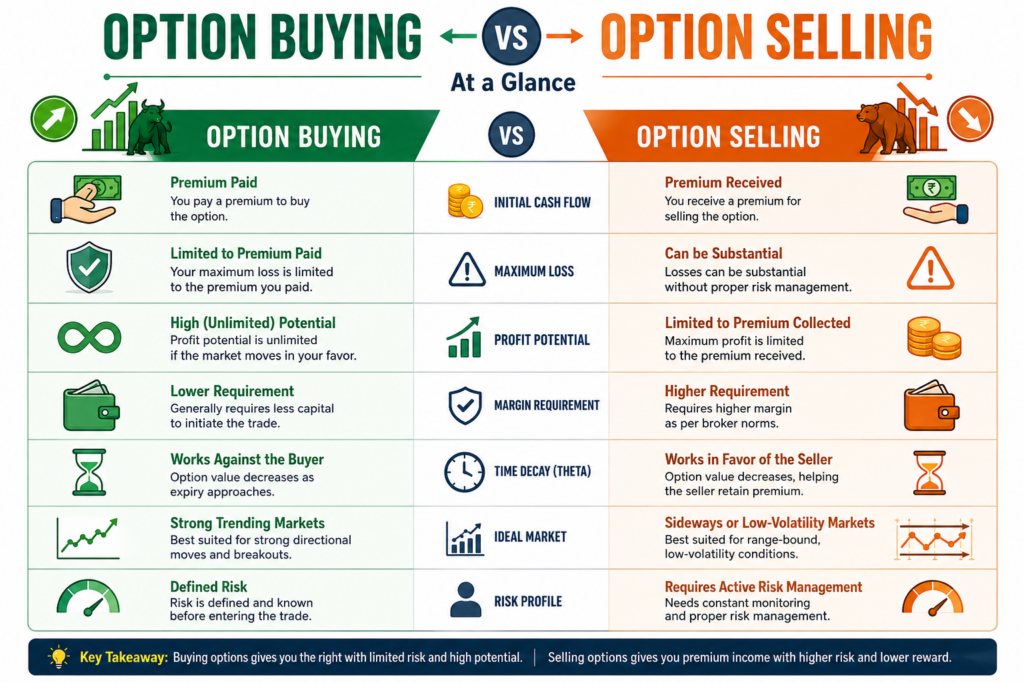
The concept of option selling is also coined as option writing. Here, the trader in contrast to paying a premium, instead receives it.
In the process of option selling, the trader assumes the responsibility of honoring the contract in case the buyer avails of the option.
Most option sellers wait for the option premium to fall as time passes by.
The reason behind this is called time decay; its essence being that the closer the expiry comes, the smaller the value of the option becomes (everything else remaining the same).
As an example, let us say you are going to sell NIFTY 25,800 Call Option for ₹120. The increase in the price leads to the expiry of the option being worthless and the premium received being kept as it is.
For this reason, it can be said that option selling becomes popular and widely adopted during horizontal and moderately trending markets. Option selling might be safer as it implies higher chances of small profits in comparison to option buying.
Option Buying vs Option Selling: Key Differences
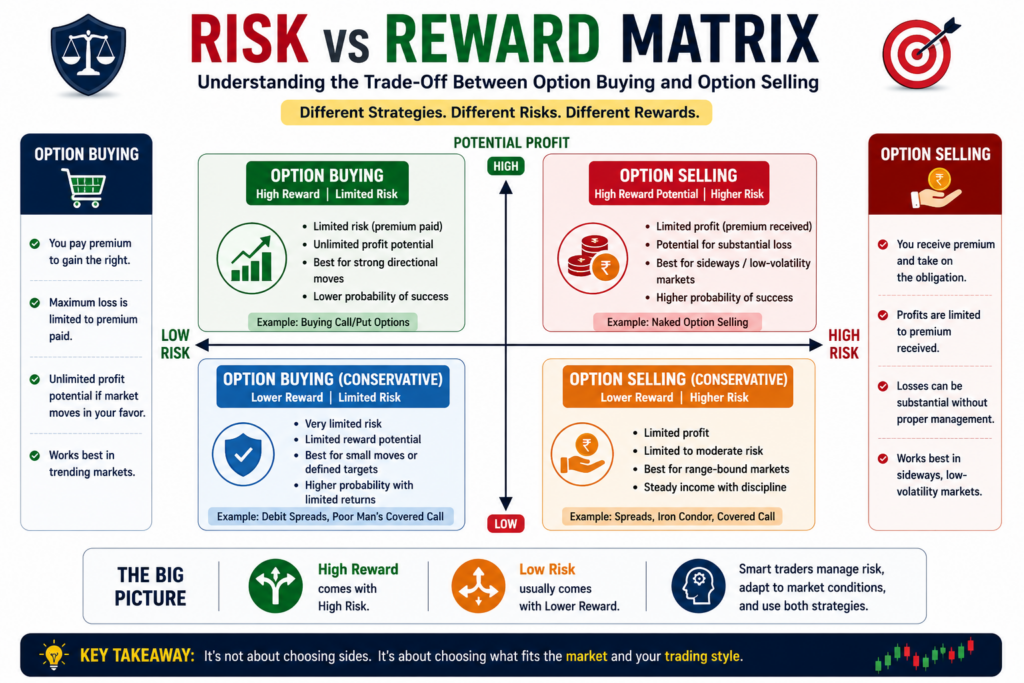
The comparison highlights that the two strategies are built around different market expectations rather than competing with each other.
| Parameter | Option Buying | Option Selling |
| Initial Cash Flow | Premium Paid | Premium Received |
| Maximum Loss | Limited to Premium Paid | Can be substantial without proper risk management |
| Profit Potential | High if the market moves sharply | Limited to Premium Collected |
| Margin Requirement | Lower | Higher |
| Time Decay | Works Against the Buyer | Works in Favor of the Seller |
| Ideal Market | Strong Trending Markets | Sideways or Low-Volatility Markets |
| Risk Profile | Defined Risk | Requires Active Risk Management |
Why Time Decay Changes Everything
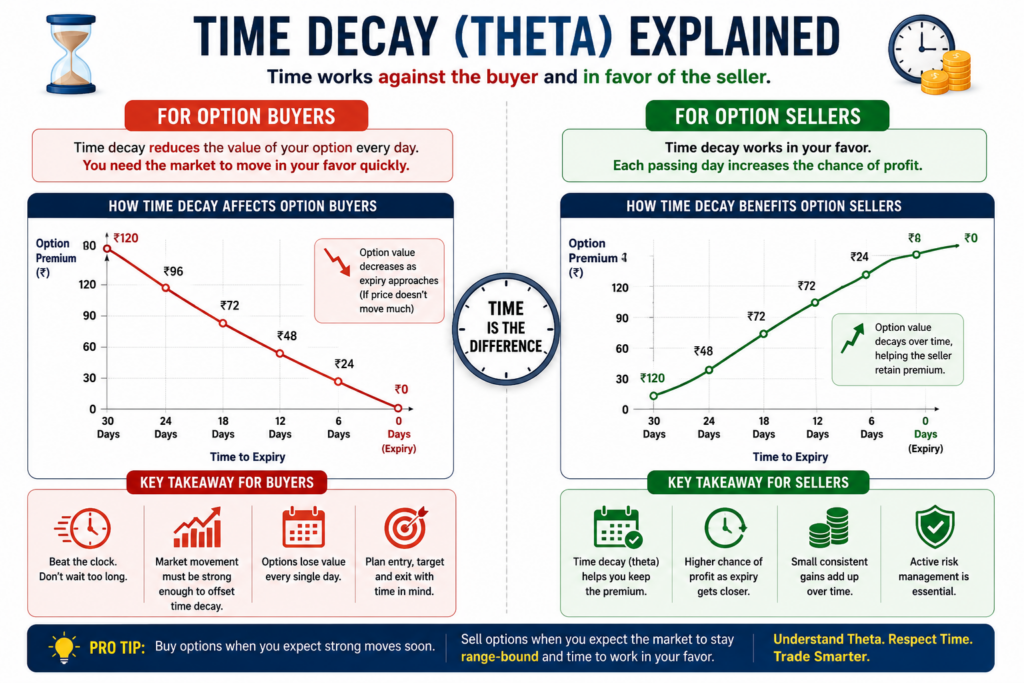
A key difference between the buying and selling of options is the role of Theta, which is usually termed as time decay.
Each option exists for a limited time. As the expiration day approaches, the option loses value if the underlying asset does not change significantly.
For an option buyer, this creates a situation to beat the clock. This means that even if you get your view on the market right, sometimes, taking too long to execute may mean you do not make enough profit to recover the premium paid.
In the case of an option seller, time can be a friend. Each day that passes means less option value and a greater chance of keeping some or all of the premium collected.
Thus, for experienced traders, this is one of the reasons why option selling is preferred when volatility is perceived to be low.
The Role of Implied Volatility (IV)
Numerous investors only pay attention to the movements of prices when considering only one of the most fundamental variables affecting the pricing of options, which is called Implied Volatility (IV).
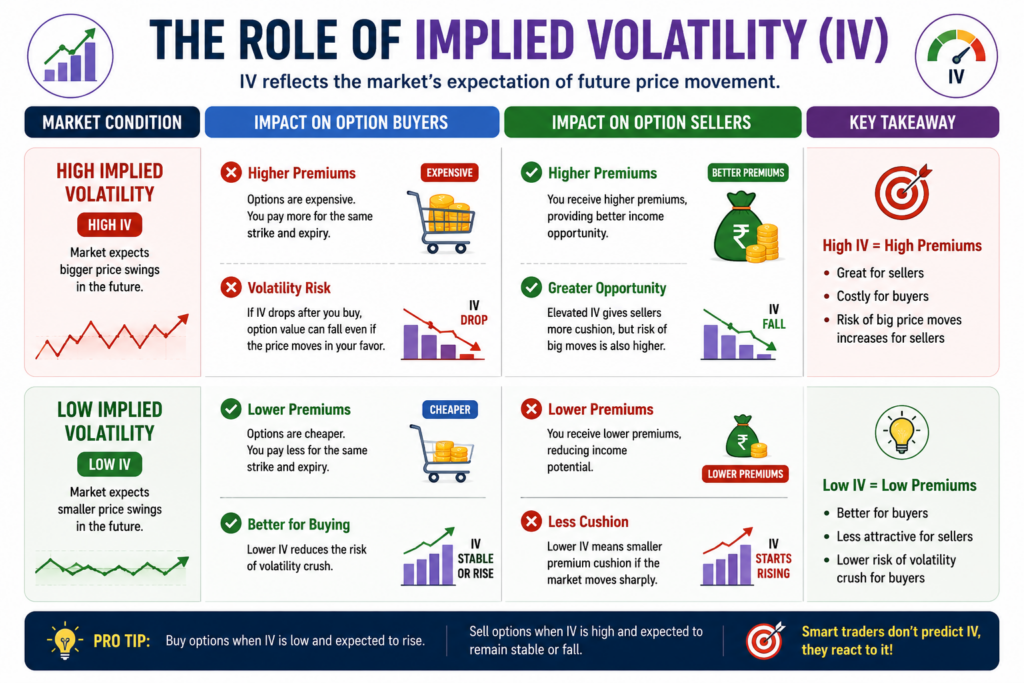
Implied Volatility represents the expectation of future price fluctuations in the market.
Implied Volatility that is higher than any other option normally leads to higher prices of options.
Conversely, Implied Volatility at low levels means cheaper options.
For Option Buyers
Purchasing an option with already heightened IV can be considered unsafe.
Even if the asset’s price moves as expected, a drop in IV value can have an adverse effect on the price of the option.
This situation is called volatility crush.
For Option Sellers
IV that is high opens good opportunities for investors to get larger premiums.
At the same time, inflated IV indicates increased uncertainty concerning possible price movements in the market.
Successful option sellers seize upon the chance, not for larger premiums only.
When Option Buying Makes More Sense
The notion that buying options is associated solely with novices is incorrect because even more experienced traders make use of options trading in certain instances.
1. During Strong Trending Markets
In circumstances when technical analysis indicates a potential for a breakout, buying options can allow an investor to gain leverage with minimal risk involved.
2. Around Momentum Events
Events like government budget announcements, decisions of the Reserve Bank of India, or other events that might significantly affect the market can lead to sudden price fluctuations. Hence, option buyers would look for directions to profit from those events.
3. For Defined-Risk Trades
Professional investors opt for the option-buying approach from time to time if they want to effectively limit their maximum possible loss while being exposed to the risk of large price fluctuations.
4. In Algorithmic Momentum Strategies
There are many algorithmic trading systems defined to find the point of volatility increase and the continuation of the trend.
When Option Selling Works Better
Selling options appears to be a better choice when there is a prediction to keep the market within a particular range, or when a decrease in volatility occurs.
1. Sideways Markets
When the prices are fluctuating within a small interval, the options can lose their value gradually because of the time decay that supports the process of selling the options.
2. Elevated Implied Volatility
With high IV, the option premium charges are usually higher. When the volatility eventually decreases, the sellers will profit from both time decay and IV reduction.
3. Income-Oriented Trading Strategies
Skilled traders apply certain strategies of options selling to make a constant premium income while avoiding risks through hedging and strict position sizing.
Capital Requirements: Why It Matters
One of the biggest practical differences between option buying and option selling is the amount of capital required.
Option Buying
Purchasing options conventionally needs a lesser capital outlay as only the option premium is paid. This permits the trader to engage in market movements without having to invest much capital.
For instance, instead of taking a NIFTY futures position, the trader can take a Call or Put Option position at the price of a premium. While this produces higher capital efficiency, it also necessitates that the option move considerably by expiry to be profitable.
Option Selling
In most cases, selling options requires a significant amount of capital as they require the collection of margin by brokers to offset possible losses. Even though a premium is received upon selling the options, the sellers must guarantee they have enough capital in the form of margin.
The higher capital requirement of this strategy is one of the reasons why selling options is usually done by experienced traders and institutional players with access to large sums of money.
The major takeaway here is that money should not be the sole criterion in deciding the strategy to choose.
Which Strategy Suits Different Market Conditions?
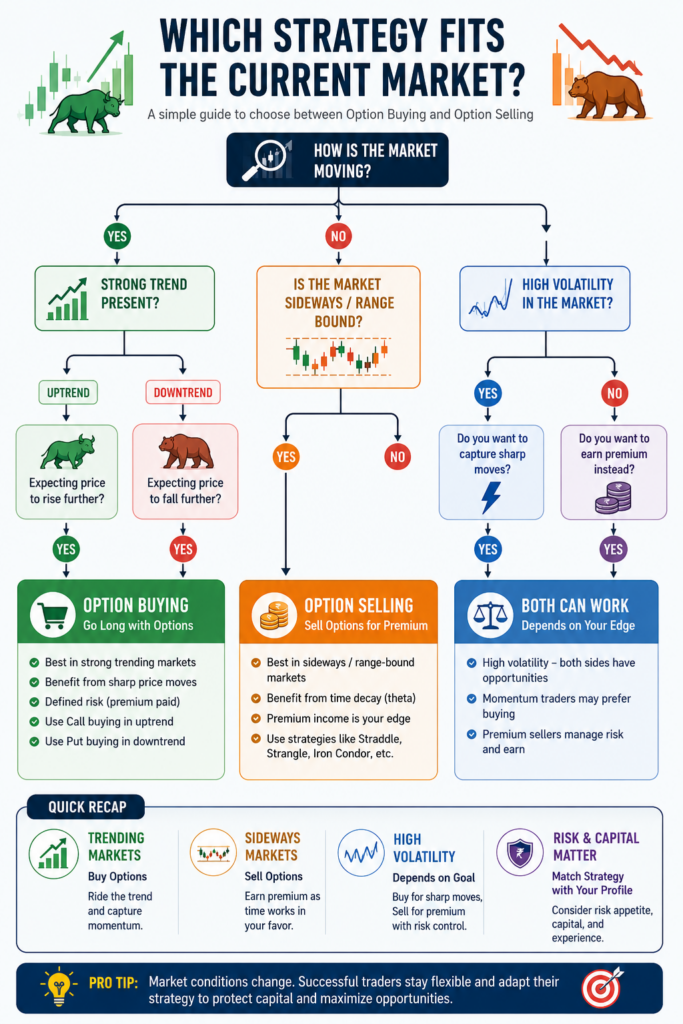
Successful traders know how to use the changing environment to their advantage.
Trending Markets
With high directional momentum in the market, options buying becomes more favorable. For example, by buying calls after NIFTY has broken a major resistance level with rising volume, one could achieve a good risk-reward trade. Similarly, puts can achieve similar positive results during strong downtrends.
Sideways Markets
Whenever the market moves in a small range, option sellers usually enjoy an advantage as time decay brings them success.
High-Volatility Markets
In times of high volatility, both types of trades work but for different purposes – option buyers look to profit from sharp price moves while option sellers use techniques that allow them to still achieve good profits.
Common Mistakes Traders Make
Whether purchasing or selling options, staying away from common mistakes will definitely help you improve your trading results.
1. Purchasing cheap options without creating a strategy.
Some traders think that low-priced options mean better options simply because they cost less. In fact, low premium prices mean a lower probability of making money. Each trade should have the right setup, entry, target, and exit.
2. Not paying attention to time decay.
Novice traders usually pay attention only to price behavior. In fact, options become worthless with every passing day, and even if the market moves in your favor, you might face a loss due to time decay.
3. Selling naked options without monitoring risk.
Selling options without having any money, as well as hedging and a Stop Loss, can lead to serious losing trades. Professional traders pay attention to risk first and then profit.
4. Overtrading
Not every market move should lead to a deal. Most losses are consequences of traders’ desire to act at all times rather than wait for an opportunity.
5. Not taking position sizing into account.
A good trading strategy can fail if the position size is not calculated properly.
Which Strategy Fits Your Trading Style?
There is no universal answer, but certain trading styles naturally align with different approaches.
Option Buying May Suit You If:
- You prefer defined-risk trades.
- You trade momentum or breakout setups.
- You have a smaller trading capital.
- You are comfortable with lower win rates but higher reward potential.
- You actively monitor the markets.
Option Selling May Suit You If:
- You understand option Greeks and implied volatility.
- You have sufficient capital to meet margin requirements.
- You are comfortable managing positions actively.
- You prefer generating consistent premium income over chasing large individual gains.
- You follow disciplined risk management practices.
Many experienced traders eventually use both strategies, selecting the one that best matches the prevailing market conditions.
A Smarter Way to Think About Option Buying and Selling
Instead of asking,
“Which strategy earns more?”
Ask yourself:
- What is the current market structure?
- Is volatility expanding or contracting?
- How much risk am I willing to take?
- What is my expected holding period?
- Does this trade fit my overall trading plan?
These questions often lead to better decisions than simply choosing between buying and selling options.
Professional traders don’t build their success around a single strategy. They build it around a repeatable decision-making process.
Building an Edge Beyond Strategy
To be successful in the modern marketplace, it is not enough to simply employ the proper strategies.
While those strategies are key factors in achieving long-term success, it is also important to examine other aspects that influence profitability and efficiency.
In the case of active traders, these aspects include both the speed of execution and availability of reliable research, charting tools, and risk management features.
In order to improve the performance of active traders, it becomes imperative for them to have access to a fully integrated trading ecosystem.
When traders are able to manage their stock positions and derivatives, carry out market analyses, and perform various transactions on different platforms, they become less effective and less efficient.
An integrated trading platform such as RMoney helps bring together various assets and services, enabling equity trading, derivatives, TradingView charts, advanced scanners, research data, APIs for algorithmic trading, and mutual funds in one system.
RMoney does not favor any specific method of trading but rather encourages the use of different techniques, letting traders adapt their trading strategies according to market conditions.
Rather than promoting one trading style over another, the platform supports different approaches, allowing traders to choose strategies based on market conditions while managing their portfolios more efficiently.
The objective isn’t to replace your trading process but to provide the tools needed to execute it with greater confidence.
Final Thoughts
The discussion about the merits of being a buyer of options versus a seller of options may lead one to the conclusion that there is always an advantage of one strategy over the other. However, both have their own distinct advantages.
A buyer of options has clearly defined risk and the opportunity to profit from movements in the direction of the market, which is why buying options suits those who are looking for trading opportunities based on movement in prices.
On the other hand, the emphasis when employing the strategy of selling options is placed on probability, decay of time, and collection of premiums, which allows disciplined traders, who can manage risks and understand the nature of the market, to reap profits.
The most successful options traders do not define themselves as either buyers or sellers; they prefer to call themselves flexible traders on the market.
They realize that the market is changing, volatility is changing, and therefore one cannot be sure which strategy would win during a particular period of time.
Table of content
Categories
Open Demat Account 

Related Posts
-

Get your Mobile Trading Account Trade on the Go
Your mobile, err, Smartphone is truly becoming smarter day by day. Today, your mobile is...
-

Know all about stocks before buying one for the first time
It is a fact that investing in stocks is one of the most effective ways...
-

As a beginner how to pick stocks for investment in India
Investment is a long term process. It requires some special skills mindset to get success...
-

Overview of Financial Ratio Analysis
The most ideal approach to analyze a financial statement is by studying financial ratios. Financial...





Filing Complaints on SCORES (SEBI) – Easy & Quick
- Register on SCORES Portal (SEBI)
- Mandatory details for filing complaints on SCORES:
- Name, PAN, Address, Mobile Number, E-mail ID
- Benefits:
- Effective Communication
- Speedy redressal of the grieva`nces


IT'S TIME TO HAVE SOME FUN!
Your family deserves this time more than we do.
Share happiness with your family today & come back soon. We will be right here.
Investment to ek bahana hai,
humein to khushiyon ko badhana hai.
E-mail
askus@rmoneyindia.com
Customer Care
+91-9568654321



Trade Endlessly with
RMoney
Deep Discount Brokerage Plan
At 999/Monthly
- Dedicated round the clock Advisory Support
- High performance in depth research
- Save more than ₹10,000 brokerage Per Month
- Ultra fast trading app