 Stock Trading
Now trade in ₹9 Per Order or ₹ 999 Per Month Plans.
Stock Trading
Now trade in ₹9 Per Order or ₹ 999 Per Month Plans.
 Future & Options
Access F&O contracts with advanced tools for hedging and speculation.
Future & Options
Access F&O contracts with advanced tools for hedging and speculation.
 Currency Trading
Trade in major currency pairs and manage forex exposure efficiently.
Currency Trading
Trade in major currency pairs and manage forex exposure efficiently.
 Commodity Trading
Diversify Trading with MCX & NCDEX by Trading in Gold, Silver, Base Metals, Energy, and Agri Products.
Commodity Trading
Diversify Trading with MCX & NCDEX by Trading in Gold, Silver, Base Metals, Energy, and Agri Products.
 Margin Trading Funding
Boost your buying power with upto 5X, Buy now Pay Later
Margin Trading Funding
Boost your buying power with upto 5X, Buy now Pay Later
 Algo Trading
Back test, Paper Trade your logic & Automate your strategies with low-latency APIs.
Algo Trading
Back test, Paper Trade your logic & Automate your strategies with low-latency APIs.
 Trading View
Leverage Trading View charts and indicators integrated into your trading platform.
Trading View
Leverage Trading View charts and indicators integrated into your trading platform.
 Advanced Options Trading
Execute multi-leg option strategies with precision and insights.
Advanced Options Trading
Execute multi-leg option strategies with precision and insights.
 Stock Lending & Borrowing
Earn passive income by lending stocks securely through SLB.
Stock Lending & Borrowing
Earn passive income by lending stocks securely through SLB.
 Foreign Portfolio Investment
Enable NRIs and FPIs to invest in Indian markets with ease and compliance.
Foreign Portfolio Investment
Enable NRIs and FPIs to invest in Indian markets with ease and compliance.
 IPO
Invest in upcoming IPOs online with real-time tracking and instant allotment updates.
IPO
Invest in upcoming IPOs online with real-time tracking and instant allotment updates.
 Direct Mutual Funds
0% Commissions by investing in more than +3500 Direct Mutual Fund Scheme.
Direct Mutual Funds
0% Commissions by investing in more than +3500 Direct Mutual Fund Scheme.
 Corporate FDRs
Earn fixed returns with low-risk investments in high-rated corporate fixed deposits.
Corporate FDRs
Earn fixed returns with low-risk investments in high-rated corporate fixed deposits.
 Stocks SIPs
Build long-term wealth with systematic investment plans in top-performing stocks.
Stocks SIPs
Build long-term wealth with systematic investment plans in top-performing stocks.
 Bonds & NCDs
Access secure, fixed-income investments through government and corporate bond offerings.
Bonds & NCDs
Access secure, fixed-income investments through government and corporate bond offerings.
 Depository Services
Safely hold and manage your securities with seamless Demat and DP services with CDSL.
Depository Services
Safely hold and manage your securities with seamless Demat and DP services with CDSL.
 RMoney Quick
Fast, hassle-free trading in one tap.
RMoney Quick
Fast, hassle-free trading in one tap.
 RMoney Rocket
Power-packed platform for active traders.
RMoney Rocket
Power-packed platform for active traders.
 Rocket API
Lightning-fast trading API for developers advanced algo traders.
Rocket API
Lightning-fast trading API for developers advanced algo traders.
 XTS Algo
Smart algo trading software for precision trades.
XTS Algo
Smart algo trading software for precision trades.
 Journey
Tracing our growth and milestones over time.
Journey
Tracing our growth and milestones over time.
 Mission & Vision
Guided by purpose, driven by long-term vision.
Mission & Vision
Guided by purpose, driven by long-term vision.
 Why RMoney Platform
Smart, reliable platform for all investors' needs.
Why RMoney Platform
Smart, reliable platform for all investors' needs.
 Management
Experienced leadership driving strategic financial excellence.
Management
Experienced leadership driving strategic financial excellence.
 Credentials
Certified expertise with trusted industry recognition.
Credentials
Certified expertise with trusted industry recognition.
 Press Release
Latest company news, updates, and announcements.
Press Release
Latest company news, updates, and announcements.
 Testimonials
Real client stories sharing their success journeys.
Testimonials
Real client stories sharing their success journeys.
 7 Reasons to Invest
Top benefits that make investing with us smart.
7 Reasons to Invest
Top benefits that make investing with us smart.
 SEBI Registered Research
Trusted insights backed by SEBI-compliant research.
SEBI Registered Research
Trusted insights backed by SEBI-compliant research.
 Our Technology
Advanced tools enabling efficient online trading.
Our Technology
Advanced tools enabling efficient online trading.
 Blog
Stay updated with expert insights, market trends, and trading strategies through our informative blogs.
Blog
Stay updated with expert insights, market trends, and trading strategies through our informative blogs.
 Video
Learn visually with easy-to-understand videos covering trading concepts, tips, and market analysis.
Video
Learn visually with easy-to-understand videos covering trading concepts, tips, and market analysis.
 Podcast
Tune in to insightful discussions and expert opinions anytime, anywhere.
Podcast
Tune in to insightful discussions and expert opinions anytime, anywhere.
 Telegram Community
Be part of an active trader community sharing ideas, updates, and market opportunities in real-time.
Telegram Community
Be part of an active trader community sharing ideas, updates, and market opportunities in real-time.
 WhatsApp Updates
Get instant alerts, key market updates, and important notifications directly on WhatsApp.
WhatsApp Updates
Get instant alerts, key market updates, and important notifications directly on WhatsApp.
 Financial Calculators
Plan your trades, margins, and returns efficiently with our smart calculation tools.
Financial Calculators
Plan your trades, margins, and returns efficiently with our smart calculation tools.
 Marketplace
Discover curated tools, strategies, and services designed to enhance your trading experience.
Marketplace
Discover curated tools, strategies, and services designed to enhance your trading experience.
 Daily Research Reports
Stay ahead with timely market insights, trends, and actionable analysis delivered every day.
Daily Research Reports
Stay ahead with timely market insights, trends, and actionable analysis delivered every day.
 Dedicated Advisory
Get personalized guidance and expert recommendations tailored to your trading goals.
Dedicated Advisory
Get personalized guidance and expert recommendations tailored to your trading goals.
 Research Team
Backed by experienced analysts delivering data-driven insights and market expertise.
Research Team
Backed by experienced analysts delivering data-driven insights and market expertise.
 Research Reports
Access in-depth reports covering stocks, commodities, and market movements to support informed decisions.
Research Reports
Access in-depth reports covering stocks, commodities, and market movements to support informed decisions.
 Feedback
Share your suggestions or concerns to help us improve your experience.
Feedback
Share your suggestions or concerns to help us improve your experience.
 Downloads
Access important forms, software, and documents in one place.
Downloads
Access important forms, software, and documents in one place.
 Locate Us
Find the nearest RMoney branch or service center quickly.
Locate Us
Find the nearest RMoney branch or service center quickly.
 Escalation Matrix
Resolve issues faster with our structured support escalation process.
Escalation Matrix
Resolve issues faster with our structured support escalation process.
 Back Office
Log in to view trade reports, ledger, and portfolio statements anytime.
Back Office
Log in to view trade reports, ledger, and portfolio statements anytime.
 Account Modification
Update personal or bank details linked to your trading account.
Account Modification
Update personal or bank details linked to your trading account.
 Fund Transfer
Transfer funds instantly online with quick limit updation to your trading account.
Fund Transfer
Transfer funds instantly online with quick limit updation to your trading account.
 Bank Details
View our registered bank account details for seamless transactions by NEFT, RTGS or IMPS.
Bank Details
View our registered bank account details for seamless transactions by NEFT, RTGS or IMPS.
 RMoney Rocket Web Version
Experience powerful web-based trading with advanced tools for algo traders.
RMoney Rocket Web Version
Experience powerful web-based trading with advanced tools for algo traders.
 Refer & Earn
Invite friends and earn rewards every time they trade with us.
Refer & Earn
Invite friends and earn rewards every time they trade with us.


What is the difference between AI Trading and Algo Trading?
By: Vaibhav Rawat | Date : Jun 5, 26
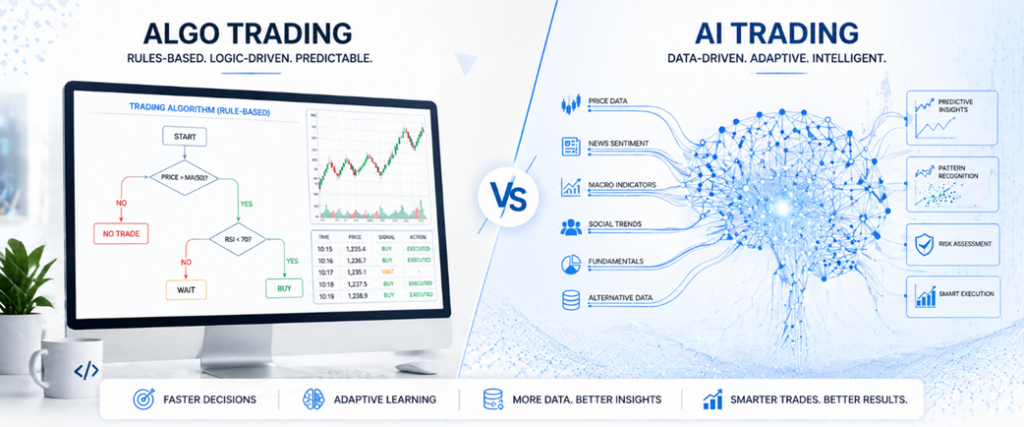
If you’ve spent any time in trading communities lately on Twitter, YouTube, or your broker’s platform, you’ve almost certainly heard both these terms. Algo trading. AI trading. People use them as if they mean the same thing. They don’t.
Yes, both involve computers making trading decisions. Yes, both aim to remove the emotion and impulsiveness that cost retail traders so much money. But the way they work, the conditions they thrive in, and what they actually require from you as a trader, these are quite different. Understanding that difference isn’t just theoretical. It directly affects which approach makes sense for where you are right now.
Let’s break it down properly.
What is Algorithmic Trading?
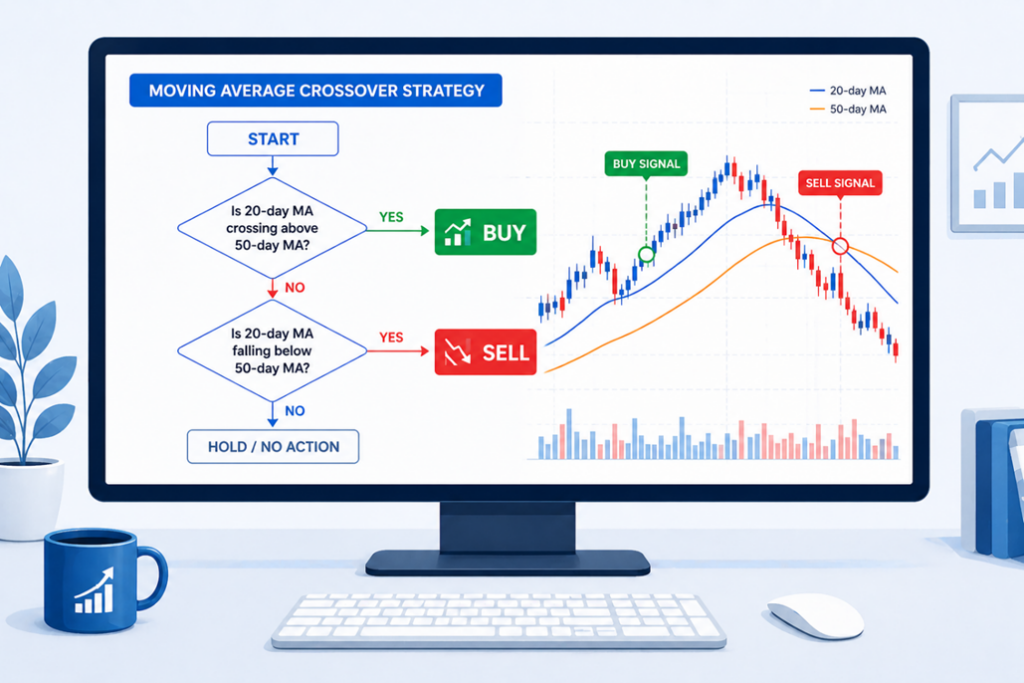
Algo trading is rule-based trading. You define the logic when to buy, when to sell, what conditions need to be met and a computer executes it automatically. No hesitation, no second-guessing, no panic selling because the market dropped 2% in an afternoon.
The rules themselves can be simple or complex. A basic strategy might be something like: buy Nifty Futures when the 20-day moving average crosses above the 50-day moving average, and exit when it crosses back below. Once you’ve coded that into a system, it watches the market for you and fires orders the moment the signal triggers faster than any human could react.
How Do You Build an Algo Trading System?
In India, building an algo trading system for retail participants typically begins with writing your strategy logic in a programming language. Python is the most popular choice among retail traders due to its simplicity and a rich ecosystem of financial libraries pandas for data handling, NumPy for numerical calculations, and TA-Lib for over 150 built-in technical indicators. For ultra-low-latency or high-frequency strategies, C++ remains the preferred language at institutional trading desks because of its execution speed advantage.
A typical Python-based algo script pulls historical OHLC data from an exchange feed or third-party data provider, computes your chosen indicator , a moving average crossover, RSI signal, or Bollinger Band breakout and generates buy or sell signals automatically. When the signal fires, the order is routed via API to the exchange within milliseconds, with no human intervention required.
Popular Platforms for Algo Coding in India
Several platforms in India are purpose-built for building, testing, and deploying algo strategies even without deep programming expertise:
- TradingView (Pine Script): A widely used charting platform with its own scripting language, Pine Script, that lets traders write, backtest, and visualise rule-based strategies directly on charts. Ideal for beginners and intermediate traders looking to test their ideas quickly without setting up a full coding environment.
- Tradetron: An Indian algo trading marketplace where traders can build automated strategies using a visual interface (no coding required for basic setups), deploy them across Indian exchanges, and subscribe to strategies built by other traders. Popular for options strategies on Nifty and Bank Nifty.
- AlgoTest: A backtesting and paper trading platform focused specifically on the Indian options market. It allows traders to test strategies across Nifty 50, Bank Nifty, and individual stock derivatives using historical data, with a no-code interface for building multi-leg option strategies.
- Backtrader and QuantConnect: Open-source Python-based frameworks used by technically advanced retail traders to build and rigorously backtest strategies using NSE/BSE historical data. QuantConnect also supports live trading through broker API integrations for those ready to deploy.
What makes algo trading powerful is consistency. The strategy runs exactly the same way every single time, regardless of news, mood, or market noise. What limits it is that same consistency. If the market shifts into a regime that your rules weren’t built for say, a prolonged sideways chop when your strategy was designed for trending markets it’ll keep firing signals that don’t work until you manually intervene and adjust.
Key characteristics:
- The strategy logic is fully defined and visible, you know exactly why every trade happens.
- Backtesting is straightforward, since the rules don’t change.
- Execution speed is a genuine edge, especially in high-frequency or intraday strategies.
- Manual updates are required when market conditions change significantly.
What is AI Trading?
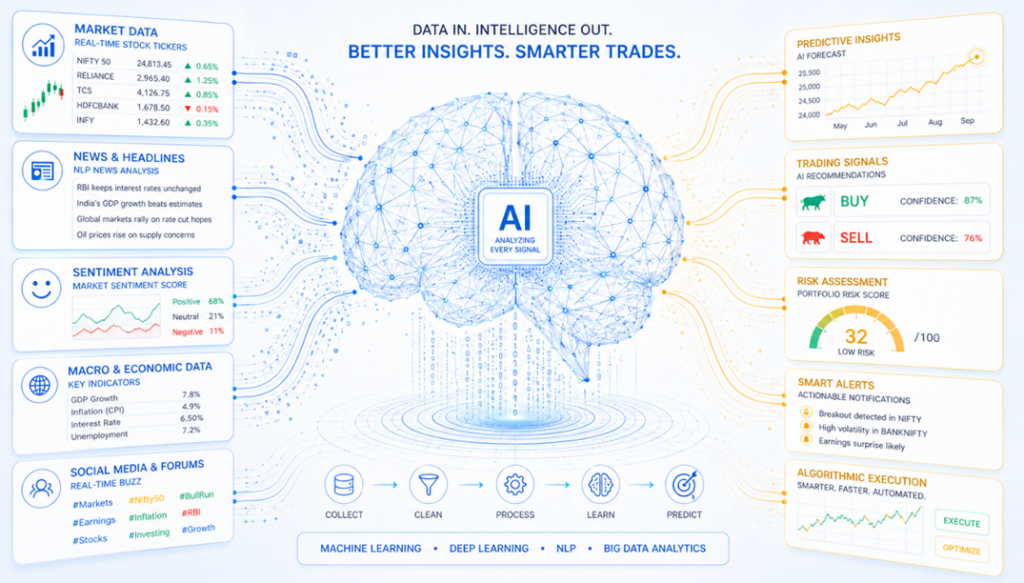
AI trading takes a fundamentally different approach. Instead of you writing the rules, the machine learns the rules or more accurately, it learns the patterns from data. You feed it historical price movements, earnings reports, news sentiment, FII flows, economic indicators, and it figures out the relationships between these inputs and future price behavior on its own.
Take a hypothetical AI model analysing a mid-cap stock. It might pick up on the fact that whenever FII buying accelerates in that sector, combined with a specific earnings beat pattern, the stock tends to rally in the following two weeks. It didn’t need you to tell it to look for that. It found it in the data.
AI and ML Models Commonly Used in Trading
The AI systems powering trading decisions today are built on a range of machine learning architectures, each suited to different types of problems:
- LSTM (Long Short-Term Memory) — A type of recurrent neural network (RNN) designed to learn patterns in sequential time-series data like stock prices. LSTMs retain long-term dependencies across sequences, making them effective for price trend and momentum prediction tasks in Indian equity markets.
- Random Forest and XGBoost — Ensemble learning models widely used for classification tasks such as predicting whether a stock will move up or down in the next session. Valued for speed, strong performance on structured financial data, and relative interpretability compared to deep learning approaches.
- Natural Language Processing (NLP) Models — Used to extract sentiment signals from earnings call transcripts, news headlines, management commentary, and financial forums. These models detect shifts in corporate tone or market sentiment before they appear in price action particularly useful around quarterly results and RBI policy announcements.
- Reinforcement Learning (RL) — An advanced approach where a model learns an optimal trading strategy through trial, error, and reward signals from the market. Used primarily at institutional desks for portfolio optimisation and building adaptive entry-exit frameworks.
Which Platforms Enable AI Trading in India?
For retail traders in India, AI-powered tools are increasingly accessible through:
- Smallcase — An investment platform that uses quantitative and AI-driven methodologies to create themed stock portfolios, with several strategies built on factor models and systematic stock-selection frameworks developed by SEBI-registered advisors.
- Tickertape and Screener— Data-driven research and stock screening platforms that apply quantitative filters, scoring models, and momentum signals, giving retail investors AI-assisted research capabilities without requiring direct algorithmic execution.
- Domestic AMCs and PMS Providers — Several large mutual fund houses and Portfolio Management Services providers in India have deployed AI-based portfolio management and risk monitoring systems, making AI-driven investing accessible to retail participants through fund structures.
Pitfalls of AI Trading
AI trading comes with significant risks every trader must understand before committing real capital:
- Overfitting — An AI model trained too precisely on historical data performs brilliantly in backtests but collapses in live markets. It has memorised the past rather than learning transferable patterns — one of the most common failure modes in retail AI trading.
- Data Quality Issues — AI models are only as good as the data they are trained on. Incorrect, incomplete, or survivorship-biased historical data leads to flawed signals that look robust in testing but fail in real market conditions.
- Black Box Risk — Unlike algo trading where every decision is traceable, deep learning models can be near-impossible to interpret. When a trade goes wrong, it may be genuinely unclear why the model made that call a serious concern in SEBI-regulated environments that demand explainability.
- Regime Shifts — Models trained in bull market conditions can underperform badly during bear markets or volatility spikes. The Indian market’s sharp macro-driven swings around RBI policy decisions, Union Budget announcements, and global events pose a particular challenge for static AI models.
- High Infrastructure Cost — Building, training, and maintaining AI trading models requires substantial computing resources, premium data subscriptions, and specialised expertise a significant barrier for most retail participants compared to the relatively low entry barrier of algorithmic trading.
That adaptability is AI trading’s biggest strength. When market conditions change, a well-trained AI model adjusts rather than breaks. It can process far more variables simultaneously than any human or rule-based system could, news sentiment, global macro shifts, social media chatter from financial forums, and price action all at once.
But it comes with real trade-offs too:
- The decision logic isn’t always transparent, sometimes even the model’s developers can’t fully explain why it made a particular call.
- It needs large, high-quality datasets and significant computing resources to train effectively.
- In India, regulatory guidelines around AI-assisted advisory are still evolving under SEBI’s framework.
- A model trained on one market regime can underperform badly when conditions shift in ways it hasn’t seen before.
The Core Differences at a Glance
Here’s a side-by-side comparison to make the distinction clear:
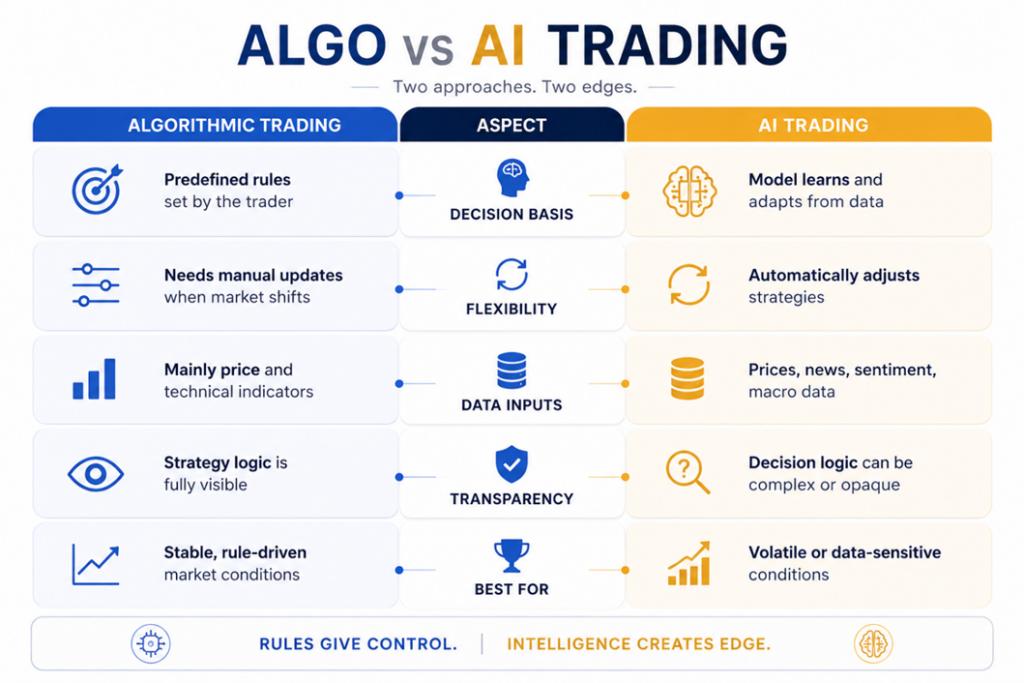
Strengths and Weaknesses of Each
Neither approach is universally better. They each have conditions where they shine and conditions where they struggle.
Algorithmic Trading works best when: markets are trending clearly, the strategy has been rigorously backtested, and conditions remain reasonably stable. It’s fast, disciplined, and easy to audit. The downside is that it’s rigid, it can’t react to a surprise RBI rate decision or a sudden geopolitical development the way a human or an AI system might.
AI Trading works best when: there’s a large volume of varied data available, the market is noisy or structurally complex, and you’re building medium to long-term predictive models. It’s adaptive and powerful. The downside is that it requires far more infrastructure, carries a degree of opacity, and can fail in unexpected ways if the underlying data quality is poor.
SEBI’s Regulatory Framework for Algo and AI Trading
The Securities and Exchange Board of India (SEBI) has been systematically building the regulatory framework around algorithmic and AI-assisted trading. SEBI’s 2012 circular first formalised rules around algorithmic trading, mandating that all algo orders be routed through broker systems with proper risk controls, order-level tagging, and maintained audit trails to ensure accountability.
In 2022, SEBI released a consultation paper proposing a structured framework specifically for retail algo trading. Under these proposals, every strategy deployed through a broker’s API would need to be registered and tagged by the broker, ensuring accountability and preventing the use of unvetted or high-risk strategies at scale by retail participants.
On AI-assisted advisory, SEBI’s Investment Adviser (IA) Regulations apply to any platform providing personalized investment recommendations whether generated by humans or algorithms. A core SEBI principle is that recommendations must be explainable and auditable. This creates friction for pure black-box AI systems and favours a hybrid approach where AI generates signals but human oversight remains in the loop.
Cost Comparison: Algo Trading vs AI Trading
The infrastructure costs between the two approaches differ substantially:
- Algo Trading — Relatively accessible for retail participants. A Python-based strategy can be developed using open-source tools. The primary costs are market data subscriptions (historical OHLC, real-time tick data) and API access. An operational retail algo setup can be built for approximately ₹5,000 to ₹25,000 per year depending on data and hosting requirements.
- AI Trading — Significantly more capital-intensive. Quality training data alone can cost ₹50,000 to several lakhs annually for institutional-grade feeds. Cloud computing for model training (GPU instances), ongoing model maintenance, and specialised expertise add further costs. A semi-professional AI trading setup realistically requires ₹1,00,000 or more annually to run effectively.
- Third-Party Platforms — Subscription-based strategy platforms and AI-assisted research tools in India typically charge ₹500 to ₹5,000 per month depending on the complexity of the strategy and the level of data access provided.
Top Players Offering AI-Powered Trading in India
On the institutional side, quantitative funds and proprietary trading desks have deployed AI systems for years. On the retail-accessible side, the ecosystem is evolving rapidly in India:
- Domestic AMCs and PMS Providers — Large mutual fund houses such as ICICI Prudential, Nippon India, and Mirae Asset, as well as several PMS providers, have launched quantitative and AI-assisted funds using machine learning for stock screening, risk management, and systematic rebalancing.
- AI-Focused Fintech Platforms — Platforms such as Sensibull (options analytics and strategy builder), Tijori Finance (business intelligence for stocks), and MarketSmith India (institutional-grade fundamental screening) are bringing data-driven, AI-assisted analysis tools to Indian retail traders.
- Global Systematic Funds — International algorithmic and AI trading firms including D.E. Shaw, Two Sigma, and Man Group have significant exposure to Indian markets through FII routes, contributing to improved liquidity and price efficiency in Indian equities and derivatives.
Algo vs AI: Which Approach Works Best for Each Asset Class?
The suitability of each approach varies meaningfully by asset class in the Indian market:
Equities (Stocks): Algo trading works well for momentum and mean-reversion strategies in liquid large-cap stocks where rule-based signals are reliable. AI trading adds the most value in mid-cap and small-cap selection, where unstructured data — management commentary, news sentiment, supply chain signals — plays a larger role in price discovery.
Futures (Index and Stock Futures): Both approaches are widely deployed. Algo systems dominate intraday and short-term positional futures trading due to execution speed. AI models are used to forecast directional bias and build smarter entry-exit frameworks for Nifty, Bank Nifty, and stock futures.
Options (Nifty 50, Bank Nifty, Stock Options): Algo trading is extremely popular for multi-leg options strategies — iron condors, straddles, calendar spreads — where simultaneous multi-leg execution must be precise. AI is applied to model implied volatility surfaces, detect mispricing, and build adaptive delta-hedging strategies.
Commodities: Rule-based algo systems are the preferred tool for commodity futures (crude oil, gold, silver on MCX), where price trends tend to be more persistent and macro-driven events have a strong and predictable influence on direction.
Which One is Right for You?
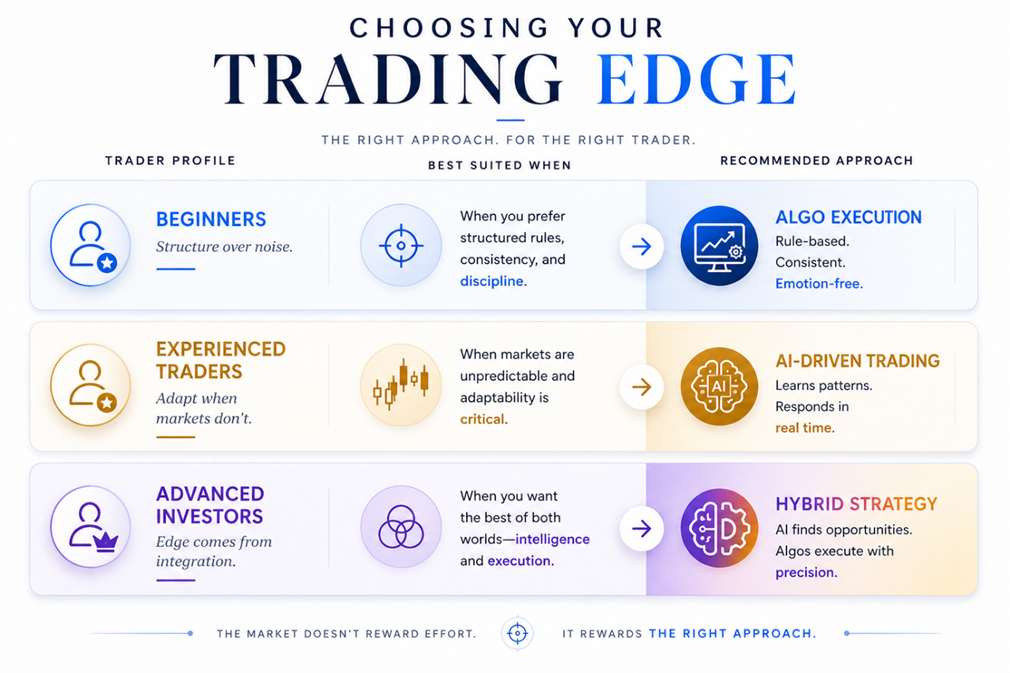
This is the question most retail traders actually care about. And the honest answer is: it depends on where you are in your journey.
If you’re relatively new to systematic trading, algorithmic trading is the better starting point. You stay in control. You can see every decision the system makes and understand why. You can test your strategy on historical data before risking a single rupee. It builds the discipline and framework that more advanced approaches eventually require.
If you’re already comfortable with systematic strategies and want to handle more complex market conditions, AI-powered tools add real value. Most sophisticated traders don’t pick one over the other anyway they use AI for analysis and insight generation, and algo systems for the actual execution. You get the intelligence of one and the speed and precision of the other.
In India specifically, the landscape is shifting fast. Broker APIs, SEBI-approved algo platforms, and increasingly accessible AI tools have brought both approaches within reach of retail traders in a way that simply wasn’t possible five years ago. The barrier isn’t technology anymore, it’s knowing how to use it thoughtfully.
Where India’s Markets Are Headed?
Digital participation in Indian capital markets has grown sharply over the past few years, and with it, the appetite for automation. Retail algo adoption has jumped significantly since brokers began offering API access and pre-built strategy platforms. AI-driven tools are no longer just for institutional desks platforms are making them accessible to individual investors willing to learn.
SEBI continues to strengthen the regulatory framework around algorithmic and AI-assisted trading, with a clear focus on transparency and investor protection. That’s a good thing. It means this space is being taken seriously, and the infrastructure is being built to support it properly over the long run.
Conclusion
Algo trading and AI trading are both powerful but they are different tools built for different jobs. Algo trading gives you speed, discipline, and full transparency within a clearly defined strategy. AI trading gives you adaptability, multi-dimensional pattern recognition, and predictive capability that fixed rules simply cannot match.
The best traders do not see them as competing options they see them as complementary layers. Start with a rule-based foundation you can fully understand and audit. Build discipline through backtesting and systematic execution. Then layer in AI-powered tools as your experience, infrastructure, and data quality grow. Technology is only as good as the thinking that sits behind it.
For Indian traders looking to explore both algorithmic and AI-assisted trading, RMoney’s platform is designed to support exactly that journey. RMoney provides API-based trading access, real-time NSE and BSE market data feeds, and a suite of tools built specifically for systematic traders in the Indian market whether you are backtesting your first moving-average strategy on Nifty Futures or building a data-driven approach to options writing on Bank Nifty. With a focus on execution quality, transparency, and SEBI regulatory compliance, RMoney makes it practical for retail participants to trade systematically without the complexity of building institutional-grade infrastructure from scratch.
Explore more RMoney’s blog here
Disclaimer: The information provided in this blog is for educational purposes only and should not be considered financial advice or a recommendation to invest. Investing involve srisk, including potential loss of principal. Please consult a SEBI-registered investment advisor before making investment decisions.
Table of content
Categories
Open Demat Account 
Related Posts
-

भारत में जमा प्रमाणपत्र के बारे में आपको क्या जानने की जरूरत है?
भारत में खुदरा निवेशकों के लिए अल्पकालिक निवेश के बहुत कम विकल्प हैं। जमा प्रमाणपत्र उनमें...
-

Things you must know about Indian stock market indices before investing
We can see Market Indices almost in every country. And people watch and track these...
-

DEE Development Engineers Limited IPO – Upcoming IPO in India June 2024
DEE Development Engineers Limited IPO (DEE Piping Systems IPO) Founded in 1988, DEE Development Engineers...
-

5 Mistakes Beginners Must Avoid for Successful Investing
Investing is one of the smartest ways to build long-term wealth and achieve financial freedom....





Filing Complaints on SCORES (SEBI) – Easy & Quick
- Register on SCORES Portal (SEBI)
- Mandatory details for filing complaints on SCORES:
- Name, PAN, Address, Mobile Number, E-mail ID
- Benefits:
- Effective Communication
- Speedy redressal of the grieva`nces


IT'S TIME TO HAVE SOME FUN!
Your family deserves this time more than we do.
Share happiness with your family today & come back soon. We will be right here.
Investment to ek bahana hai,
humein to khushiyon ko badhana hai.
E-mail
askus@rmoneyindia.com
Customer Care
+91-9568654321



Trade Endlessly with
RMoney
Deep Discount Brokerage Plan
At 999/Monthly
- Dedicated round the clock Advisory Support
- High performance in depth research
- Save more than ₹10,000 brokerage Per Month
- Ultra fast trading app