 Stock Trading
Now trade in ₹9 Per Order or ₹ 999 Per Month Plans.
 Future & Options
Access F&O contracts with advanced tools for hedging and speculation.
 Currency Trading
Trade in major currency pairs and manage forex exposure efficiently.
 Commodity Trading
Diversify Trading with MCX & NCDEX by Trading in Gold, Silver, Base Metals, Energy, and Agri
Products.
 Margin Trading Funding
Boost your buying power with upto 5X, Buy now Pay Later
 Algo Trading
Back test, Paper Trade your logic & Automate your strategies with low-latency APIs.
 Trading View
Leverage Trading View charts and indicators integrated into your trading platform.
 Advanced Options Trading
Execute multi-leg option strategies with precision and insights.
 Stock Lending & Borrowing
Earn passive income by lending stocks securely through SLB.
 Foreign Portfolio Investment
Enable NRIs and FPIs to invest in Indian markets with ease and compliance.
 IPO
Invest in upcoming IPOs online with real-time tracking and instant allotment updates.
 Direct Mutual Funds
0% Commissions by investing in more than +3500 Direct Mutual Fund Scheme.
 Corporate FDRs
Earn fixed returns with low-risk investments in high-rated corporate fixed deposits.
 Stocks SIPs
Build long-term wealth with systematic investment plans in top-performing stocks.
 Bonds & NCDs
Access secure, fixed-income investments through government and corporate bond offerings.
 Depository Services
Safely hold and manage your securities with seamless Demat and DP services with CDSL.
 RMoney Quick
Fast, hassle-free trading in one tap.
 RMoney Rocket
Power-packed platform for active traders.
 Rocket API
Lightning-fast trading API for developers advanced algo traders.
 XTS Algo
Smart algo trading software for precision trades.
 Journey
Tracing our growth and milestones over time.
 Mission & Vision
Guided by purpose, driven by long-term vision.
 Why RMoney Platform
Smart, reliable platform for all investors' needs.
 Management
Experienced leadership driving strategic financial excellence.
 Credentials
Certified expertise with trusted industry recognition.
 Press Release
Latest company news, updates, and announcements.
 Testimonials
Real client stories sharing their success journeys.
 7 Reasons to Invest
Top benefits that make investing with us smart.
 SEBI Registered Research
Trusted insights backed by SEBI-compliant research.
 Our Technology
Advanced tools enabling efficient online trading.
 Blog
Stay updated with expert insights, market trends, and trading strategies through our
informative blogs.
 Video
Learn visually with easy-to-understand videos covering trading concepts, tips, and market
analysis.
 Podcast
Tune in to insightful discussions and expert opinions anytime, anywhere.
 Telegram Community
Be part of an active trader community sharing ideas, updates, and market opportunities in
real-time.
 WhatsApp Updates
Get instant alerts, key market updates, and important notifications directly on WhatsApp.
 Financial Calculators
Plan your trades, margins, and returns efficiently with our smart calculation tools.
 Marketplace
Discover curated tools, strategies, and services designed to enhance your trading
experience.
 Daily Research Reports
Stay ahead with timely market insights, trends, and actionable analysis delivered every day.
 Dedicated Advisory
Get personalized guidance and expert recommendations tailored to your trading goals.
 Research Team
Backed by experienced analysts delivering data-driven insights and market expertise.
 Research Reports
Access in-depth reports covering stocks, commodities, and market movements to support
informed decisions.
 Feedback
Share your suggestions or concerns to help us improve your experience.
 Downloads
Access important forms, software, and documents in one place.
 Locate Us
Find the nearest RMoney branch or service center quickly.
 Escalation Matrix
Resolve issues faster with our structured support escalation process.
 Back Office
Log in to view trade reports, ledger, and portfolio statements anytime.
 Account Modification
Update personal or bank details linked to your trading account.
 Fund Transfer
Transfer funds instantly online with quick limit updation to your trading account.
 Bank Details
View our registered bank account details for seamless transactions by NEFT, RTGS or IMPS.
 RMoney Rocket Web Version
Experience powerful web-based trading with advanced tools for algo traders.
 Refer & Earn
Invite friends and earn rewards every time they trade with us.


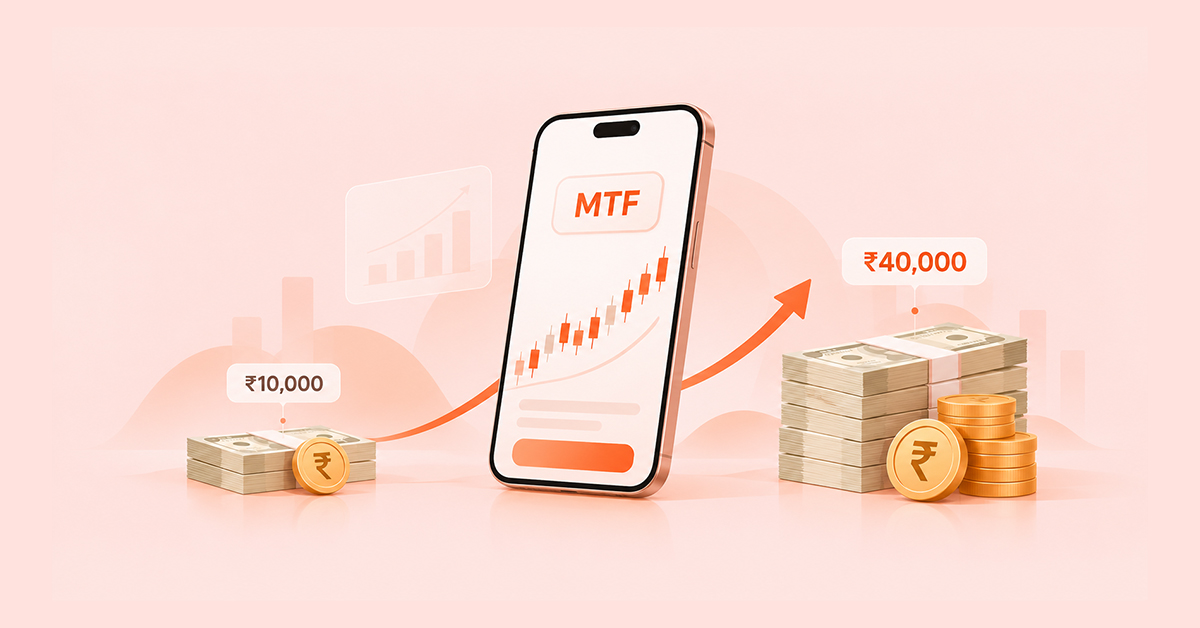
MTF Trading Explained: How ₹10,000 Can Become a ₹40,000 Position
By: Social | Date : Oct 30, 26
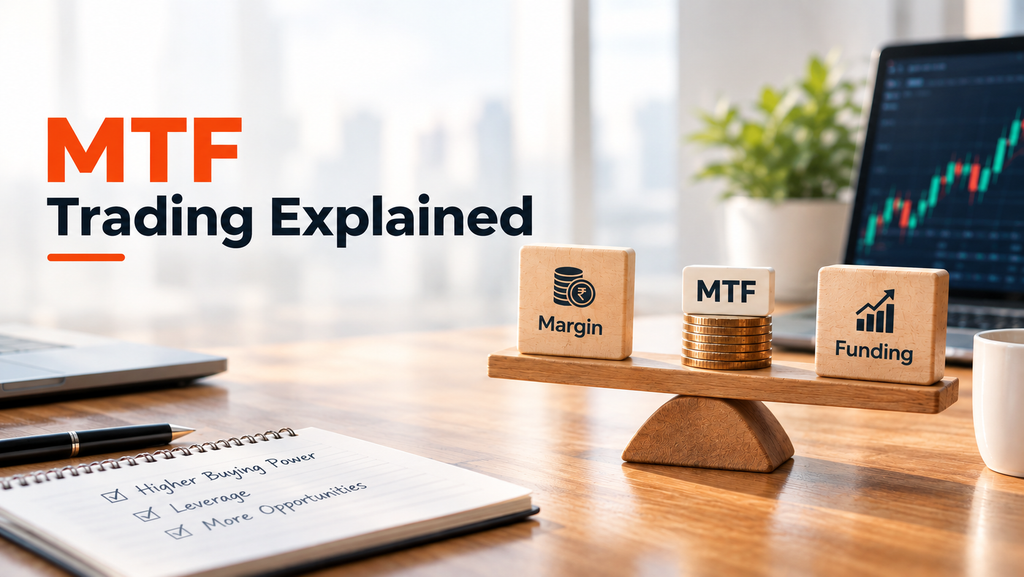
MTF opens up more buying power. But with MTF trading, there is one thing you should never forget: leverage works both ways.
Margin Trading Facility (MTF)allows you to buy an eligible stock by paying part of the trade value, while the broker’s funds will cover the remaining amount. It will be subject to applicable terms and margin requirements.
We offer up to 4X buying power on select stocks. So, ₹10,000 of your funds could help you take a position of up to ₹40,000.
Sounds attractive? It can be. But here’s what can go wrong.
How Does MTF Leverage Affect Your Trade?
Suppose you take a ₹2 lakh position using ₹50,000 of your own capital.
If the stock rises 5%:
₹2,00,000 × 5% = ₹10,000 profit
That’s a 20% gain on your ₹50,000 capital, before applicable charges and interest.
But the same leverage works against you.
| Stock Movement | Profit/Loss on ₹2 Lakh | Impact on ₹50K Capital |
|---|---|---|
| +5% | +₹10,000 | +20% |
| -5% | -₹10,000 | -20% |
| -10% | -₹20,000 | -40% |
A 5% fall in the stock can therefore mean a 20% hit to your initial capital.
That’s the key MTF risk: your exposure is based on the full position, not just your own contribution.
MTF Isn’t Free Buying Power: Understanding Interest Cost
The funded amount attracts interest.
MTF interest is charged on the amount funded by the broker. On our platform, the applicable interest rate and calculation terms determine the funding cost, which can accumulate over the holding period.
So even if your stock is in profit, interest, brokerage, taxes, and other applicable charges can reduce your final profit.
The longer you hold, the more important the funding cost becomes.
What Happens If the Stock Keeps Falling?
If the price of the underlying stock declines, this will affect your margin position. A margin decline which brings your account below the minimum required level means that you may be required to deposit additional funds or supply other acceptable collateral, depending on the relevant agreements. If you do not satisfy the margin requirements in time, your broker will close your position according to the applicable laws and internal regulations.
So don’t just ask:
“How much can I lose?”
Ask:
“Can I maintain this position if the stock falls sharply?”
How to Decide Whether Maximum Leverage Makes Sense
We offer up to 4X leverage on select stocks, but maximum leverage doesn’t mean maximum position size.
Before using MTF, consider:
- Stock volatility
- Your downside risk
- Available margin buffer
- Holding period
- Funding cost
- Exit strategy
The objective isn’t to maximise your exposure.
It’s to use leverage without putting your trading capital under unnecessary pressure.
Don’t Ignore Overnight Risk
If you hold an MTF position overnight, the stock can open significantly higher or lower because of company news, earnings or global market movements.
A sharp gap against your position can quickly affect both your capital and margin position.
So, Is MTF Bad?
Not necessarily.
MTF can be useful when the leverage, funding cost, and margin requirements fit your risk capacity. The problem begins when leverage is treated as free money.
The smarter question isn’t:
“How much can I buy with MTF?”
It’s:
“How much exposure can I responsibly manage?”
Final Takeaway
MTF can increase your buying power, but it can also amplify your losses.
Before using MTF, understand the leverage, interest cost, margin requirement, position size and liquidation risk.
More buying power doesn’t automatically mean better returns. Better risk management does.
FAQs About MTF Trading
1. How should MTF trading be defined?
MTF trading is a setup wherein traders can purchase non-violating shares by making payment for a fraction of the entire purchase price, with the broker covering the rest of the cost in line with the relevant margin requirements and conditions. Aside from the requisite funds for margin trading, interest payments and additional charges can also be incurred.
2. How to calculate MTF?
The total value of your position in margin trading is determined by the participation of both the trader’s and the broker’s capital in the total amount. For instance, if the trader invested a sum of ₹50,000 and the broker added ₹1.5 lakh to the total, then the total value will be ₹2 lakh if the margin trading conditions are fulfilled her requirements.
3. Is MTF beneficial for profit and loss?
Indeed, MTF enhances an investor’s exposure relative to its capital. It offers enhanced returns from positive price changes but amplifies losses with negative movements. The total return also takes into account interest expenses and other fees, such as those resulting from using margin.
4. What are the main risks of MTF?
The principal risks associated with MTF include additional losses, interest fees, margin shortfall, and risks associated with forced square-off or overnight gap.
5. Are there any interest charges on MTF?
The part funded by the broker is usually charged interest. The applicable rate and terms vary with the broker or MTF used.
6. How should I determine how much to position in MTF?
Your MTF position size shouldn’t be determined by the maximum leverage available alone. It should also account for the stock’s volatility, potential downside, interest costs, and the margin you can comfortably set aside.
Disclaimer: This article is for educational purposes only and should not be treated as investment advice. MTF involves market risk and funding costs. Actual margin requirements, interest rates, eligibility, and charges are subject to applicable regulations and broker terms.
Table of content
Categories
Open Demat Account 



Related Posts
-

Top 5 US Economic Data to Watch
Unites States (US) economy is the largest economy in terms of nominal Growth Domestic Products...
-

India’s New Route to Investing in US Stocks: What the Latest NSE Changes Mean for Indian Investors?
For a long time, buying Apple or Microsoft shares from India felt more complicated than...
-

What is SLBM Risk: Risks for Lenders and Borrowers
SLBM Risks for Lenders and Borrowers: What You Must Know SLBM can make trading easier...
-

Indian derivatives market – things you must know before investing
The Indian derivatives market is in existence for very long. In the derivatives market, we...





Filing Complaints on SCORES (SEBI) – Easy & Quick
- Register on SCORES Portal (SEBI)
- Mandatory details for filing complaints on SCORES:
- Name, PAN, Address, Mobile Number, E-mail ID
- Benefits:
- Effective Communication
- Speedy redressal of the grieva`nces


IT'S TIME TO HAVE SOME FUN!
Your family deserves this time more than we do.
Share happiness with your family today & come back soon. We will be right here.
Investment to ek bahana hai,
humein to khushiyon ko badhana hai.
E-mail
askus@rmoneyindia.com
Customer Care
+91-9568654321



Trade Endlessly with
RMoney
Deep Discount Brokerage Plan
At 999/Monthly
- Dedicated round the clock Advisory Support
- High performance in depth research
- Save more than ₹10,000 brokerage Per Month
- Ultra fast trading app