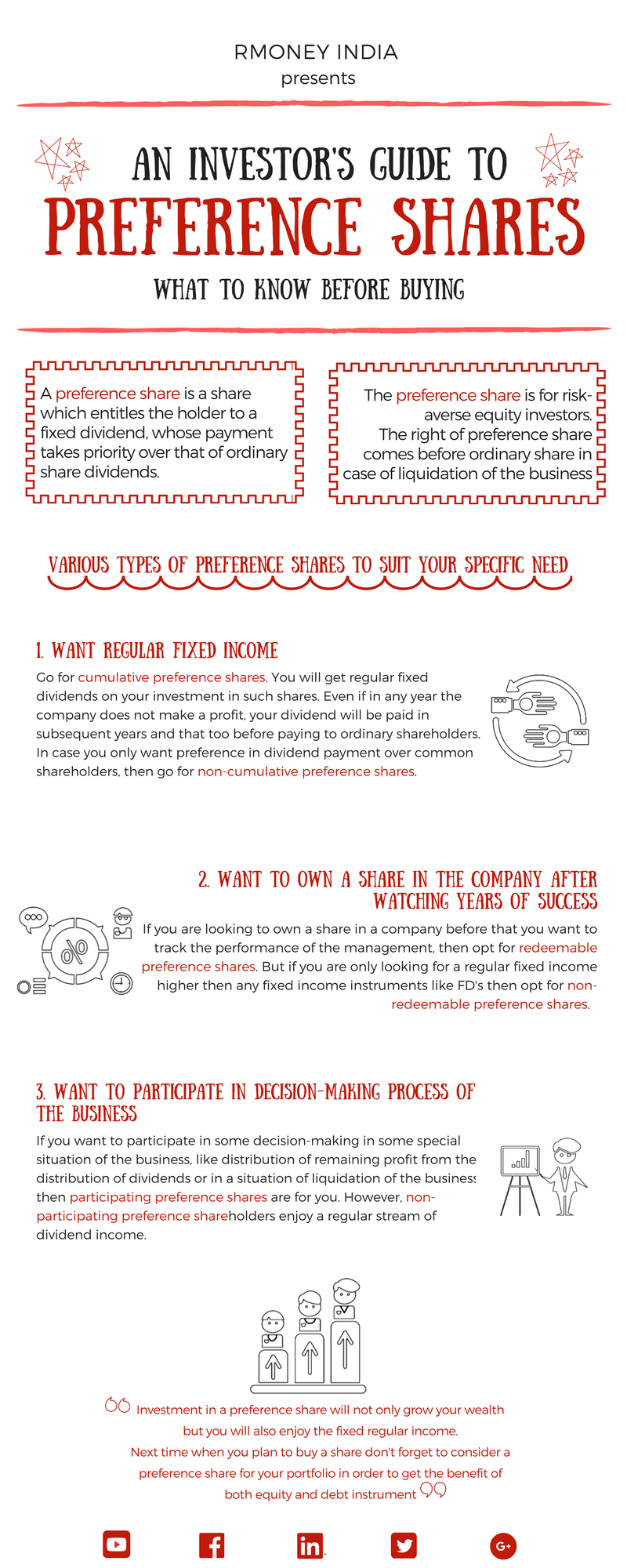
Preference shares refer to ownership in a listed company that bears higher right on assets and profits than common stock. Also, if you hold preferred shares you will receive the dividend before common shareholders. However, this class of shares does not bring voting powers.
What do you mean by preference shares?
Thus, from the above, the meaning of preferential shares is clear. In other words, preference shares are the shares those are preferred over common shares at the time of profit distribution. Owners of preference shares receive regular dividends. Consider a situation where a company goes into liquidation. In such situation, you will get your share after bondholders and creditors. However, you will get it before an equity holder.
Thus, preferred shares combine features of debt and equity. Debt because it pays fixed dividends. And equity, because there is potential for price appreciation. The details of each preferred stock depend on the issue.
Features of preference shares
You qualify for the following before any ordinary shareholders, in case you own preferential shares in a company –
- Dividend at a fixed rate or a fixed amount on your shares before common equity holders.
- During the liquidation of the company, your return on preference share capital is coming prior to the equity share capital
Besides above-mentioned features of preferential shares, some other importance of preferential shares is also there. Preference shareholders, have right to participate in any excess profits. Excess profit is those profits which remain with the company after paying to equity shareholders. You also have a right to participate in the premium at the time of redemption. However, there is the greatest limitation to a preferential shareholder. You do not carry any voting rights, like an ordinary shareholder.
Preferential shares are for what type of investors?
Preference shares are an optimal choice for risk-averse equity investors. These shares are typically less volatile than common shares. It also offers investors a steadier flow of dividends. Moreover, they are usually callable. It means that the issuer of the shares can redeem them at any time. Thus it provides investors with more options than common shares.
How preference shares differ from ordinary shares
Indian companies issues two different types of shares to the public. The first one is ordinary shares and the other is preference shares. The law of the land permits to attach different rights to both types of shares. The various purposes for the same are as follows –
- distinguish voting rights
- prioritize distribution of dividends and claim on assets during liquidation
- to issue fresh shares to raise funds with debt features
- investors get an option to invest and redeem it in future. Thus, allow the investor to exit
Let us now understand the basic difference between preference shares and ordinary shares of a company. The following table explains the two common types of shares and the different rights attached to them.
Preference shares vs ordinary shares – a comparison
|
Characteristics
|
Ordinary shares
|
Preference shares
|
General character
|
It is an equity investment. And is a most common type of share. |
Preference shares have the characteristics of both equity and debt instruments. It does not entitle the holder a right to vote. However, preference shareholders entitle to get the dividend, and have preferential right on redemption or winding up of the company. |
For whom?
|
Suitable for individuals who are looking for all of the three – Some control (voting rights), participate in earnings (dividends income) and growth (capital appreciation of share price) of the company. |
Preference shares are for those individuals who – do not require voting rights and involvement in the management of the company, opt for medium risks and returns, prefers hybrid of debt and equity investment. |
Right to vote
|
By default ordinary shareholders have full voting rights. They are the owner of the company and have full right in the decision-making process. |
Holders of preference shares do not have statutory voting rights. However, they have some preferential rights in respect dividends and claim over assets of the company to ordinary shareholders. However, the article may confer a right to vote in a certain matter of the company. But this is not a general practice. |
Dividend payment
|
The claim on dividend by ordinary shares come after preference share are paid. |
Preference share receives dividends prior to ordinary shares. |
Dividend rate
|
Paying dividends to ordinary share is neither mandatory nor fixed. Also, the rate of the dividend is at the discretion of the board of directors. Further, there is no obligation to declare dividends for common shareholders. |
Preference shares may have the right to the fixed rate of dividend. Or they may have the right to get the same rate of dividends as ordinary shares but prior to ordinary shareholders. |
Dividend accumulation
|
Ordinary shares do not have any right on the accumulated dividends from previous years. |
A cumulative right to dividends may be there in a preference share. However, when there is a provision in the article of the company, then the company have to pay any unpaid accumulated dividends to its holder. For example, suppose a company did not pay dividends 2018 due to some reason. Those holding preference share will get that years dividend in 2019 on onwards when the company makes profits. |
Capital repayment post winding up of company
|
In case of winding up of a company, costs, wages, statutory contributions, and taxes are repaid first followed by creditors. If any capital remains after that, then come the preferential shareholders right over that capital. Ordinary shareholders receive their share at last. |
Preference shareholders are eligible to receive repayment of leftover capital from creditors but before ordinary shareholders. |
Surplus profits distribution in case of winding up of the company
|
The remain of the surplus profits or assets of the company left after repayment of capital post-liquidation of the company is distributed to such shareholders. |
In general preference, shareholders do not have right to participate in such surplus profits. This is only possible with special resolution in the article of the company. |
Redemption of shares
|
Cannot be redeemed by the company. Also, a company cannot repurchase shares from ordinary shareholders. However, with a special resolution approved by an ordinary shareholder, the company can buyback such ordinary shares. |
Redeemable preference shares are redeemed in the future by the company. A company can issue a preference share for short term and is generally authorized by the articles of the company. The company may redeem such shares from available profits. These profits may be kept for distribution of dividends. Or such redemption is possible from proceeds of a new issue of made especially for the purposes of redemption. A premium may be paid to the redeemable preference shareholders. |
The option of convertibility
|
Ordinary shares is non-convertible to other class of shares. |
Convertible preference shares have the option to convert to ordinary shares at a pre-determined time and rate. |
What are the types of preference shares?
Basically, the difference in the types of preference shares arises due to various rights associated with it. Whether it is right on dividends of the company, or it relates to voting in the business and management, or the right to which you can hold such shares. The following are the major classes of preference shares –
1. Right on dividend – cumulative and non-cumulative preference shares
Depending upon the right on the dividend paid by any company, preference shares can be cumulative or non-cumulative. There is an obligation or no obligation on the company to pay dividends, irrespective of profits in any year. The dividends accumulate, and there is an obligation on business to pay it out of profit in later years only to preference shareholders. This is possible only when you hold a cumulative preference share.
On the other hand, in case you hold a non-cumulative preference share, you are treated same as ordinary shareholders. The only thing is that the company needs to declare a dividend in case of profit in a particular year. However, the difference is you will get the dividend prior to the ordinary shareholders and at a pre-decided fixed rate.
Any unpaid dividends on cumulative preference shares accumulate. Also, the company has to make provision to pay these arrears before paying to ordinary equity shareholders. In general preference shares are cumulative except explicitly specified as non-cumulative.
Let us understand this with an example. Suppose a company has 1000 8% preference shares of Rs. 10 each. Also, the company did not pay the dividends for 2011 and 2012 so far. Now suppose in 2013, the company made a profit after the gap of 2 years of no or very low profit. Then in such case, the management must keep aside and pay Rs. 24,000 for the year 2011, 2012 and 2013 to shareholders of cumulative preference shares before declaring dividends to ordinary shareholders for the year 2013.
2. Option to convert to ordinary shares – redeemable and non-redeemable preference shares
There is an option attached to preference share. The option related to the conversion of preference shares unit to ordinary shares in, say 5 years or 7 years period. You can exercise such option during the filling the application for the preference share. In this case, you become entitled to convert such shares to ordinary shares on prespecified date and price. This option is known as convertible preference share. The other name of this category is redeemable preference shares. These preference shares are redeemed or repaid after the expiry of a fixed period or as per the prescribed notice issued by the company.
The opposite to this right is non-convertible preference shares or non-redeemable preference shares. Here, there are no such options to convert the preference shares into common shares of the company. The end of such shares is possible only when the company goes into liquidation. There may be an option attached to resell such non-convertible preference shares in a stock market.
3. Right to vote – non-participating & participating preference shares
Ordinary shareholders have right to vote in the working of the business. Companies need to seek permission from common shareholders before any ordinary or extraordinary decisions. However, preference shareholders are not entitled to vote in any such decision-making process. But there are some instances where such preference shareholders have voting rights with limited scope.
A participating preference share makes the holder eligible to participate in the balance of profits with ordinary shareholders. Even, after they receive nay fixed rate of dividend on shareholdings. They may also have the share in any surplus assets in case of winding up of the company.
On the other hand, a non- participating preference shares get only a fixed rate of dividend. They do not share the surplus profits. In general preference shares are non-participating in nature, unless expressly mentioned in the memorandum or the articles of the issue of preference shares.

 Stock Trading
Now trade in ₹9 Per Order or ₹ 999 Per Month Plans.
Stock Trading
Now trade in ₹9 Per Order or ₹ 999 Per Month Plans.
 Future & Options
Access F&O contracts with advanced tools for hedging and speculation.
Future & Options
Access F&O contracts with advanced tools for hedging and speculation.
 Currency Trading
Trade in major currency pairs and manage forex exposure efficiently.
Currency Trading
Trade in major currency pairs and manage forex exposure efficiently.
 Commodity Trading
Diversify Trading with MCX & NCDEX by Trading in Gold, Silver, Base Metals, Energy, and Agri Products.
Commodity Trading
Diversify Trading with MCX & NCDEX by Trading in Gold, Silver, Base Metals, Energy, and Agri Products.
 Margin Trading Funding
Boost your buying power with upto 5X, Buy now Pay Later
Margin Trading Funding
Boost your buying power with upto 5X, Buy now Pay Later
 Algo Trading
Back test, Paper Trade your logic & Automate your strategies with low-latency APIs.
Algo Trading
Back test, Paper Trade your logic & Automate your strategies with low-latency APIs.
 Trading View
Leverage Trading View charts and indicators integrated into your trading platform.
Trading View
Leverage Trading View charts and indicators integrated into your trading platform.
 Advanced Options Trading
Execute multi-leg option strategies with precision and insights.
Advanced Options Trading
Execute multi-leg option strategies with precision and insights.
 Stock Lending & Borrowing
Earn passive income by lending stocks securely through SLB.
Stock Lending & Borrowing
Earn passive income by lending stocks securely through SLB.
 Foreign Portfolio Investment
Enable NRIs and FPIs to invest in Indian markets with ease and compliance.
Foreign Portfolio Investment
Enable NRIs and FPIs to invest in Indian markets with ease and compliance.
 IPO
Invest in upcoming IPOs online with real-time tracking and instant allotment updates.
IPO
Invest in upcoming IPOs online with real-time tracking and instant allotment updates.
 Direct Mutual Funds
0% Commissions by investing in more than +3500 Direct Mutual Fund Scheme.
Direct Mutual Funds
0% Commissions by investing in more than +3500 Direct Mutual Fund Scheme.
 Corporate FDRs
Earn fixed returns with low-risk investments in high-rated corporate fixed deposits.
Corporate FDRs
Earn fixed returns with low-risk investments in high-rated corporate fixed deposits.
 Stocks SIPs
Build long-term wealth with systematic investment plans in top-performing stocks.
Stocks SIPs
Build long-term wealth with systematic investment plans in top-performing stocks.
 Bonds & NCDs
Access secure, fixed-income investments through government and corporate bond offerings.
Bonds & NCDs
Access secure, fixed-income investments through government and corporate bond offerings.
 Depository Services
Safely hold and manage your securities with seamless Demat and DP services with CDSL.
Depository Services
Safely hold and manage your securities with seamless Demat and DP services with CDSL.
 Journey
Tracing our growth and milestones over time.
Journey
Tracing our growth and milestones over time.
 Mission & Vision
Guided by purpose, driven by long-term vision.
Mission & Vision
Guided by purpose, driven by long-term vision.
 Why RMoney Platform
Smart, reliable platform for all investors' needs.
Why RMoney Platform
Smart, reliable platform for all investors' needs.
 Management
Experienced leadership driving strategic financial excellence.
Management
Experienced leadership driving strategic financial excellence.
 Credentials
Certified expertise with trusted industry recognition.
Credentials
Certified expertise with trusted industry recognition.
 Press Release
Latest company news, updates, and announcements.
Press Release
Latest company news, updates, and announcements.
 Testimonials
Real client stories sharing their success journeys.
Testimonials
Real client stories sharing their success journeys.
 7 Reasons to Invest
Top benefits that make investing with us smart.
7 Reasons to Invest
Top benefits that make investing with us smart.
 SEBI Registered Research
Trusted insights backed by SEBI-compliant research.
SEBI Registered Research
Trusted insights backed by SEBI-compliant research.
 Our Technology
Advanced tools enabling efficient online trading.
Our Technology
Advanced tools enabling efficient online trading.
 Calculators
Access a suite of smart tools to plan trades, margins, and returns effectively.
Calculators
Access a suite of smart tools to plan trades, margins, and returns effectively.
 Margin Calculator
Instantly check margin requirements for intraday and delivery trades.
Margin Calculator
Instantly check margin requirements for intraday and delivery trades.
 MTF Calculator
Calculate MTF funding cost upfront to ensure full transparency before placing a trade.
MTF Calculator
Calculate MTF funding cost upfront to ensure full transparency before placing a trade.
 Brokerage Calculator
Know your exact brokerage charges before placing any trade.
Brokerage Calculator
Know your exact brokerage charges before placing any trade.
 Market Place
Explore curated investment products and trading tools in one convenient hub.
Market Place
Explore curated investment products and trading tools in one convenient hub.
 RMoney Gyan
Enhance your market knowledge with expert blogs, videos, and tutorials.
RMoney Gyan
Enhance your market knowledge with expert blogs, videos, and tutorials.
 Performance Tracker
Track our research performance with full transparency using our performance tracker.
Performance Tracker
Track our research performance with full transparency using our performance tracker.
 Feedback
Share your suggestions or concerns to help us improve your experience.
Feedback
Share your suggestions or concerns to help us improve your experience.
 Downloads
Access important forms, software, and documents in one place.
Downloads
Access important forms, software, and documents in one place.
 Locate Us
Find the nearest RMoney branch or service center quickly.
Locate Us
Find the nearest RMoney branch or service center quickly.
 Escalation Matrix
Resolve issues faster with our structured support escalation process.
Escalation Matrix
Resolve issues faster with our structured support escalation process.
 Back Office
Log in to view trade reports, ledger, and portfolio statements anytime.
Back Office
Log in to view trade reports, ledger, and portfolio statements anytime.
 Account Modification
Update personal or bank details linked to your trading account.
Account Modification
Update personal or bank details linked to your trading account.
 Fund Transfer
Transfer funds instantly online with quick limit updation to your trading account.
Fund Transfer
Transfer funds instantly online with quick limit updation to your trading account.
 Bank Details
View our registered bank account details for seamless transactions by NEFT, RTGS or IMPS.
Bank Details
View our registered bank account details for seamless transactions by NEFT, RTGS or IMPS.
 RMoney Quick Mobile App
Trade on-the-go with our all-in-one mobile trading app.
RMoney Quick Mobile App
Trade on-the-go with our all-in-one mobile trading app.
 RMoney Quick login
Quickly access your trading account through the RMoney Quick web-based trading.
RMoney Quick login
Quickly access your trading account through the RMoney Quick web-based trading.
 RMoney Rocket Web Version
Experience powerful web-based trading with advanced tools for algo traders.
RMoney Rocket Web Version
Experience powerful web-based trading with advanced tools for algo traders.
 RMoney Rocket Mobile Version
Trade anytime, anywhere with our feature-rich mobile trading platform.
RMoney Rocket Mobile Version
Trade anytime, anywhere with our feature-rich mobile trading platform.
 Rocket API
Lightning-fast trading API for developers advanced algo traders.
Rocket API
Lightning-fast trading API for developers advanced algo traders.
 XTS Algo
Smart algo trading software for precision trades.
XTS Algo
Smart algo trading software for precision trades.
 Authorised Person Partner with us as an Authorised Person to grow your financial business.
 Refer & Earn
Invite friends and earn rewards every time they trade with us.
Refer & Earn
Invite friends and earn rewards every time they trade with us.