 Stock Trading
Now trade in ₹9 Per Order or ₹ 999 Per Month Plans.
Stock Trading
Now trade in ₹9 Per Order or ₹ 999 Per Month Plans.
 Future & Options
Access F&O contracts with advanced tools for hedging and speculation.
Future & Options
Access F&O contracts with advanced tools for hedging and speculation.
 Currency Trading
Trade in major currency pairs and manage forex exposure efficiently.
Currency Trading
Trade in major currency pairs and manage forex exposure efficiently.
 Commodity Trading
Diversify Trading with MCX & NCDEX by Trading in Gold, Silver, Base Metals, Energy, and Agri Products.
Commodity Trading
Diversify Trading with MCX & NCDEX by Trading in Gold, Silver, Base Metals, Energy, and Agri Products.
 Margin Trading Funding
Boost your buying power with upto 5X, Buy now Pay Later
Margin Trading Funding
Boost your buying power with upto 5X, Buy now Pay Later
 Algo Trading
Back test, Paper Trade your logic & Automate your strategies with low-latency APIs.
Algo Trading
Back test, Paper Trade your logic & Automate your strategies with low-latency APIs.
 Trading View
Leverage Trading View charts and indicators integrated into your trading platform.
Trading View
Leverage Trading View charts and indicators integrated into your trading platform.
 Advanced Options Trading
Execute multi-leg option strategies with precision and insights.
Advanced Options Trading
Execute multi-leg option strategies with precision and insights.
 Stock Lending & Borrowing
Earn passive income by lending stocks securely through SLB.
Stock Lending & Borrowing
Earn passive income by lending stocks securely through SLB.
 Foreign Portfolio Investment
Enable NRIs and FPIs to invest in Indian markets with ease and compliance.
Foreign Portfolio Investment
Enable NRIs and FPIs to invest in Indian markets with ease and compliance.
 IPO
Invest in upcoming IPOs online with real-time tracking and instant allotment updates.
IPO
Invest in upcoming IPOs online with real-time tracking and instant allotment updates.
 Direct Mutual Funds
0% Commissions by investing in more than +3500 Direct Mutual Fund Scheme.
Direct Mutual Funds
0% Commissions by investing in more than +3500 Direct Mutual Fund Scheme.
 Corporate FDRs
Earn fixed returns with low-risk investments in high-rated corporate fixed deposits.
Corporate FDRs
Earn fixed returns with low-risk investments in high-rated corporate fixed deposits.
 Stocks SIPs
Build long-term wealth with systematic investment plans in top-performing stocks.
Stocks SIPs
Build long-term wealth with systematic investment plans in top-performing stocks.
 Bonds & NCDs
Access secure, fixed-income investments through government and corporate bond offerings.
Bonds & NCDs
Access secure, fixed-income investments through government and corporate bond offerings.
 Depository Services
Safely hold and manage your securities with seamless Demat and DP services with CDSL.
Depository Services
Safely hold and manage your securities with seamless Demat and DP services with CDSL.
 RMoney Quick
Fast, hassle-free trading in one tap.
RMoney Quick
Fast, hassle-free trading in one tap.
 RMoney Rocket
Power-packed platform for active traders.
RMoney Rocket
Power-packed platform for active traders.
 Rocket API
Lightning-fast trading API for developers advanced algo traders.
Rocket API
Lightning-fast trading API for developers advanced algo traders.
 XTS Algo
Smart algo trading software for precision trades.
XTS Algo
Smart algo trading software for precision trades.
 Journey
Tracing our growth and milestones over time.
Journey
Tracing our growth and milestones over time.
 Mission & Vision
Guided by purpose, driven by long-term vision.
Mission & Vision
Guided by purpose, driven by long-term vision.
 Why RMoney Platform
Smart, reliable platform for all investors' needs.
Why RMoney Platform
Smart, reliable platform for all investors' needs.
 Management
Experienced leadership driving strategic financial excellence.
Management
Experienced leadership driving strategic financial excellence.
 Credentials
Certified expertise with trusted industry recognition.
Credentials
Certified expertise with trusted industry recognition.
 Press Release
Latest company news, updates, and announcements.
Press Release
Latest company news, updates, and announcements.
 Testimonials
Real client stories sharing their success journeys.
Testimonials
Real client stories sharing their success journeys.
 7 Reasons to Invest
Top benefits that make investing with us smart.
7 Reasons to Invest
Top benefits that make investing with us smart.
 SEBI Registered Research
Trusted insights backed by SEBI-compliant research.
SEBI Registered Research
Trusted insights backed by SEBI-compliant research.
 Our Technology
Advanced tools enabling efficient online trading.
Our Technology
Advanced tools enabling efficient online trading.
 Blog
Stay updated with expert insights, market trends, and trading strategies through our informative blogs.
Blog
Stay updated with expert insights, market trends, and trading strategies through our informative blogs.
 Video
Learn visually with easy-to-understand videos covering trading concepts, tips, and market analysis.
Video
Learn visually with easy-to-understand videos covering trading concepts, tips, and market analysis.
 Podcast
Tune in to insightful discussions and expert opinions anytime, anywhere.
Podcast
Tune in to insightful discussions and expert opinions anytime, anywhere.
 Telegram Community
Be part of an active trader community sharing ideas, updates, and market opportunities in real-time.
Telegram Community
Be part of an active trader community sharing ideas, updates, and market opportunities in real-time.
 WhatsApp Updates
Get instant alerts, key market updates, and important notifications directly on WhatsApp.
WhatsApp Updates
Get instant alerts, key market updates, and important notifications directly on WhatsApp.
 Financial Calculators
Plan your trades, margins, and returns efficiently with our smart calculation tools.
Financial Calculators
Plan your trades, margins, and returns efficiently with our smart calculation tools.
 Marketplace
Discover curated tools, strategies, and services designed to enhance your trading experience.
Marketplace
Discover curated tools, strategies, and services designed to enhance your trading experience.
 Daily Research Reports
Stay ahead with timely market insights, trends, and actionable analysis delivered every day.
Daily Research Reports
Stay ahead with timely market insights, trends, and actionable analysis delivered every day.
 Dedicated Advisory
Get personalized guidance and expert recommendations tailored to your trading goals.
Dedicated Advisory
Get personalized guidance and expert recommendations tailored to your trading goals.
 Research Team
Backed by experienced analysts delivering data-driven insights and market expertise.
Research Team
Backed by experienced analysts delivering data-driven insights and market expertise.
 Research Reports
Access in-depth reports covering stocks, commodities, and market movements to support informed decisions.
Research Reports
Access in-depth reports covering stocks, commodities, and market movements to support informed decisions.
 Feedback
Share your suggestions or concerns to help us improve your experience.
Feedback
Share your suggestions or concerns to help us improve your experience.
 Downloads
Access important forms, software, and documents in one place.
Downloads
Access important forms, software, and documents in one place.
 Locate Us
Find the nearest RMoney branch or service center quickly.
Locate Us
Find the nearest RMoney branch or service center quickly.
 Escalation Matrix
Resolve issues faster with our structured support escalation process.
Escalation Matrix
Resolve issues faster with our structured support escalation process.
 Back Office
Log in to view trade reports, ledger, and portfolio statements anytime.
Back Office
Log in to view trade reports, ledger, and portfolio statements anytime.
 Account Modification
Update personal or bank details linked to your trading account.
Account Modification
Update personal or bank details linked to your trading account.
 Fund Transfer
Transfer funds instantly online with quick limit updation to your trading account.
Fund Transfer
Transfer funds instantly online with quick limit updation to your trading account.
 Bank Details
View our registered bank account details for seamless transactions by NEFT, RTGS or IMPS.
Bank Details
View our registered bank account details for seamless transactions by NEFT, RTGS or IMPS.
 RMoney Rocket Web Version
Experience powerful web-based trading with advanced tools for algo traders.
RMoney Rocket Web Version
Experience powerful web-based trading with advanced tools for algo traders.
 Refer & Earn
Invite friends and earn rewards every time they trade with us.
Refer & Earn
Invite friends and earn rewards every time they trade with us.



India’s New Route to Investing in US Stocks: What the Latest NSE Changes Mean for Indian Investors?
By: Akriti Tomar | Date : Apr 7, 26
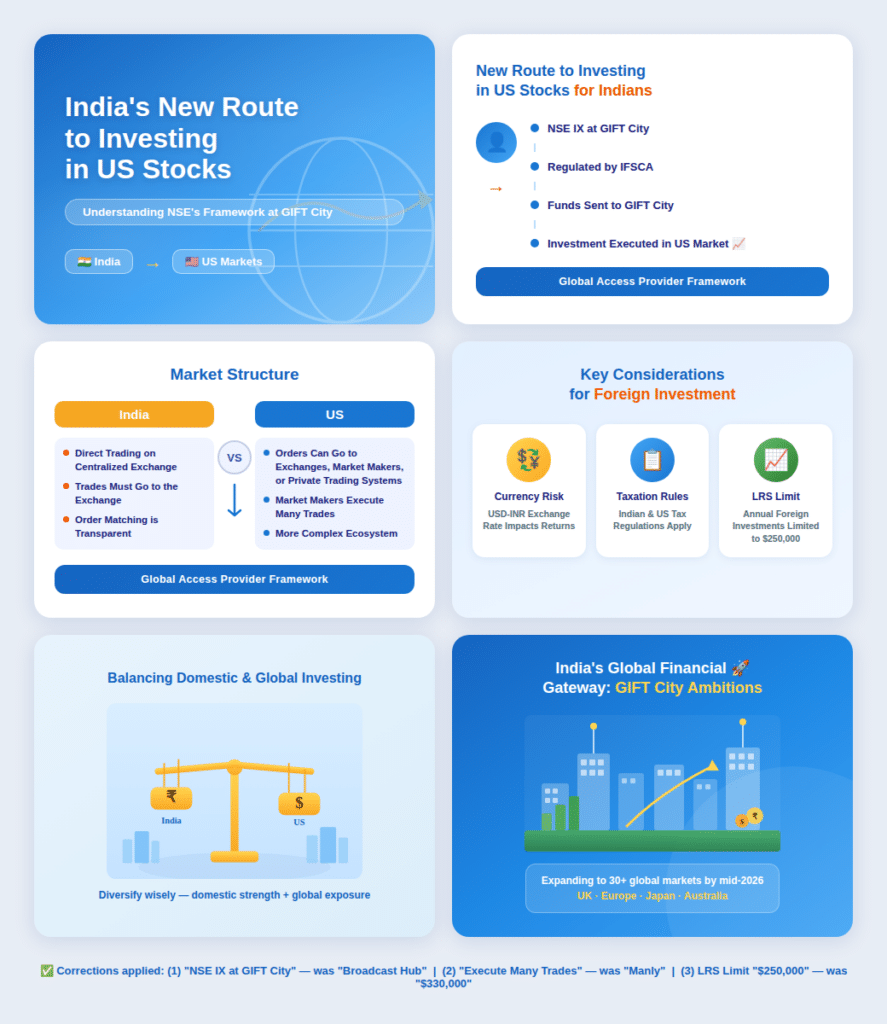
For a long time, buying Apple or Microsoft shares from India felt more complicated than it should have been. You needed to open an account with an overseas broker, transfer money abroad, deal with a foreign custodian, and hope everything settled correctly across two different regulatory systems. It worked, but it was never smooth.
That changed in February 2026.
NSE’s international exchange at GIFT City launched what it calls the Global Access platform, and for the first time, Indian investors can buy US stocks while staying within an Indian-regulated framework. If you’ve heard about this and want to understand what actually changed not just the marketing version of it this guide is for you.
Why Investors Wanted US Stocks in the First Place?
Let’s start with the basic question: why bother?
India has great companies. The Nifty 50 has delivered solid long-term returns. So why look abroad?
A few reasons come up consistently.
The first is simple: some of the world’s most valuable businesses in semiconductors, cloud computing, consumer technology, electric vehicles are listed in the US, not India. If you want to invest in Nvidia’s AI story or Amazon’s logistics dominance, there’s no Indian equivalent.
The second reason is currency. When the rupee weakens against the dollar — which, historically, it tends to do over long periods — dollar-denominated assets gain additional value in rupee terms. Holding some portion of your portfolio in USD-denominated assets can work as a natural hedge.
The third is straightforward diversification. Being 100% invested in one country ties your portfolio to that country’s economic cycle, political environment, and regulatory changes. Spreading across geographies reduces that concentration.
None of this is new thinking. What was missing was a clean, regulated way to act on it.
How It Worked Before and What the Problem Was?
Until recently, the typical route for an Indian investor buying US stocks looked like this:
Your bank → RBI outward remittance → overseas broker platform → US custodian → your account
The RBI watched the money leave India under its Liberalised Remittance Scheme. The US Securities and Exchange Commission supervised the broker on the other end. But the link in the middle, the actual trading and custody layer sat outside Indian regulatory visibility.
Most platforms using this structure operated perfectly fine. But from a regulatory standpoint, once your money crossed the border, Indian authorities had limited oversight of what happened next. There was no Indian regulator you could approach if something went wrong with the overseas broker.
What GIFT City Changes?
GIFT City (Gujarat International Finance Tec-City) is India’s dedicated international financial hub. It operates under IFSCA (International Financial Services Centres Authority), which is a unified regulator for India’s international financial services.
When NSE IX (NSE’s international exchange at GIFT City) launched the Global Access platform in February 2026, it introduced a new layer into the investment chain:
Before: Your order → overseas broker → US market (limited Indian oversight)
Now: Your order → NSE IX at GIFT City → US market (supervised by IFSCA throughout)
The entities facilitating this access called Global Access Providers, or GAPs — are regulated by IFSCA. Platforms like RMoney operate as regulated access partners within this structure.
The practical difference for you as an investor: if something goes wrong, there is now an Indian regulatory body with jurisdiction over your investment route. That’s a meaningful shift.
How the Process Actually Works?
Opening an Account
The onboarding is entirely digital. You need your Aadhaar, PAN, and DigiLocker access. The process takes a few minutes, there are no charges, and you don’t need a separate demat account for holding international securities.
Sending Money
All investments go through RBI’s Liberalised Remittance Scheme. Under LRS, Indian residents can remit up to $2,50,000 per financial year (April to March) for permitted capital account transactions including equity investments. Your bank handles LRS compliance. The money goes into a designated USD account at a GIFT City bank.
Trading
Once your USD balance is credited, you can start buying. US markets open at 9:30 AM Eastern Time, which is 7:00 PM IST, and close at 4:00 PM Eastern, which is 1:30 AM IST. Prices show in real time during market hours. Settlement follows the US T+1 cycle your trades typically settle the next business day.
What You Can Buy?
Phase 1 of the platform offers access to 50+ large-cap US stocks — the names most Indian investors are already familiar with: Apple, Microsoft, Amazon, Tesla, Nvidia, Meta, and others in that category. ETFs tracking major US indices and sectors are also available. There’s also fractional investing, meaning you can buy a portion of a share rather than a full unit. You don’t need tens of thousands of rupees to start.
The Tax Side of Things – Which You Cannot Ignore?
This is where most investors underestimate what they’re getting into. US stock investing from India has three separate tax considerations, and you need to understand all three.
Tax Collected at Source (TCS) on Remittances
When you send money abroad under LRS, TCS applies above a threshold. For FY 2025-26 onwards, no TCS is deducted on remittances up to ₹10 lakh in a financial year. Above that, TCS is collected at 20%.
The important thing to understand: TCS is not a final tax. It’s an advance tax credit. Whatever is deducted gets adjusted against your total tax liability when you file your ITR. If your actual tax is less than what was collected, you get a refund.
To put it simply: if you remit ₹15 lakh, TCS applies on ₹5 lakh at 20%, meaning ₹1 lakh is collected upfront. You claim this back at ITR time.
Capital Gains on US Stocks
Under Indian tax law, US-listed stocks are treated as unlisted foreign securities. The holding period and rates are different from what you’re used to with Indian stocks.
Short-term — held for less than 24 months — gains are taxed at your applicable income tax slab rate. Long-term — held for 24 months or more — gains are taxed at 12.5% on amounts exceeding ₹1.25 lakh. Note that the threshold here is 24 months, not 12 months as it is for Indian listed equities.
Dividends
US companies withhold 25% tax on dividends paid to Indian investors before the money reaches you. Under the India-US Double Taxation Avoidance Agreement (DTAA), you can claim this as a foreign tax credit when filing in India, preventing you from being taxed twice on the same income.
Filing Requirements
You must file ITR-2, not ITR-1. All foreign assets must be disclosed under Schedule FA. Non-disclosure is treated seriously — penalties can go up to ₹10 lakh, and in certain cases, prosecution under FEMA is possible. This is not an area to take lightly. If you hold US stocks, get a CA to help with your return.
Currency Risk: The Variable Most People Forget
Here’s a scenario worth thinking through. Say you buy a US stock at $200. A year later it’s trading at $220, a clean 10% gain. You feel good.
But if the rupee has strengthened 8% against the dollar during that period, your actual rupee return on the trade is closer to 2%. The stock performed, but the currency worked against you.
This cuts both ways. If the rupee weakens, your returns get amplified in rupee terms. Some investors use US assets specifically as a hedge against rupee depreciation, which has historically been a slow but consistent trend.
The point is that you’re not just betting on stock performance. You’re simultaneously taking a view on two currencies. Most investors who are new to international investing don’t account for this in their return expectations — and then feel surprised when the numbers don’t match.
What the Platform Doesn’t Offer?
It’s worth being direct about limitations. No leverage, no margin trading. No options or derivatives. The stock universe is currently around 50 large-cap names if you want access to thousands of US stocks including mid-caps, small-caps, or sector-specific names outside that list, you’d need a traditional international brokerage account.
For most retail investors starting out with US exposure, 50 well-known large-cap stocks and ETFs is more than adequate. But if your strategy requires specific stocks or instruments beyond that, it’s something to factor in before deciding.
Is This Route Right for You?
The GIFT City Global Access platform is a good fit if you want simple, regulated exposure to the biggest US companies without navigating foreign brokerages. It’s particularly well-suited for long-term investors who want to add global diversification without complexity.
It’s not the right fit if you want advanced strategies, a wide stock universe, or instruments beyond equities and ETFs.
What it is, unambiguously, is a more regulated and more transparent route than what existed before. For retail investors who were always slightly uncomfortable with the offshore structure, that matters.
A Quick Note on Forward Outlook
NSE IX has indicated that Global Access is planned to expand to 30+ international markets including the UK, Europe, Japan, and Australia potentially by mid to late 2026. If that timeline holds, Indian investors could eventually build geographically diversified global portfolios entirely within the Indian regulatory ecosystem. That’s a meaningful shift in what domestic capital markets infrastructure can offer.
Disclaimer: This blog is for educational purposes only and does not constitute financial or investment advice. Taxation rules, LRS limits, and TCS rates are subject to change. Please consult a SEBI-registered financial advisor and a qualified CA before making investment decisions.
Table of content
Categories
Open Demat Account 


Related Posts
-

Indian Capital Market: Opportunities and Challenges
Capital Market is a commonly used term. Capital market is a market for both debt...
-

Penny stocks or multibagger stocks – Which one should you own?
Multibagger stocks with strong fundamentals are hard to find. But it is not impossible to...
-

NSE Norms for Safer Participation of Algo Traders: 16 Takeaways
The implementation standards intended to safeguard the interests of retail investors have been dictated by...
-
Learn stock classification before entering Indian stock market
Stock classification is the process of grouping stocks for ease of understanding. In India both...





Filing Complaints on SCORES (SEBI) – Easy & Quick
- Register on SCORES Portal (SEBI)
- Mandatory details for filing complaints on SCORES:
- Name, PAN, Address, Mobile Number, E-mail ID
- Benefits:
- Effective Communication
- Speedy redressal of the grieva`nces


IT'S TIME TO HAVE SOME FUN!
Your family deserves this time more than we do.
Share happiness with your family today & come back soon. We will be right here.
Investment to ek bahana hai,
humein to khushiyon ko badhana hai.
E-mail
askus@rmoneyindia.com
Customer Care
+91-9568654321



Trade Endlessly with
RMoney
Deep Discount Brokerage Plan
At 999/Monthly
- Dedicated round the clock Advisory Support
- High performance in depth research
- Save more than ₹10,000 brokerage Per Month
- Ultra fast trading app