 Stock Trading
Now trade in ₹9 Per Order or ₹ 999 Per Month Plans.
Stock Trading
Now trade in ₹9 Per Order or ₹ 999 Per Month Plans.
 Future & Options
Access F&O contracts with advanced tools for hedging and speculation.
Future & Options
Access F&O contracts with advanced tools for hedging and speculation.
 Currency Trading
Trade in major currency pairs and manage forex exposure efficiently.
Currency Trading
Trade in major currency pairs and manage forex exposure efficiently.
 Commodity Trading
Diversify Trading with MCX & NCDEX by Trading in Gold, Silver, Base Metals, Energy, and Agri Products.
Commodity Trading
Diversify Trading with MCX & NCDEX by Trading in Gold, Silver, Base Metals, Energy, and Agri Products.
 Margin Trading Funding
Boost your buying power with upto 5X, Buy now Pay Later
Margin Trading Funding
Boost your buying power with upto 5X, Buy now Pay Later
 Algo Trading
Back test, Paper Trade your logic & Automate your strategies with low-latency APIs.
Algo Trading
Back test, Paper Trade your logic & Automate your strategies with low-latency APIs.
 Trading View
Leverage Trading View charts and indicators integrated into your trading platform.
Trading View
Leverage Trading View charts and indicators integrated into your trading platform.
 Advanced Options Trading
Execute multi-leg option strategies with precision and insights.
Advanced Options Trading
Execute multi-leg option strategies with precision and insights.
 Stock Lending & Borrowing
Earn passive income by lending stocks securely through SLB.
Stock Lending & Borrowing
Earn passive income by lending stocks securely through SLB.
 Foreign Portfolio Investment
Enable NRIs and FPIs to invest in Indian markets with ease and compliance.
Foreign Portfolio Investment
Enable NRIs and FPIs to invest in Indian markets with ease and compliance.
 IPO
Invest in upcoming IPOs online with real-time tracking and instant allotment updates.
IPO
Invest in upcoming IPOs online with real-time tracking and instant allotment updates.
 Direct Mutual Funds
0% Commissions by investing in more than +3500 Direct Mutual Fund Scheme.
Direct Mutual Funds
0% Commissions by investing in more than +3500 Direct Mutual Fund Scheme.
 Corporate FDRs
Earn fixed returns with low-risk investments in high-rated corporate fixed deposits.
Corporate FDRs
Earn fixed returns with low-risk investments in high-rated corporate fixed deposits.
 Stocks SIPs
Build long-term wealth with systematic investment plans in top-performing stocks.
Stocks SIPs
Build long-term wealth with systematic investment plans in top-performing stocks.
 Bonds & NCDs
Access secure, fixed-income investments through government and corporate bond offerings.
Bonds & NCDs
Access secure, fixed-income investments through government and corporate bond offerings.
 Depository Services
Safely hold and manage your securities with seamless Demat and DP services with CDSL.
Depository Services
Safely hold and manage your securities with seamless Demat and DP services with CDSL.
 RMoney Quick
Fast, hassle-free trading in one tap.
RMoney Quick
Fast, hassle-free trading in one tap.
 RMoney Rocket
Power-packed platform for active traders.
RMoney Rocket
Power-packed platform for active traders.
 Rocket API
Lightning-fast trading API for developers advanced algo traders.
Rocket API
Lightning-fast trading API for developers advanced algo traders.
 XTS Algo
Smart algo trading software for precision trades.
XTS Algo
Smart algo trading software for precision trades.
 Journey
Tracing our growth and milestones over time.
Journey
Tracing our growth and milestones over time.
 Mission & Vision
Guided by purpose, driven by long-term vision.
Mission & Vision
Guided by purpose, driven by long-term vision.
 Why RMoney Platform
Smart, reliable platform for all investors' needs.
Why RMoney Platform
Smart, reliable platform for all investors' needs.
 Management
Experienced leadership driving strategic financial excellence.
Management
Experienced leadership driving strategic financial excellence.
 Credentials
Certified expertise with trusted industry recognition.
Credentials
Certified expertise with trusted industry recognition.
 Press Release
Latest company news, updates, and announcements.
Press Release
Latest company news, updates, and announcements.
 Testimonials
Real client stories sharing their success journeys.
Testimonials
Real client stories sharing their success journeys.
 7 Reasons to Invest
Top benefits that make investing with us smart.
7 Reasons to Invest
Top benefits that make investing with us smart.
 SEBI Registered Research
Trusted insights backed by SEBI-compliant research.
SEBI Registered Research
Trusted insights backed by SEBI-compliant research.
 Our Technology
Advanced tools enabling efficient online trading.
Our Technology
Advanced tools enabling efficient online trading.
 Blog
Stay updated with expert insights, market trends, and trading strategies through our informative blogs.
Blog
Stay updated with expert insights, market trends, and trading strategies through our informative blogs.
 Video
Learn visually with easy-to-understand videos covering trading concepts, tips, and market analysis.
Video
Learn visually with easy-to-understand videos covering trading concepts, tips, and market analysis.
 Podcast
Tune in to insightful discussions and expert opinions anytime, anywhere.
Podcast
Tune in to insightful discussions and expert opinions anytime, anywhere.
 Telegram Community
Be part of an active trader community sharing ideas, updates, and market opportunities in real-time.
Telegram Community
Be part of an active trader community sharing ideas, updates, and market opportunities in real-time.
 WhatsApp Updates
Get instant alerts, key market updates, and important notifications directly on WhatsApp.
WhatsApp Updates
Get instant alerts, key market updates, and important notifications directly on WhatsApp.
 Financial Calculators
Plan your trades, margins, and returns efficiently with our smart calculation tools.
Financial Calculators
Plan your trades, margins, and returns efficiently with our smart calculation tools.
 Marketplace
Discover curated tools, strategies, and services designed to enhance your trading experience.
Marketplace
Discover curated tools, strategies, and services designed to enhance your trading experience.
 Daily Research Reports
Stay ahead with timely market insights, trends, and actionable analysis delivered every day.
Daily Research Reports
Stay ahead with timely market insights, trends, and actionable analysis delivered every day.
 Dedicated Advisory
Get personalized guidance and expert recommendations tailored to your trading goals.
Dedicated Advisory
Get personalized guidance and expert recommendations tailored to your trading goals.
 Research Team
Backed by experienced analysts delivering data-driven insights and market expertise.
Research Team
Backed by experienced analysts delivering data-driven insights and market expertise.
 Research Reports
Access in-depth reports covering stocks, commodities, and market movements to support informed decisions.
Research Reports
Access in-depth reports covering stocks, commodities, and market movements to support informed decisions.
 Feedback
Share your suggestions or concerns to help us improve your experience.
Feedback
Share your suggestions or concerns to help us improve your experience.
 Downloads
Access important forms, software, and documents in one place.
Downloads
Access important forms, software, and documents in one place.
 Locate Us
Find the nearest RMoney branch or service center quickly.
Locate Us
Find the nearest RMoney branch or service center quickly.
 Escalation Matrix
Resolve issues faster with our structured support escalation process.
Escalation Matrix
Resolve issues faster with our structured support escalation process.
 Back Office
Log in to view trade reports, ledger, and portfolio statements anytime.
Back Office
Log in to view trade reports, ledger, and portfolio statements anytime.
 Account Modification
Update personal or bank details linked to your trading account.
Account Modification
Update personal or bank details linked to your trading account.
 Fund Transfer
Transfer funds instantly online with quick limit updation to your trading account.
Fund Transfer
Transfer funds instantly online with quick limit updation to your trading account.
 Bank Details
View our registered bank account details for seamless transactions by NEFT, RTGS or IMPS.
Bank Details
View our registered bank account details for seamless transactions by NEFT, RTGS or IMPS.
 RMoney Rocket Web Version
Experience powerful web-based trading with advanced tools for algo traders.
RMoney Rocket Web Version
Experience powerful web-based trading with advanced tools for algo traders.
 Refer & Earn
Invite friends and earn rewards every time they trade with us.
Refer & Earn
Invite friends and earn rewards every time they trade with us.



Impact of Inflation on Savings
By: Shailly Saxena | Date : Aug 5, 26
How inflation erodes the value of idle savings, and why every Indian family needs both an emergency fund and a growth engine.
The Silent Cost of Inflation

Why saving alone isn’t enough anymore.
I was born in 2001, which means I’ve basically lived alongside inflation without ever being formally introduced to it. Nobody handed me a definition. It just showed up, quietly, at every stage of growing up, wearing a different disguise each time.
Chapter one: Soft toys

At five, my currency was a ₹10 note, and my ambition was a soft toy from the local mela stall. Back then, ₹10 got you something with actual stuffing and a face. Today, ₹10 barely gets you a toffee, and not even a good one. Nobody explained this to me as a child. I just remember, somewhere around age eight or nine, that the same amount of pocket money started buying visibly less. That was my first, completely unlabeled encounter with inflation; I just called it “things getting expensive” because that’s the only vocabulary a child has for it.
Chapter two: School fees

By the time I hit middle school, the currency changed. It wasn’t about toys anymore; it was about school fees, and this is where I actually watched my parents do math out loud. Every April brought a fee hike, and every fee hike came with a version of the same conversation at the dinner table-not panic, just quiet recalculating. I didn’t understand percentages then. I understood the tone of that conversation, though. That tone was infantile too, just adult-shaped.
Chapter three: Everything since
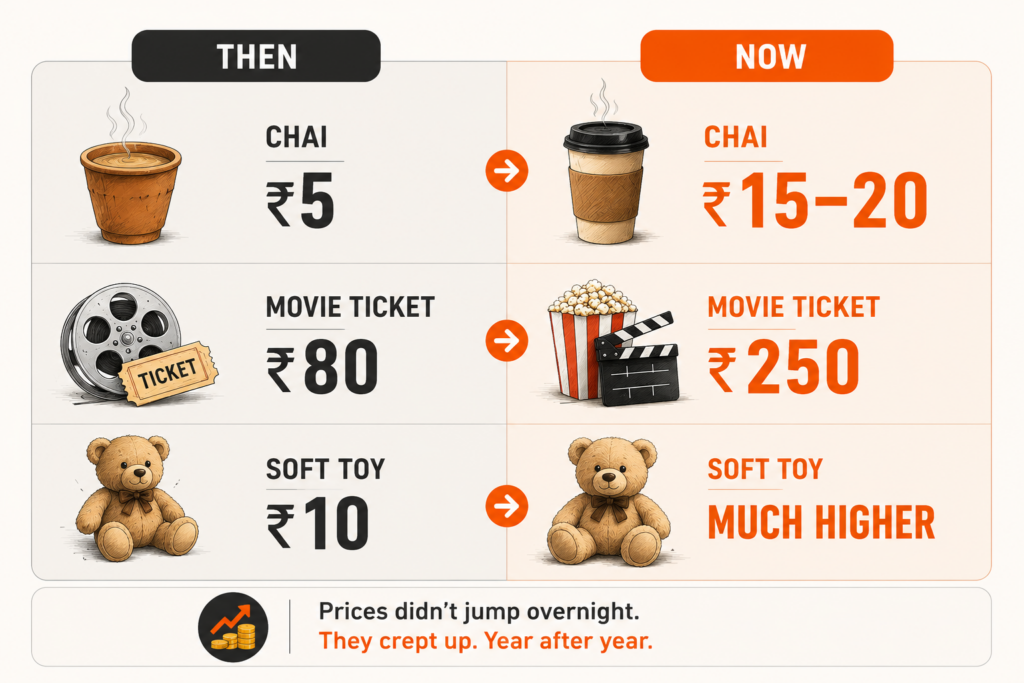
Cut to now. Movie tickets that used to be ₹80 are closer to ₹250. The chai outside my college that was ₹5 is now ₹15, sometimes ₹20 if there’s a “specialty” tag attached. None of these jumps happened in one dramatic year. They crept, the way inflation always does: the rupee, then another, spread out so thin across the years that no single price hike ever felt like a crisis. It’s only when you stack all of it- the toy, the fee, and the coffee- that the pattern becomes impossible to ignore.
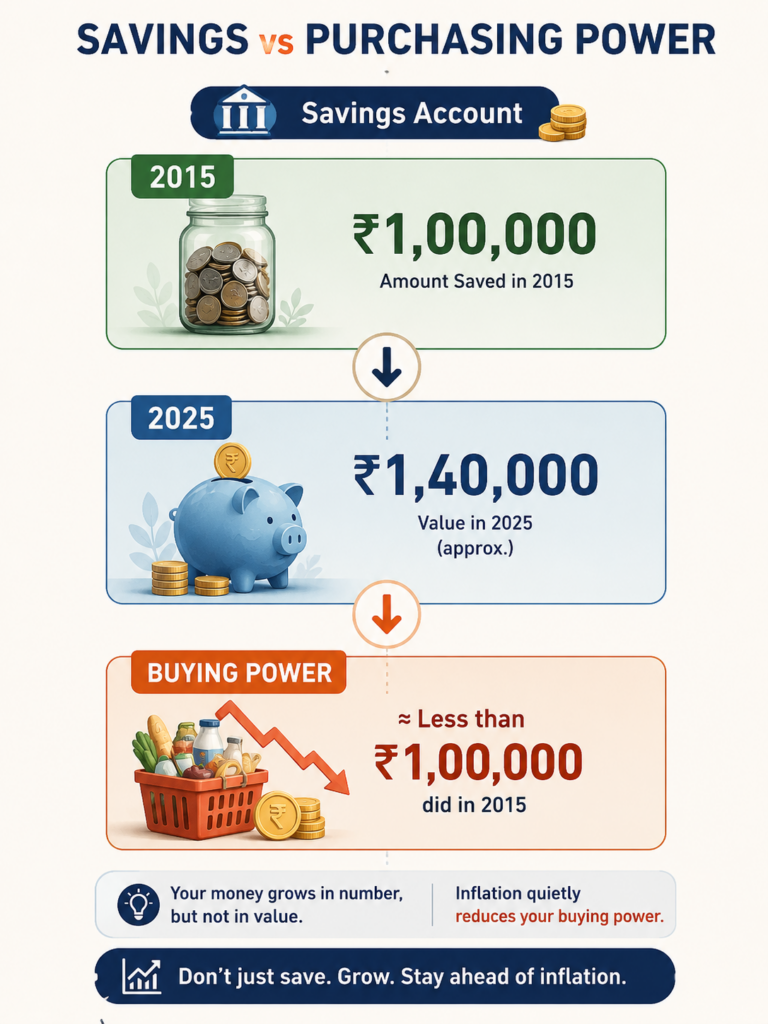
Here’s the number that actually made me sit up: put ₹1 lakh into a savings account in 2015, leave it completely untouched, and by 2025 it’s grown to roughly ₹1.4 lakh. Feels like progress, until you check what ₹1.4 lakh actually buys today compared to what ₹1 lakh bought back then. It buys less. Meaningfully less. That gap between the number growing and your ability to actually buy things staying flat, or shrinking, is the entire story of this blog.
The market was never the mystery. We were just never introduced

Here’s something I wish someone had told twelve-year-old me: the stock market isn’t some cold, distant machine reserved for people in suits. It’s closer to a mela: stalls run for thirty years, others that opened last week, all open to anyone willing to walk in. I didn’t know I was allowed to.
I grew up, like most Indian kids, on one repeated instruction: save, save, save. Nobody ever mentioned investing might matter just as much, sometimes more. Maybe because saving feels safe and investing comes with a disclaimer attached. So “save” won by default every time.
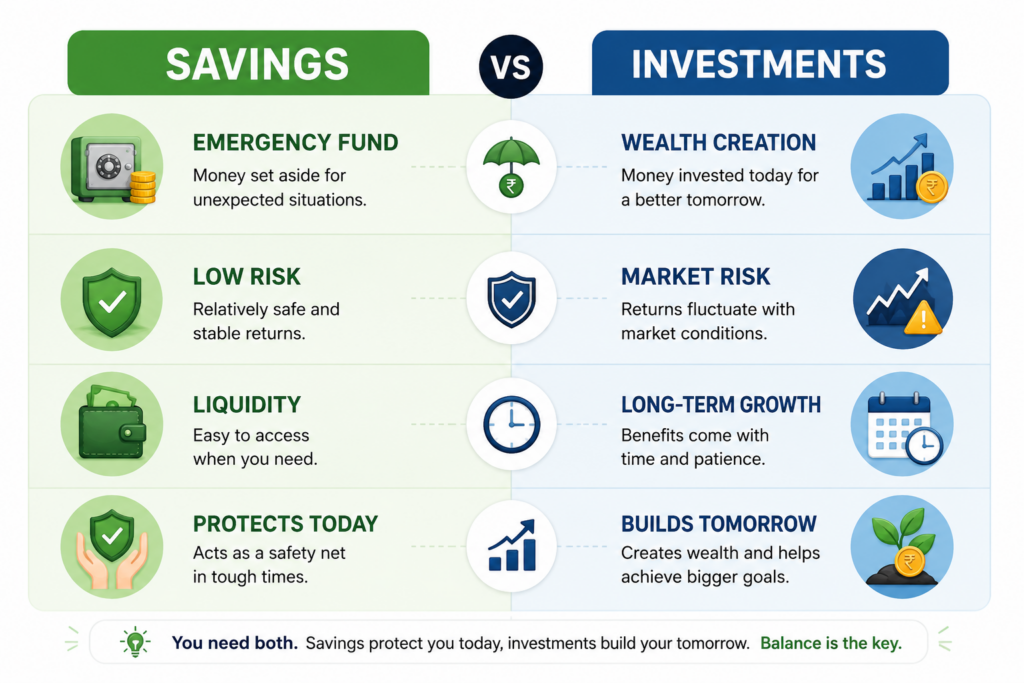
But saving and investing were never actually in competition. It’s not safe to invest. Savings are the net that catches you when something goes wrong, an emergency, a job loss, or a medical bill you didn’t see coming. Investments are what actually build something over time, instead of just sitting there, aging quietly. You need the net. You also need the thing that grows. Picking only one is like buying a phone with no charger; technically it works until it very obviously doesn’t.
What actually counts as “investing” in India today
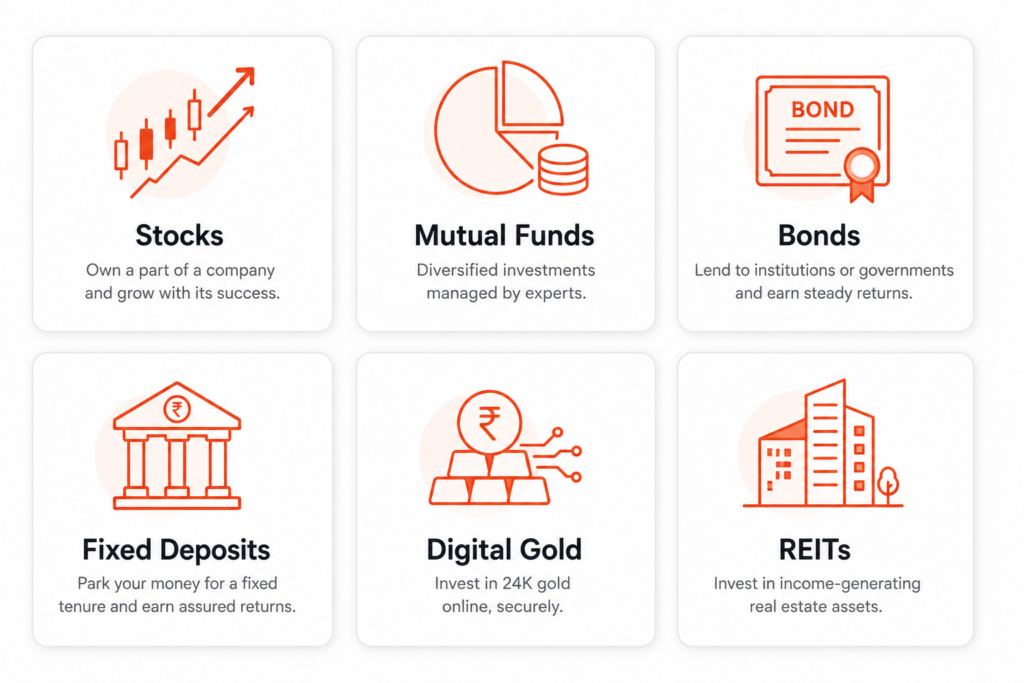
In practical terms, investing means putting money somewhere with a real expectation that it grows, not just parks. In India, that spans equities, mutual funds, bonds, fixed deposits (a step up from a plain savings account), and more recently, digital gold and REITs. Each carries its own risk and return profile, and none is a substitute for the others. The one thing they share: your money is doing something, instead of waiting around.
The part where the fees at the dinner table become national data
By the end of 2025, India crossed 215 million demat accounts: the accounts you need to hold stocks and securities electronically. Back in 2019, that number was just 39.3 million. Six years, more than a fivefold jump.
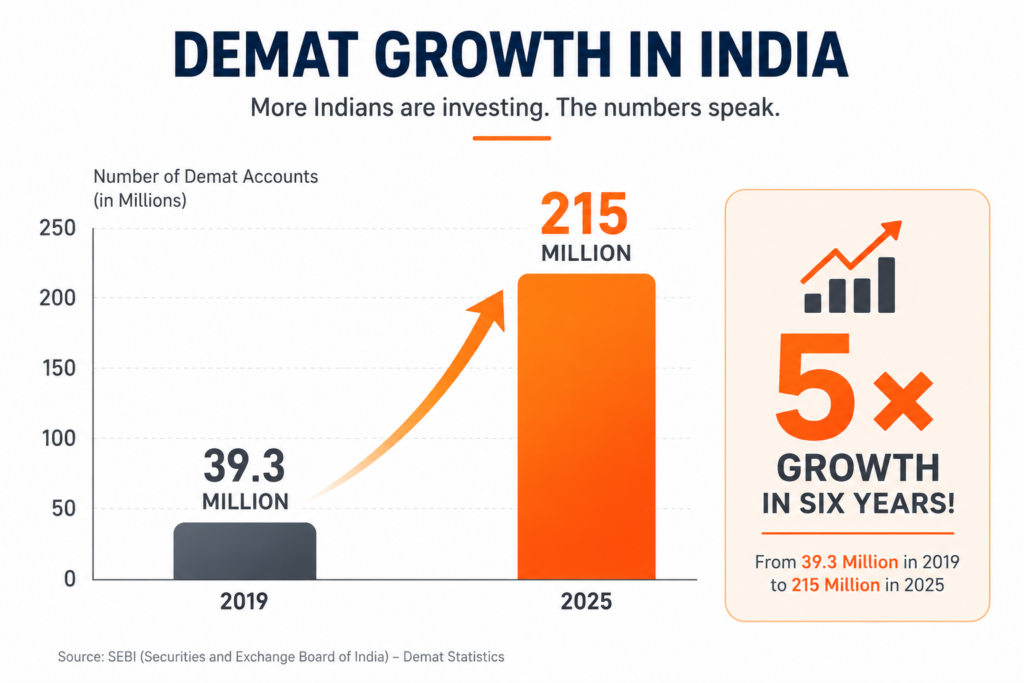
What surprises me is where this growth is coming from. Not Mumbai, not Delhi. It’s Tier II and Tier III towns leading the charge, powered by mobile-first apps and branch-free onboarding. SEBI’s investor education push has helped, and so has the fact that finance content is now some of the most-watched stuff on the same platforms my generation grew up scrolling for entirely different reasons. A conversation that used to belong to a specific class of household is now genuinely everybody’s to walk into.
A framework, not a lecture
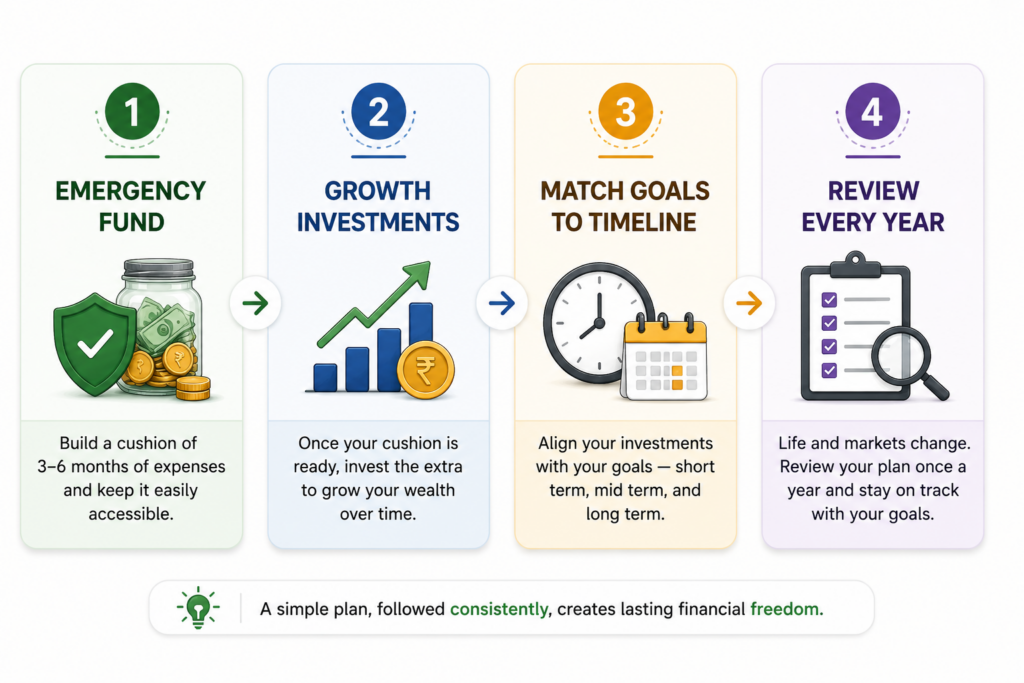
You don’t need a finance degree for any of this. Here’s the rough shape of it:
- Build your cushion first: three to six months of expenses, kept accessible. Not the place to chase returns.
- Everything beyond the cushion is growth money. Idle now becomes the risky choice, not the safe one.
- Match the money to the timeline. Next year’s money and fifteen-years-away money shouldn’t sit in the same basket.
- Check in once a year. Prices move, life moves, and an unreviewed plan quietly stops working.
Where Rmoney fits into my own story
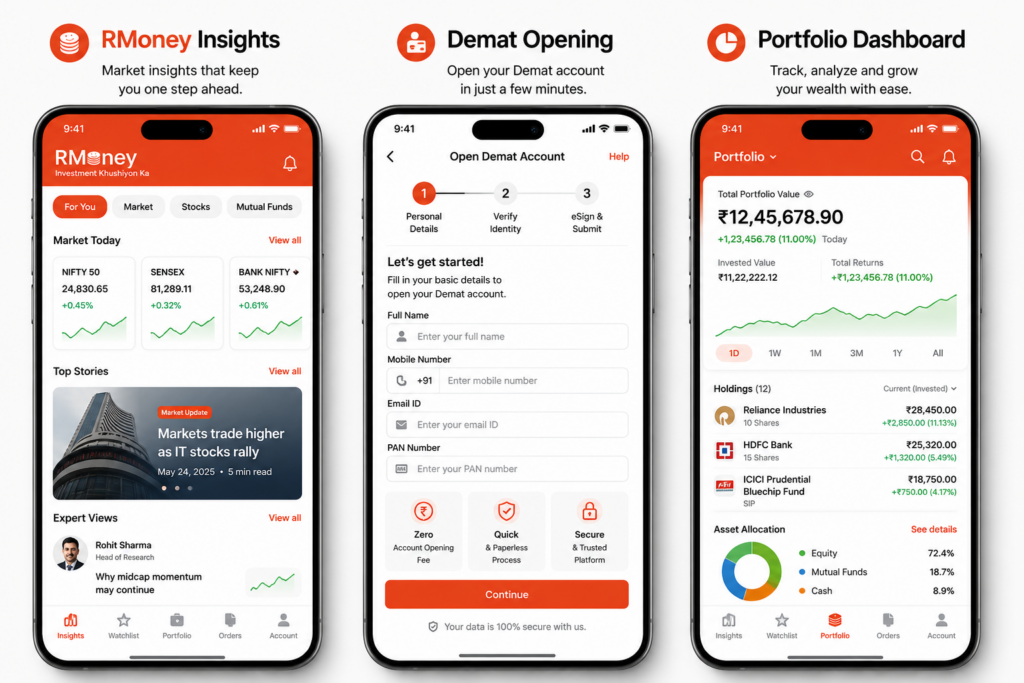
This is exactly the gap Rmoney Insights was built to close: not another lecture on why investing matters, but the actual tools to start doing it inside the same app you’d use to check your first mutual fund or open your first demat account. If a twelve-year-old me had access to something like this, “save, save, save” might have had a second half to that sentence a lot sooner. Explore Rmoney Insights or open a free demat account, and let this be the year the second half of that sentence finally shows up for you too.
Key takeaway

Finance was never meant to be reserved for the financially trained. The tools always existed; what was missing was someone telling us we were allowed to use them. Savings taught me to be careful. Investments are teaching me, slowly, to look ahead instead of just holding on.
The market, like that childhood mela stall, was always open. The only real question was whether anyone bothered to tell you that you could walk in.
Disclaimer: The information provided in this blog is for educational purposes only and should not be considered financial advice or a recommendation to invest. Investing involves risk, including potential loss of principal. Please consult a SEBI-registered investment advisor before making any investment decisions.
Table of content
Categories
Open Demat Account 


Related Posts
-
Support and Resistance Explained: The Basics of Price Action Trading
When you start trading in stocks, foreign exchange, commodities or other markets. You will often...
-

Mastering your mobile trading application – expertise in this digital era!
Mobile trading is made possible in recent years. The advent of technology is making every...
-

Know about full-service brokerage in India
Full-service brokers in India Full-Service Broker refers to stock brokers who offer a large variety...
-

Commodities Market: How are prices determined?
The commodities market is the market that regulates commodity trading in India. Commodities trading, as...





Filing Complaints on SCORES (SEBI) – Easy & Quick
- Register on SCORES Portal (SEBI)
- Mandatory details for filing complaints on SCORES:
- Name, PAN, Address, Mobile Number, E-mail ID
- Benefits:
- Effective Communication
- Speedy redressal of the grieva`nces


IT'S TIME TO HAVE SOME FUN!
Your family deserves this time more than we do.
Share happiness with your family today & come back soon. We will be right here.
Investment to ek bahana hai,
humein to khushiyon ko badhana hai.
E-mail
askus@rmoneyindia.com
Customer Care
+91-9568654321



Trade Endlessly with
RMoney
Deep Discount Brokerage Plan
At 999/Monthly
- Dedicated round the clock Advisory Support
- High performance in depth research
- Save more than ₹10,000 brokerage Per Month
- Ultra fast trading app