 Stock Trading
Now trade in ₹9 Per Order or ₹ 999 Per Month Plans.
 Future & Options
Access F&O contracts with advanced tools for hedging and speculation.
 Currency Trading
Trade in major currency pairs and manage forex exposure efficiently.
 Commodity Trading
Diversify Trading with MCX & NCDEX by Trading in Gold, Silver, Base Metals, Energy, and Agri
Products.
 Margin Trading Funding
Boost your buying power with upto 5X, Buy now Pay Later
 Algo Trading
Back test, Paper Trade your logic & Automate your strategies with low-latency APIs.
 Trading View
Leverage Trading View charts and indicators integrated into your trading platform.
 Advanced Options Trading
Execute multi-leg option strategies with precision and insights.
 Stock Lending & Borrowing
Earn passive income by lending stocks securely through SLB.
 Foreign Portfolio Investment
Enable NRIs and FPIs to invest in Indian markets with ease and compliance.
 IPO
Invest in upcoming IPOs online with real-time tracking and instant allotment updates.
 Direct Mutual Funds
0% Commissions by investing in more than +3500 Direct Mutual Fund Scheme.
 Corporate FDRs
Earn fixed returns with low-risk investments in high-rated corporate fixed deposits.
 Stocks SIPs
Build long-term wealth with systematic investment plans in top-performing stocks.
 Bonds & NCDs
Access secure, fixed-income investments through government and corporate bond offerings.
 Depository Services
Safely hold and manage your securities with seamless Demat and DP services with CDSL.
 RMoney Quick
Fast, hassle-free trading in one tap.
 RMoney Rocket
Power-packed platform for active traders.
 Rocket API
Lightning-fast trading API for developers advanced algo traders.
 XTS Algo
Smart algo trading software for precision trades.
 Journey
Tracing our growth and milestones over time.
 Mission & Vision
Guided by purpose, driven by long-term vision.
 Why RMoney Platform
Smart, reliable platform for all investors' needs.
 Management
Experienced leadership driving strategic financial excellence.
 Credentials
Certified expertise with trusted industry recognition.
 Press Release
Latest company news, updates, and announcements.
 Testimonials
Real client stories sharing their success journeys.
 7 Reasons to Invest
Top benefits that make investing with us smart.
 SEBI Registered Research
Trusted insights backed by SEBI-compliant research.
 Our Technology
Advanced tools enabling efficient online trading.
 Blog
Stay updated with expert insights, market trends, and trading strategies through our
informative blogs.
 Video
Learn visually with easy-to-understand videos covering trading concepts, tips, and market
analysis.
 Podcast
Tune in to insightful discussions and expert opinions anytime, anywhere.
 Telegram Community
Be part of an active trader community sharing ideas, updates, and market opportunities in
real-time.
 WhatsApp Updates
Get instant alerts, key market updates, and important notifications directly on WhatsApp.
 Financial Calculators
Plan your trades, margins, and returns efficiently with our smart calculation tools.
 Marketplace
Discover curated tools, strategies, and services designed to enhance your trading
experience.
 Daily Research Reports
Stay ahead with timely market insights, trends, and actionable analysis delivered every day.
 Dedicated Advisory
Get personalized guidance and expert recommendations tailored to your trading goals.
 Research Team
Backed by experienced analysts delivering data-driven insights and market expertise.
 Research Reports
Access in-depth reports covering stocks, commodities, and market movements to support
informed decisions.
 Feedback
Share your suggestions or concerns to help us improve your experience.
 Downloads
Access important forms, software, and documents in one place.
 Locate Us
Find the nearest RMoney branch or service center quickly.
 Escalation Matrix
Resolve issues faster with our structured support escalation process.
 Back Office
Log in to view trade reports, ledger, and portfolio statements anytime.
 Account Modification
Update personal or bank details linked to your trading account.
 Fund Transfer
Transfer funds instantly online with quick limit updation to your trading account.
 Bank Details
View our registered bank account details for seamless transactions by NEFT, RTGS or IMPS.
 RMoney Rocket Web Version
Experience powerful web-based trading with advanced tools for algo traders.
 Refer & Earn
Invite friends and earn rewards every time they trade with us.



MTM in Futures: How Daily Settlement Hits Your Margin
By: Shailly Saxena | Date : Nov 21, 26

Remember those old electricity meters? A little metal disc spinning behind glass, clicking away on the wall outside your house. It never asked what you planned to do tomorrow. It just logged what you’d used so far and kept the tally running, whether you were watching or not.
Futures work a bit like that. Every day, your position goes through MTM: mark-to-market, which settles that day’s profit or loss. You can hold a position and stay convinced the market will turn your way, but your account still has to cover every loss along the road. Plenty of traders miss this.
If the basics are still fuzzy, start with Futures Trading: The Beginner’s Guide and come back.
What happens to a futures position every day?
Buy a stock, and the price wanders up and down, but the gain or loss stays on paper until you sell. Futures don’t play that way.
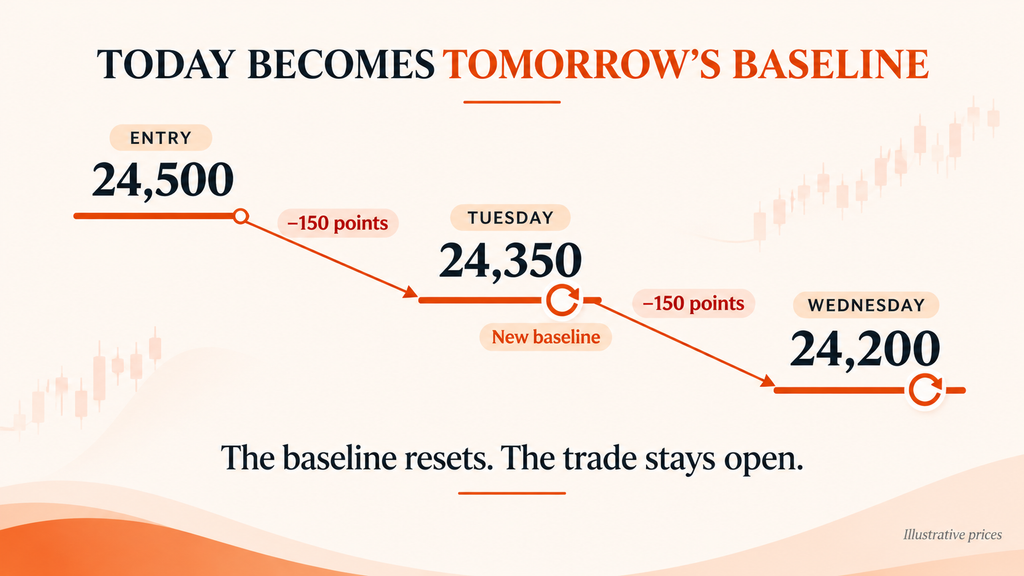
When each trading day ends, NSE marks your open futures position to that contract’s daily settlement price. On day one, your profit or loss is measured from your entry price. After that, it’s measured from the previous day’s settlement price. Move against you, and you’ve got a loss. Move with you, and you’ve got a gain.
Then the position resets to that day’s settlement price, and tomorrow’s MTM (mark-to-market) starts from there. It’s an accounting adjustment, not a fresh trade. Your position stays open, but each day begins from a new baseline.
Here’s the calculation in one line:
MTM = (Today’s settlement − Previous settlement) × Lot size × Lots
One thing worth separating out: MTM is calculated daily, while NSE’s standard equity-derivatives settlement generally runs on T+1, so pay-in and pay-out happen the next working day. Your broker’s margin checks and risk controls may run on a different clock altogether, which means a shortfall can land on you sooner than you’d expect.
That’s why the meter comparison works. The market keeps counting what has already happened, even if you plan to hold on longer.
Why settle daily instead of at expiry?
Picture a trader with a big futures position and a market moving hard against them. If those losses pile up for weeks with no settlement, they might eventually be unable to pay. And that unpaid amount becomes a problem for the whole clearing system.
Daily MTM settlement cuts that risk down by clearing losses as they happen rather than letting them build in the dark.
Margins add another layer. NSE Clearing uses SPAN (Standard Portfolio Analysis of Risk) to work out initial margins, based on a 99% value-at-risk measure. For index and single-stock futures, it assumes a two-day risk horizon, since the daily MTM may not be collected before the next morning’s trading starts. You can read more in NSE Clearing’s margin methodology.
So the money you need to enter a futures trade isn’t always enough to stay in it. Margin helps manage risk. It doesn’t cap your loss.
To see how the margin you put up differs from the position you actually control, read Initial Margin vs. Exposure. And How Leverage Works explains why a small move can hit your account so hard.
A week that shows how it plays out
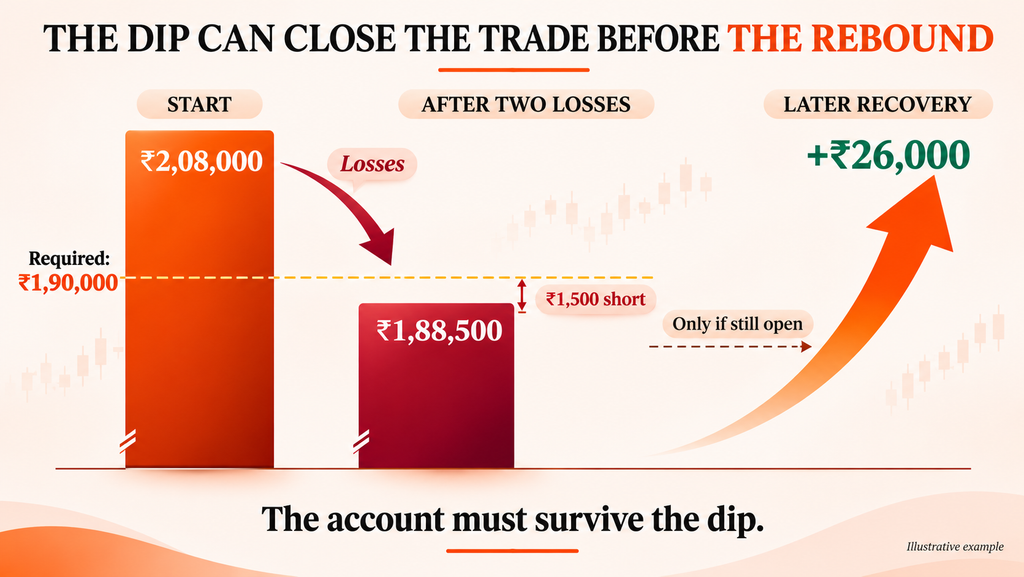
Say you buy one lot of Nifty 50 futures on Monday at 24,500. With the current lot size of 65 units, the contract is worth ₹15,92,500, or roughly ₹15.9 lakh. (That lot size reflects NSE’s December 2025 revision.)
For this example, assume the required margin is ₹1.9 lakh and you’ve got ₹2.08 lakh in eligible funds backing the trade. These are made-up numbers, not a live margin quote. Real requirements shift with market conditions and rules.
Each day’s MTM is the point move × 65, the lot size. Here’s how the week plays out:
| Day | Settlement | Points | MTM | Funds left | Margin status |
| Monday | 24,500 (entry) | – | – | ₹2,08,000 | Above ₹1.9 lakh |
| Tuesday | 24,350 | −150 | −₹9,750 | ₹1,98,250 | Above ₹1.9 lakh |
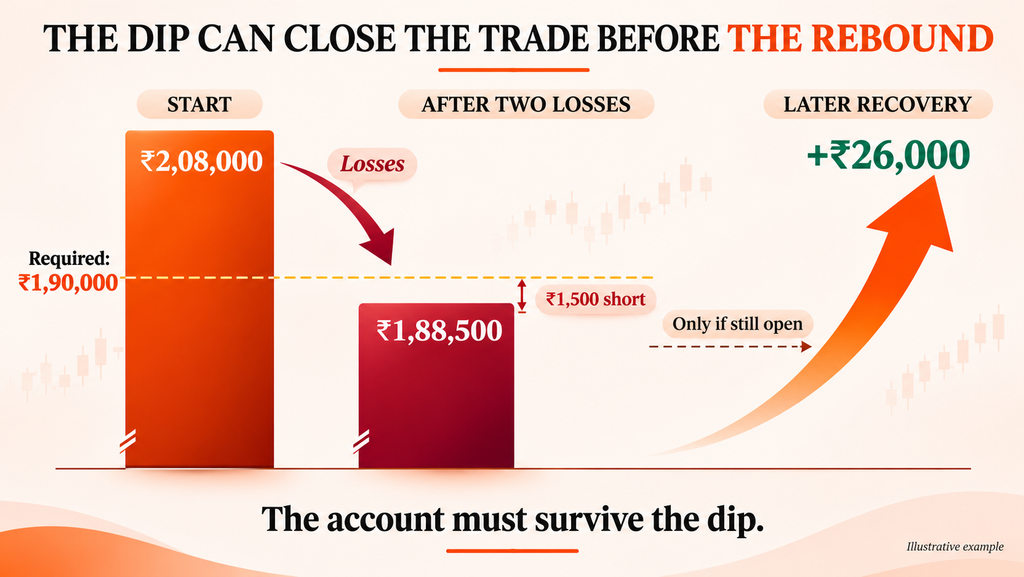
| Wednesday | 24,200 | −150 | −₹9,750 | ₹1,88,500 | ₹1,500 short |
| Thursday | 24,600 | +400 | +₹26,000 | ₹2,14,500 | Above ₹1.9 lakh |
If the margin requirement hasn’t changed, Wednesday leaves you ₹1,500 short. Depending on its policies and your actual position, your broker might send a shortfall alert or step in with risk action. Thursday’s figures assume the position is still open.
Add it up, and the three days are net positive by ₹6,500: two losses of ₹9,750, then a ₹26,000 gain. (Brokerage and other charges aren’t counted here.)
Now the catch. If the shortfall went unaddressed and the position got squared off on Wednesday, you’d never see Thursday’s recovery. A trade that would have ended in profit becomes a realised loss.
Again, it’s a hypothetical, and real margin alerts depend on your broker’s rules and the funds you actually hold. But the point stands. Where the market eventually ends up isn’t the only thing that matters. Your account has to survive the trip.
Why does this catch so many people off guard?
A lot of new futures traders come from stock investing, where day-to-day swings stay unrealised as long as you keep holding. It’s natural to carry that habit over and assume you can just wait out a dip.
But having enough to open a position isn’t the same as having enough to keep it through a rough patch. Even if your view turns out right, a bad move today can eat into the funds that keep your trade alive.
If you’re comparing futures with options, Futures vs. Options lays out the differences.
How should this change your position sizing?
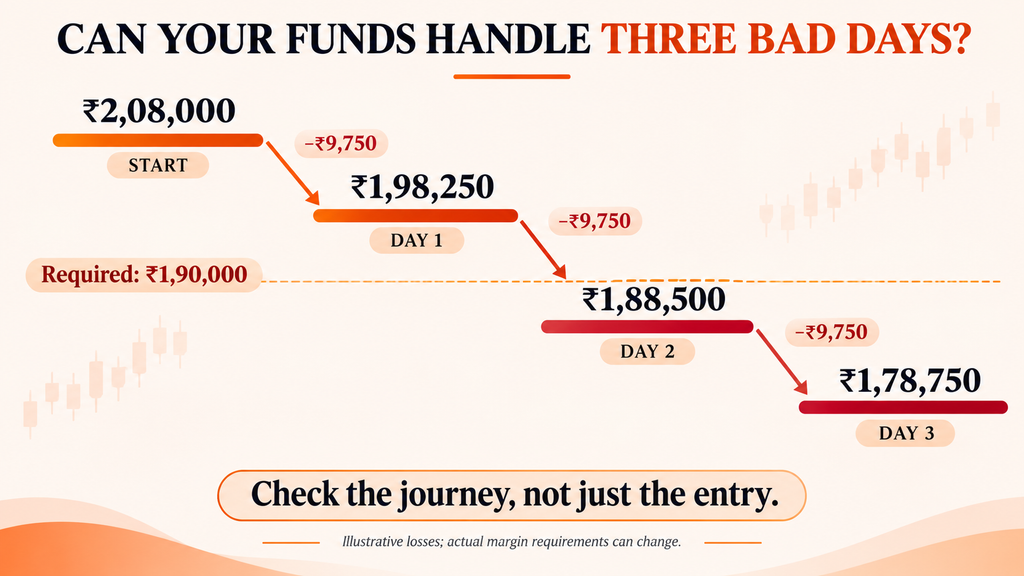
Before you place a trade, don’t stop at “can I cover the initial margin?” Ask whether your account can take a few bad days in a row without dropping below the required level.
In our example, three straight 150-point declines would produce a cumulative MTM loss of ₹29,250. That’s about 14% of the ₹2.08 lakh starting funds, before charges and other adjustments.
Margins also move when volatility does. A reasonable cushion above the minimum, a regular look at your available funds, and a clear understanding of your broker’s square-off policy can all lower the odds of a nasty surprise. They can’t remove the risk entirely.
For a fuller walkthrough on sizing, see Position Sizing and Risk.
Before you place an order, check the current requirement on RMoney’s Equity Futures Margin Calculator. Treat the number as a snapshot, not a promise that it’ll stay put.
Quick answers: margin calls and MTM
What is MTM in futures trading?
It’s how the profit or loss on a futures position is worked out each day using the applicable settlement price. The amount is then settled through the exchange’s process.
Can I face a margin shortfall even if the trade eventually turns profitable?
Yes. A position can move against you first, leaving you short on margin before the market has a chance to recover. Your broker may not keep the position open while you wait for that recovery.
What happens if I don’t cover a shortfall?
That depends on the situation and your broker’s risk policy. You may need to add funds to your account. If you don’t, your broker may reduce your position or close it altogether.
How can I reduce the risk of an unexpected shortfall?
Start by keeping some extra funds available rather than using your entire margin. Check your available balance regularly, and consider what a few bad trading days in a row could mean for the size of your position.
Where does this leave you
That old meter never cared about anyone’s plans. It recorded what happened and kept adding it up. Futures run on a similar rhythm: daily settlement reflects what the market did, not how sure you feel about where it’s headed.
Being right by Friday doesn’t undo a shortfall that hit on Wednesday. If you trade futures, or you’re thinking of starting, understanding MTM and managing margin matter as much as having a view on direction.
For more on trading and risk management, browse the RMoney Resources Hub, and check the current margin requirement before you enter any position.
Ready to trade? Explore RMoney’s futures and options trading page.
Disclaimer: This article is for educational purposes only and isn’t financial advice or a recommendation to invest or trade. Futures trading carries substantial risk, including losses that can exceed the initial margin deposited. Lot sizes, margin requirements, and settlement procedures follow exchange rules and may change. The numerical example is hypothetical, not an actual trade or live margin quote. Please consult a SEBI-registered investment adviser before making trading decisions.
Table of content
Categories
Open Demat Account 




Related Posts
-

Dr. Agarwal’s Health Care Limited IPO (Dr. Agarwal’s Upcoming IPO -2025)
Dr. Agarwal’s IPO is set to raise ₹3,027.26 crores through a book-built issue. This includes...
-

4 NITI Aayog budget 2017 advice to pitch Indian stock market
Indian stock market has the capacity to discount the effect of the budget on them,...
-

हम डीमैट खाता ऑनलाइन क्यों पसंद करते हैं (और आपको चाहिए भी!)
जब भी आप शेयरों में निवेश करने या शेयर बाजार में ट्रेडिंग करने के बारे...
-

नि:शुल्क डीमैट खाता लाभ और कमियां जो आपको जाननी चाहिए
1996 में शुरू किए गए एक डीमैट खाते ने भारतीय शेयर बाजारों के परिदृश्य को...





Filing Complaints on SCORES (SEBI) – Easy & Quick
- Register on SCORES Portal (SEBI)
- Mandatory details for filing complaints on SCORES:
- Name, PAN, Address, Mobile Number, E-mail ID
- Benefits:
- Effective Communication
- Speedy redressal of the grieva`nces


IT'S TIME TO HAVE SOME FUN!
Your family deserves this time more than we do.
Share happiness with your family today & come back soon. We will be right here.
Investment to ek bahana hai,
humein to khushiyon ko badhana hai.
E-mail
askus@rmoneyindia.com
Customer Care
+91-9568654321



Trade Endlessly with
RMoney
Deep Discount Brokerage Plan
At 999/Monthly
- Dedicated round the clock Advisory Support
- High performance in depth research
- Save more than ₹10,000 brokerage Per Month
- Ultra fast trading app