 Stock Trading
Now trade in ₹9 Per Order or ₹ 999 Per Month Plans.
Stock Trading
Now trade in ₹9 Per Order or ₹ 999 Per Month Plans.
 Future & Options
Access F&O contracts with advanced tools for hedging and speculation.
Future & Options
Access F&O contracts with advanced tools for hedging and speculation.
 Currency Trading
Trade in major currency pairs and manage forex exposure efficiently.
Currency Trading
Trade in major currency pairs and manage forex exposure efficiently.
 Commodity Trading
Diversify Trading with MCX & NCDEX by Trading in Gold, Silver, Base Metals, Energy, and Agri Products.
Commodity Trading
Diversify Trading with MCX & NCDEX by Trading in Gold, Silver, Base Metals, Energy, and Agri Products.
 Margin Trading Funding
Boost your buying power with upto 5X, Buy now Pay Later
Margin Trading Funding
Boost your buying power with upto 5X, Buy now Pay Later
 Algo Trading
Back test, Paper Trade your logic & Automate your strategies with low-latency APIs.
Algo Trading
Back test, Paper Trade your logic & Automate your strategies with low-latency APIs.
 Trading View
Leverage Trading View charts and indicators integrated into your trading platform.
Trading View
Leverage Trading View charts and indicators integrated into your trading platform.
 Advanced Options Trading
Execute multi-leg option strategies with precision and insights.
Advanced Options Trading
Execute multi-leg option strategies with precision and insights.
 Stock Lending & Borrowing
Earn passive income by lending stocks securely through SLB.
Stock Lending & Borrowing
Earn passive income by lending stocks securely through SLB.
 Foreign Portfolio Investment
Enable NRIs and FPIs to invest in Indian markets with ease and compliance.
Foreign Portfolio Investment
Enable NRIs and FPIs to invest in Indian markets with ease and compliance.
 IPO
Invest in upcoming IPOs online with real-time tracking and instant allotment updates.
IPO
Invest in upcoming IPOs online with real-time tracking and instant allotment updates.
 Direct Mutual Funds
0% Commissions by investing in more than +3500 Direct Mutual Fund Scheme.
Direct Mutual Funds
0% Commissions by investing in more than +3500 Direct Mutual Fund Scheme.
 Corporate FDRs
Earn fixed returns with low-risk investments in high-rated corporate fixed deposits.
Corporate FDRs
Earn fixed returns with low-risk investments in high-rated corporate fixed deposits.
 Stocks SIPs
Build long-term wealth with systematic investment plans in top-performing stocks.
Stocks SIPs
Build long-term wealth with systematic investment plans in top-performing stocks.
 Bonds & NCDs
Access secure, fixed-income investments through government and corporate bond offerings.
Bonds & NCDs
Access secure, fixed-income investments through government and corporate bond offerings.
 Depository Services
Safely hold and manage your securities with seamless Demat and DP services with CDSL.
Depository Services
Safely hold and manage your securities with seamless Demat and DP services with CDSL.
 RMoney Quick
Fast, hassle-free trading in one tap.
RMoney Quick
Fast, hassle-free trading in one tap.
 RMoney Rocket
Power-packed platform for active traders.
RMoney Rocket
Power-packed platform for active traders.
 Rocket API
Lightning-fast trading API for developers advanced algo traders.
Rocket API
Lightning-fast trading API for developers advanced algo traders.
 XTS Algo
Smart algo trading software for precision trades.
XTS Algo
Smart algo trading software for precision trades.
 Journey
Tracing our growth and milestones over time.
Journey
Tracing our growth and milestones over time.
 Mission & Vision
Guided by purpose, driven by long-term vision.
Mission & Vision
Guided by purpose, driven by long-term vision.
 Why RMoney Platform
Smart, reliable platform for all investors' needs.
Why RMoney Platform
Smart, reliable platform for all investors' needs.
 Management
Experienced leadership driving strategic financial excellence.
Management
Experienced leadership driving strategic financial excellence.
 Credentials
Certified expertise with trusted industry recognition.
Credentials
Certified expertise with trusted industry recognition.
 Press Release
Latest company news, updates, and announcements.
Press Release
Latest company news, updates, and announcements.
 Testimonials
Real client stories sharing their success journeys.
Testimonials
Real client stories sharing their success journeys.
 7 Reasons to Invest
Top benefits that make investing with us smart.
7 Reasons to Invest
Top benefits that make investing with us smart.
 SEBI Registered Research
Trusted insights backed by SEBI-compliant research.
SEBI Registered Research
Trusted insights backed by SEBI-compliant research.
 Our Technology
Advanced tools enabling efficient online trading.
Our Technology
Advanced tools enabling efficient online trading.
 Blog
Stay updated with expert insights, market trends, and trading strategies through our informative blogs.
Blog
Stay updated with expert insights, market trends, and trading strategies through our informative blogs.
 Video
Learn visually with easy-to-understand videos covering trading concepts, tips, and market analysis.
Video
Learn visually with easy-to-understand videos covering trading concepts, tips, and market analysis.
 Podcast
Tune in to insightful discussions and expert opinions anytime, anywhere.
Podcast
Tune in to insightful discussions and expert opinions anytime, anywhere.
 Telegram Community
Be part of an active trader community sharing ideas, updates, and market opportunities in real-time.
Telegram Community
Be part of an active trader community sharing ideas, updates, and market opportunities in real-time.
 WhatsApp Updates
Get instant alerts, key market updates, and important notifications directly on WhatsApp.
WhatsApp Updates
Get instant alerts, key market updates, and important notifications directly on WhatsApp.
 Financial Calculators
Plan your trades, margins, and returns efficiently with our smart calculation tools.
Financial Calculators
Plan your trades, margins, and returns efficiently with our smart calculation tools.
 Marketplace
Discover curated tools, strategies, and services designed to enhance your trading experience.
Marketplace
Discover curated tools, strategies, and services designed to enhance your trading experience.
 Daily Research Reports
Stay ahead with timely market insights, trends, and actionable analysis delivered every day.
Daily Research Reports
Stay ahead with timely market insights, trends, and actionable analysis delivered every day.
 Dedicated Advisory
Get personalized guidance and expert recommendations tailored to your trading goals.
Dedicated Advisory
Get personalized guidance and expert recommendations tailored to your trading goals.
 Research Team
Backed by experienced analysts delivering data-driven insights and market expertise.
Research Team
Backed by experienced analysts delivering data-driven insights and market expertise.
 Research Reports
Access in-depth reports covering stocks, commodities, and market movements to support informed decisions.
Research Reports
Access in-depth reports covering stocks, commodities, and market movements to support informed decisions.
 Feedback
Share your suggestions or concerns to help us improve your experience.
Feedback
Share your suggestions or concerns to help us improve your experience.
 Downloads
Access important forms, software, and documents in one place.
Downloads
Access important forms, software, and documents in one place.
 Locate Us
Find the nearest RMoney branch or service center quickly.
Locate Us
Find the nearest RMoney branch or service center quickly.
 Escalation Matrix
Resolve issues faster with our structured support escalation process.
Escalation Matrix
Resolve issues faster with our structured support escalation process.
 Back Office
Log in to view trade reports, ledger, and portfolio statements anytime.
Back Office
Log in to view trade reports, ledger, and portfolio statements anytime.
 Account Modification
Update personal or bank details linked to your trading account.
Account Modification
Update personal or bank details linked to your trading account.
 Fund Transfer
Transfer funds instantly online with quick limit updation to your trading account.
Fund Transfer
Transfer funds instantly online with quick limit updation to your trading account.
 Bank Details
View our registered bank account details for seamless transactions by NEFT, RTGS or IMPS.
Bank Details
View our registered bank account details for seamless transactions by NEFT, RTGS or IMPS.
 RMoney Rocket Web Version
Experience powerful web-based trading with advanced tools for algo traders.
RMoney Rocket Web Version
Experience powerful web-based trading with advanced tools for algo traders.
 Refer & Earn
Invite friends and earn rewards every time they trade with us.
Refer & Earn
Invite friends and earn rewards every time they trade with us.



Chanakya Was Trading F&O Before Chicago Existed
By: Shailly Saxena | Date : Aug 5, 26
Long before anyone called it a derivative, Indian merchants were locking in prices and betting on them rising or falling. Turns out we didn’t need to import this instinct: we just stopped teaching it.

As we all know, personal decisions have shaped our futures and led us to several options. We, as human beings, barely live in the present. We hover around our past or continuously try to hop onto our future. But besides philosophy, we all know the future is meant to be secured, not only for us but also for our people.
Similarly, finance works the same way. We have all lived through the terms but were never introduced to them.
We have all made decisions about the future. Some cautious, some bold, and most of them driven by one simple desire: to reduce uncertainty. You book a hotel room months in advance because you do not want to pay more closer to the date. You lock in a school admission for your child before the fees are revised. You prepay for a service today because you suspect it will cost more tomorrow.
You were not thinking about finance when you made those decisions. But finance was thinking about you.
Markets took a practical approach to human nature.
They built instruments around our instinct to secure the future before it arrives. Those instruments are called Futures and Options.
It Did Not Begin in Chicago. It Began Much Earlier.

Standard textbooks teach that modern derivatives began at the Chicago Board of Trade in 1848, where American farmers locked in grain prices before harvest to protect against price swings. That is accurate, but it is an incomplete picture.
Chanakya’s Arthashastra, written centuries before Chicago existed, documented forward pricing in agricultural trade across Indian markets. Long before electronic terminals, Indian merchants operated a sophisticated native derivatives network called the Teji-Mandi system. Teji meant a bet on rising prices. Mandi meant a bet on falling prices. Traders in the Fatka markets of Bombay were effectively trading options without calling them that.
F&O was never a Western import into India. The psychology behind it has been in the Indian merchant DNA for generations. We simply stopped teaching it.
The Problem With What People Know Today
Awareness around F&O has grown, but half-baked knowledge is often worse than none. Discount brokers and social media influencers made it feel accessible, maybe too accessible. Knowing the terms isn’t the same as understanding the instrument; that’s the exact gap Rmoney is built to close before you place a trade, not after.”
A recent SEBI report found nearly 91% of F&O traders in India end up in losses, with the average trader losing over Rs. 1.1 lakh. That’s 9 out of 10 people losing real money, mostly because they walked in with a surface-level understanding and no real guidance.
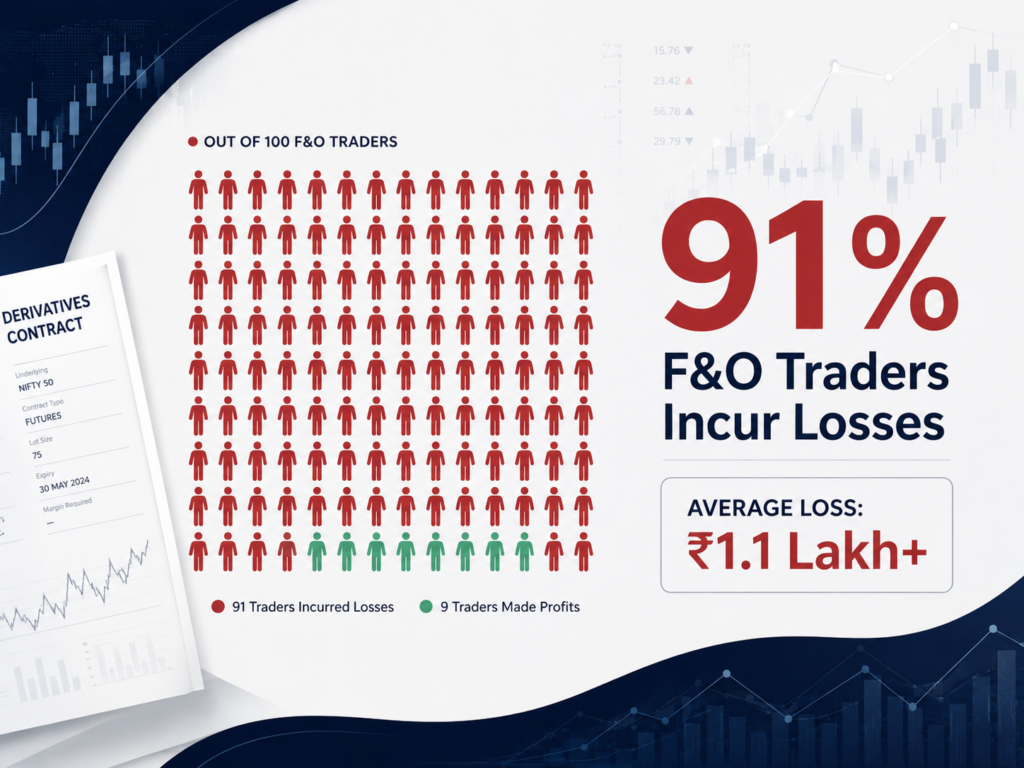
F&O isn’t a shortcut to wealth. Used well, it’s a powerful risk management tool. Used carelessly, it’s expensive. At Rmoney, we’ve watched this pattern for years, and the barrier is rarely capability; it’s familiarity. Most people who lose aren’t unintelligent; they’re simply unintroduced. That changes here.
What Are Futures?
A Future is a contract to buy or sell an asset at a fixed price on a future date. Both sides are obligated to honour it, no matter where the market moves.
Say you run a namkeen business in Indore. Edible oil, your key raw material, costs Rs. 120 a litre today, and you’re worried it’ll touch Rs. 140 by the time your next big order comes in three months. So you lock in a futures contract today at Rs. 120. If the price rises to Rs. 140, you’ve saved Rs. 20 a litre. If it falls to Rs. 100 instead, you still pay Rs. 120, an opportunity cost, but your business stays protected either way.
This is what airlines do with jet fuel, what jewellers do with gold, and what exporters do with currency. Futures aren’t speculation; they’re certainty bought in advance.
In the stock market, futures trade on indices like Nifty 50 and Sensex and on individual stocks in fixed lots, expiring monthly, needing only a margin deposit rather than the full contract value.
What Are Options?

An Option gives the buyer the right, not the obligation, to buy or sell an asset at a set price before a specific date. That one word, right instead of obligation, is what makes options fundamentally different from futures.
A Call is the right to buy, bought when you expect prices to rise. A Put is the right to sell, bought when you expect them to fall.
Say you’re eyeing a flat in Pune worth Rs. 80 lakh. You think the area will develop and prices will climb, but you’re not ready to commit the full amount yet. So you pay the builder Rs. 2 lakh to reserve it at Rs. 80 lakh for six months. If prices rise to Rs. 95 lakh, you exercise your right and buy at Rs. 80 lakh, saving Rs. 15 lakh. If prices fall, or you change your mind, you walk away, losing only the Rs. 2 lakh.
That Rs. 2 lakh is the premium. Rs. 80 lakh is the strike price. Six months is the expiry. You’ve just understood the core mechanics of an options contract.
Key Terms, Simply Put
Premium: What you pay for an option and the most you can lose as a buyer. Strike Price: the price at which you can buy or sell. Expiry Date: When the contract ends, usually the last Thursday of the month, with weekly expiries on indices. In the Money (ITM): exercising would be profitable right now. Out of the Money (OTM): It wouldn’t be, so it’s cheaper but riskier. Open Interest: total outstanding contracts, and rising open interest with a rising price usually signals a strong trend.
The Greeks: Your Risk Dashboard
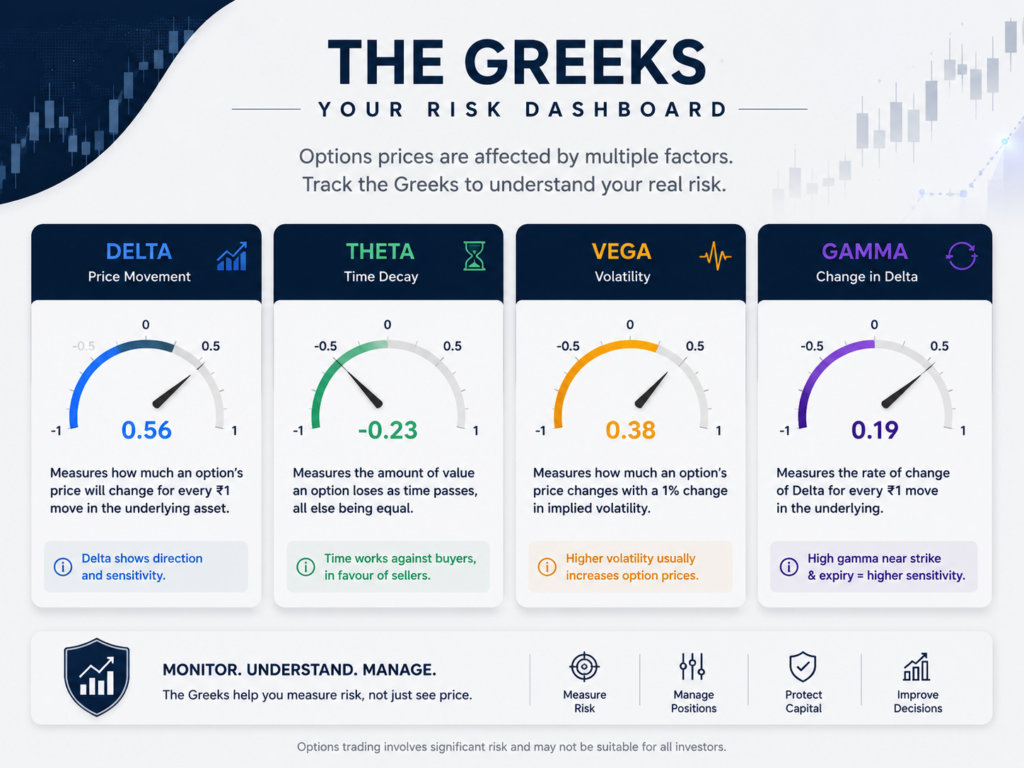
Option prices move for reasons beyond the underlying asset, and those reasons are the Greeks.
Delta shows how much an option’s price moves for every Rs. 1 move in the underlying. A delta of 0.5 means 50 paise gained for every rupee the stock rises.
Theta is time decay, quietly working against buyers and for sellers every day the market doesn’t move in the buyer’s favour.
Vega measures sensitivity to volatility. Events like budget announcements or RBI policy decisions spike volatility, and premiums along with it.
Gamma tracks how fast Delta itself changes and matters most near the strike price close to expiry.
None of this is optional if you’re serious about F&O. It’s the difference between knowing what you hold and knowing why it’s moving.
Buyer vs. Seller: Two Very Different Games
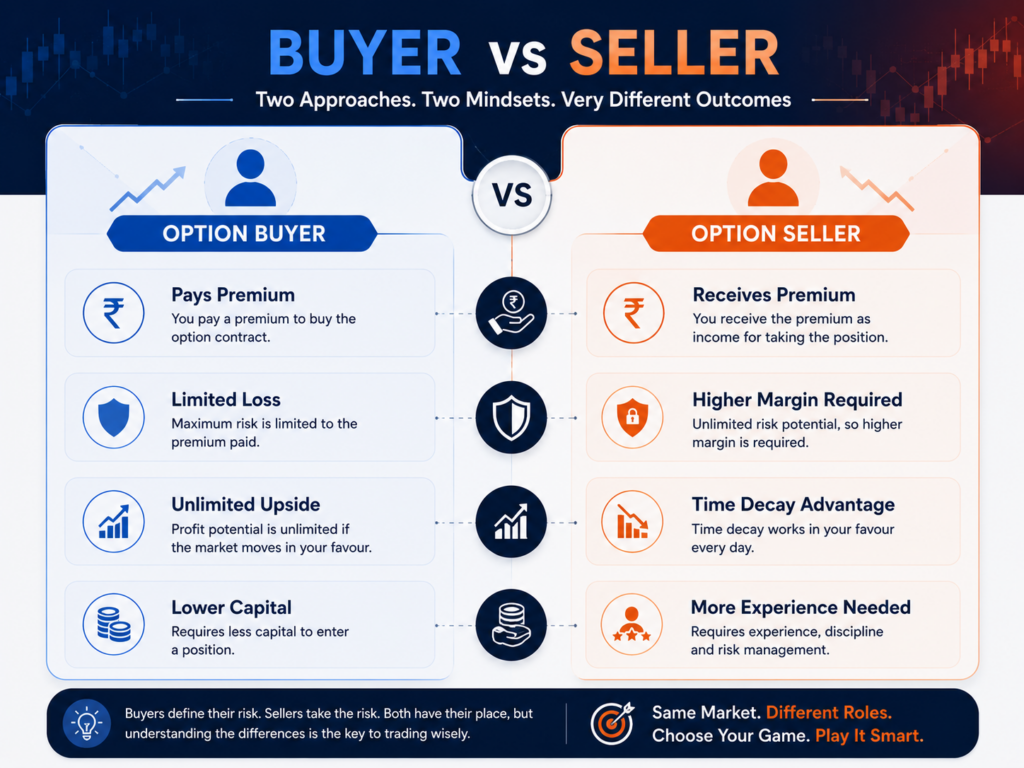
Most beginners start as buyers since the entry cost is low: pay the premium, take the position, and hope the market cooperates. Limited loss, unlimited gain: sounds good on paper.
But sellers, the ones collecting the premium and taking on the obligation, tend to have the edge over time, since time decay works for them on every day the market doesn’t move sharply against them. Selling needs more margin and tighter risk management, so it isn’t for beginners, but understanding it changes how you see the entire market.
Where This Actually Leads
Knowing the history and the mechanics gets you to the starting line. The actual gap: the one that swallows 91% of traders, usually opens up later. Once you’re past strike prices and expiries and into questions like who’s actually on the other side of your trade or why a seller’s incentives look nothing like yours. That’s a different conversation. We’ve gone deeper into the different participants in the derivatives market here, and honestly, it’s worth reading before your first trade, not after it goes wrong.
This is the actual reason this piece exists, not an afterthought bolted on at the end. Understanding a Greek or a strike price shouldn’t remain theoretical. Start exploring F&O tools on Rmoney →, and put what you just read to use: one trade, actually informed this time. https://rmoneyindia.com/
Disclaimer: The information provided in this blog is for educational purposes only and should not be considered financial advice or a recommendation to invest. Investing involves risk, including potential loss of principal. Please consult a SEBI-registered investment advisor before making any investment decisions.
Table of content
Categories
Open Demat Account 

Related Posts
-
The Ultimate Cheat Sheet on Learning Stock Trading
Most of us are reluctant to start trading mainly because we lack a proper understanding...
-
Option Trading: It’s Not As Difficult As You Think
An option trading is something that the new investors usually don’t take up as it...
-

Cyrus & crisis – are they synonymous for Tata Motors Ltd?
Tata Motors Ltd (TML) was in limelight along with other Tata group companies since 24...
-

2 Wise Investment Options for Tax Saving
Gosh!!! It’s March again. Scary huh. Scary? Buy Why? What so new in the month...





Filing Complaints on SCORES (SEBI) – Easy & Quick
- Register on SCORES Portal (SEBI)
- Mandatory details for filing complaints on SCORES:
- Name, PAN, Address, Mobile Number, E-mail ID
- Benefits:
- Effective Communication
- Speedy redressal of the grieva`nces


IT'S TIME TO HAVE SOME FUN!
Your family deserves this time more than we do.
Share happiness with your family today & come back soon. We will be right here.
Investment to ek bahana hai,
humein to khushiyon ko badhana hai.
E-mail
askus@rmoneyindia.com
Customer Care
+91-9568654321



Trade Endlessly with
RMoney
Deep Discount Brokerage Plan
At 999/Monthly
- Dedicated round the clock Advisory Support
- High performance in depth research
- Save more than ₹10,000 brokerage Per Month
- Ultra fast trading app