 Stock Trading
Now trade in ₹9 Per Order or ₹ 999 Per Month Plans.
Stock Trading
Now trade in ₹9 Per Order or ₹ 999 Per Month Plans.
 Future & Options
Access F&O contracts with advanced tools for hedging and speculation.
Future & Options
Access F&O contracts with advanced tools for hedging and speculation.
 Currency Trading
Trade in major currency pairs and manage forex exposure efficiently.
Currency Trading
Trade in major currency pairs and manage forex exposure efficiently.
 Commodity Trading
Diversify Trading with MCX & NCDEX by Trading in Gold, Silver, Base Metals, Energy, and Agri Products.
Commodity Trading
Diversify Trading with MCX & NCDEX by Trading in Gold, Silver, Base Metals, Energy, and Agri Products.
 Margin Trading Funding
Boost your buying power with upto 5X, Buy now Pay Later
Margin Trading Funding
Boost your buying power with upto 5X, Buy now Pay Later
 Algo Trading
Back test, Paper Trade your logic & Automate your strategies with low-latency APIs.
Algo Trading
Back test, Paper Trade your logic & Automate your strategies with low-latency APIs.
 Trading View
Leverage Trading View charts and indicators integrated into your trading platform.
Trading View
Leverage Trading View charts and indicators integrated into your trading platform.
 Advanced Options Trading
Execute multi-leg option strategies with precision and insights.
Advanced Options Trading
Execute multi-leg option strategies with precision and insights.
 Stock Lending & Borrowing
Earn passive income by lending stocks securely through SLB.
Stock Lending & Borrowing
Earn passive income by lending stocks securely through SLB.
 Foreign Portfolio Investment
Enable NRIs and FPIs to invest in Indian markets with ease and compliance.
Foreign Portfolio Investment
Enable NRIs and FPIs to invest in Indian markets with ease and compliance.
 IPO
Invest in upcoming IPOs online with real-time tracking and instant allotment updates.
IPO
Invest in upcoming IPOs online with real-time tracking and instant allotment updates.
 Direct Mutual Funds
0% Commissions by investing in more than +3500 Direct Mutual Fund Scheme.
Direct Mutual Funds
0% Commissions by investing in more than +3500 Direct Mutual Fund Scheme.
 Corporate FDRs
Earn fixed returns with low-risk investments in high-rated corporate fixed deposits.
Corporate FDRs
Earn fixed returns with low-risk investments in high-rated corporate fixed deposits.
 Stocks SIPs
Build long-term wealth with systematic investment plans in top-performing stocks.
Stocks SIPs
Build long-term wealth with systematic investment plans in top-performing stocks.
 Bonds & NCDs
Access secure, fixed-income investments through government and corporate bond offerings.
Bonds & NCDs
Access secure, fixed-income investments through government and corporate bond offerings.
 Depository Services
Safely hold and manage your securities with seamless Demat and DP services with CDSL.
Depository Services
Safely hold and manage your securities with seamless Demat and DP services with CDSL.
 RMoney Quick
Fast, hassle-free trading in one tap.
RMoney Quick
Fast, hassle-free trading in one tap.
 RMoney Rocket
Power-packed platform for active traders.
RMoney Rocket
Power-packed platform for active traders.
 Rocket API
Lightning-fast trading API for developers advanced algo traders.
Rocket API
Lightning-fast trading API for developers advanced algo traders.
 XTS Algo
Smart algo trading software for precision trades.
XTS Algo
Smart algo trading software for precision trades.
 Journey
Tracing our growth and milestones over time.
Journey
Tracing our growth and milestones over time.
 Mission & Vision
Guided by purpose, driven by long-term vision.
Mission & Vision
Guided by purpose, driven by long-term vision.
 Why RMoney Platform
Smart, reliable platform for all investors' needs.
Why RMoney Platform
Smart, reliable platform for all investors' needs.
 Management
Experienced leadership driving strategic financial excellence.
Management
Experienced leadership driving strategic financial excellence.
 Credentials
Certified expertise with trusted industry recognition.
Credentials
Certified expertise with trusted industry recognition.
 Press Release
Latest company news, updates, and announcements.
Press Release
Latest company news, updates, and announcements.
 Testimonials
Real client stories sharing their success journeys.
Testimonials
Real client stories sharing their success journeys.
 7 Reasons to Invest
Top benefits that make investing with us smart.
7 Reasons to Invest
Top benefits that make investing with us smart.
 SEBI Registered Research
Trusted insights backed by SEBI-compliant research.
SEBI Registered Research
Trusted insights backed by SEBI-compliant research.
 Our Technology
Advanced tools enabling efficient online trading.
Our Technology
Advanced tools enabling efficient online trading.
 Blog
Stay updated with expert insights, market trends, and trading strategies through our informative blogs.
Blog
Stay updated with expert insights, market trends, and trading strategies through our informative blogs.
 Video
Learn visually with easy-to-understand videos covering trading concepts, tips, and market analysis.
Video
Learn visually with easy-to-understand videos covering trading concepts, tips, and market analysis.
 Podcast
Tune in to insightful discussions and expert opinions anytime, anywhere.
Podcast
Tune in to insightful discussions and expert opinions anytime, anywhere.
 Telegram Community
Be part of an active trader community sharing ideas, updates, and market opportunities in real-time.
Telegram Community
Be part of an active trader community sharing ideas, updates, and market opportunities in real-time.
 WhatsApp Updates
Get instant alerts, key market updates, and important notifications directly on WhatsApp.
WhatsApp Updates
Get instant alerts, key market updates, and important notifications directly on WhatsApp.
 Financial Calculators
Plan your trades, margins, and returns efficiently with our smart calculation tools.
Financial Calculators
Plan your trades, margins, and returns efficiently with our smart calculation tools.
 Marketplace
Discover curated tools, strategies, and services designed to enhance your trading experience.
Marketplace
Discover curated tools, strategies, and services designed to enhance your trading experience.
 Daily Research Reports
Stay ahead with timely market insights, trends, and actionable analysis delivered every day.
Daily Research Reports
Stay ahead with timely market insights, trends, and actionable analysis delivered every day.
 Dedicated Advisory
Get personalized guidance and expert recommendations tailored to your trading goals.
Dedicated Advisory
Get personalized guidance and expert recommendations tailored to your trading goals.
 Research Team
Backed by experienced analysts delivering data-driven insights and market expertise.
Research Team
Backed by experienced analysts delivering data-driven insights and market expertise.
 Research Reports
Access in-depth reports covering stocks, commodities, and market movements to support informed decisions.
Research Reports
Access in-depth reports covering stocks, commodities, and market movements to support informed decisions.
 Feedback
Share your suggestions or concerns to help us improve your experience.
Feedback
Share your suggestions or concerns to help us improve your experience.
 Downloads
Access important forms, software, and documents in one place.
Downloads
Access important forms, software, and documents in one place.
 Locate Us
Find the nearest RMoney branch or service center quickly.
Locate Us
Find the nearest RMoney branch or service center quickly.
 Escalation Matrix
Resolve issues faster with our structured support escalation process.
Escalation Matrix
Resolve issues faster with our structured support escalation process.
 Back Office
Log in to view trade reports, ledger, and portfolio statements anytime.
Back Office
Log in to view trade reports, ledger, and portfolio statements anytime.
 Account Modification
Update personal or bank details linked to your trading account.
Account Modification
Update personal or bank details linked to your trading account.
 Fund Transfer
Transfer funds instantly online with quick limit updation to your trading account.
Fund Transfer
Transfer funds instantly online with quick limit updation to your trading account.
 Bank Details
View our registered bank account details for seamless transactions by NEFT, RTGS or IMPS.
Bank Details
View our registered bank account details for seamless transactions by NEFT, RTGS or IMPS.
 RMoney Rocket Web Version
Experience powerful web-based trading with advanced tools for algo traders.
RMoney Rocket Web Version
Experience powerful web-based trading with advanced tools for algo traders.
 Refer & Earn
Invite friends and earn rewards every time they trade with us.
Refer & Earn
Invite friends and earn rewards every time they trade with us.



What to do if your Mutual Fund portfolio has massive overlaps
By: Shailly Saxena | Date : Sep 29, 26
Turns out five funds can be one fund wearing five names. Here’s the check that actually catches it and why it only shows up in a crash.

I once went through my kitchen pantry expecting variety and found something else instead. Five different packets of chips, five different brands printed on the front, and five different flavors claimed on the label. Then I flipped them over. Same manufacturer. Same oil. Same base ingredients, just repackaged with a different name and a different mascot on the front.
It looked like a shelf full of choices. It was actually one product wearing five costumes.
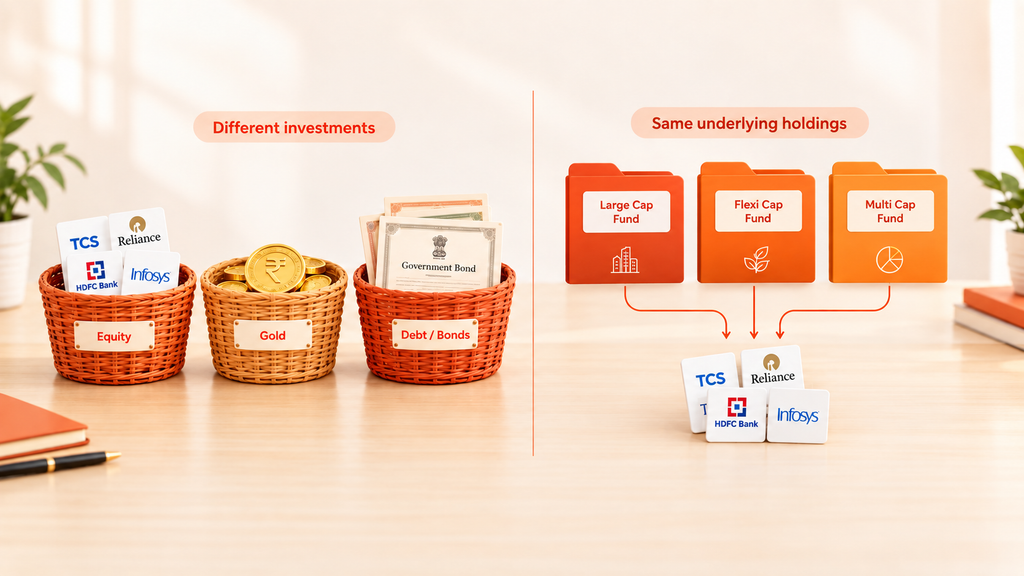
I think about that pantry a lot now, because the exact same thing happens with mutual fund portfolios, and it’s far easier to miss there than it is with a packet of chips, since nobody flips a mutual fund over to check what’s actually inside it. What “Diversified” Actually Means
Diversification is the idea that holding several different investments protects you, because if one falls, the others might not fall with it or might not fall as much. That’s the whole point of spreading money across multiple funds, stocks, or strategies instead of putting it all into one.
The word doing the real work in that sentence is “different.” Five funds only protect you the way five different chips could, flavors would if they were actually built from different ingredients. Five funds that are all secretly holding the same twenty large companies, just arranged in slightly different proportions, aren’t five different investments. They’re one investment, wearing five names.
How This Actually Happens Without Anyone Noticing
Nobody sets out to build a repetitive portfolio on purpose. It usually happens gradually. Someone starts with one large-cap mutual fund, often after weighing whether mutual funds or direct equity suit them better. Later, they add a second fund from a different company, thinking it adds variety. Then a third, maybe a flexi-cap fund this time, for good measure.
The problem is that many large-cap and flexi-cap funds in India can end up holding a fairly similar set of the biggest, most liquid companies, simply because there are only so many large, well-established businesses to choose from at that size. Fund managers across different companies sometimes end up owning overlapping names in comparable weights, since those are often the companies considered safest and most liquid to hold at scale. This doesn’t happen with every fund pairing, but it happens often enough to be worth actually checking rather than assuming.
So an investor holding three “different” large-cap-oriented funds might actually be holding the same handful of companies three times over, just packaged under three different fund names, exactly like five chip packets from one factory.
Where This Actually Gets Dangerous: During a Stress Event
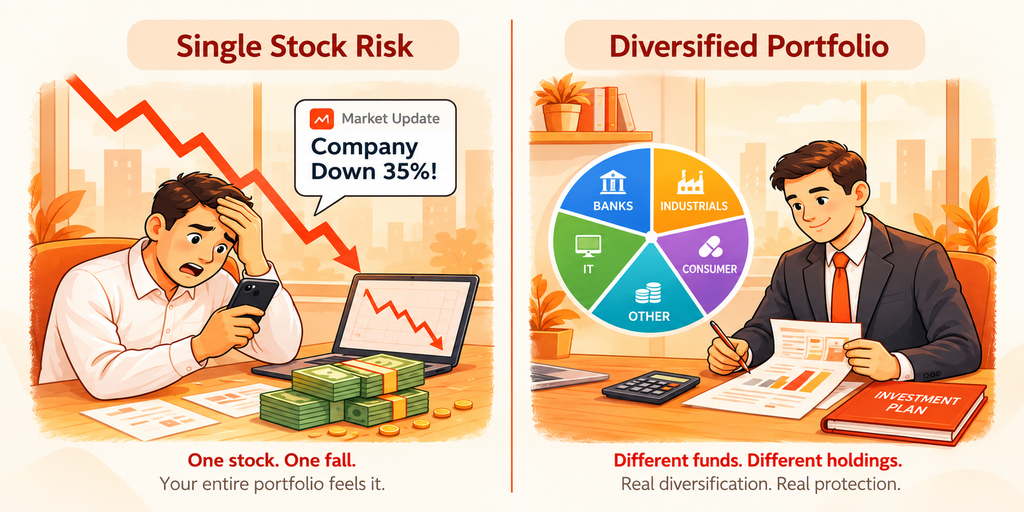
In an ordinary, calm market, this overlap barely matters. It becomes a real problem specifically when something bad happens to the market as a whole, because that’s when correlated investments stop pretending to be different and start moving together, in the same direction, by similar amounts.
The Nifty 50 fell close to 38% between its January high and its March low in 2020, as COVID hit global markets. Almost every equity fund fell during that stretch, overlapping or not, because a market-wide crash pulls down equity investments broadly. That part isn’t unique to overlapping funds.
Here’s where the overlap actually shows its cost: an investor holding three genuinely different funds, spread across large-cap, mid-cap, and a non-equity asset like debt or gold, would likely have seen some cushioning, since not every part of that mix falls by the same amount at the same time. An investor holding three large-cap funds that all quietly held the same twenty companies got no such cushioning. All three positions fell in near lockstep because there was really only one underlying position spread across three statements, not three separate ones. The crash didn’t create the overlap. It just removed the one thing, calm markets, that had been hiding it.
This is the part that makes correlation risk genuinely tricky: it hides during good times and only reveals itself at exactly the moment you need real protection.
A Simple Way to Actually Check
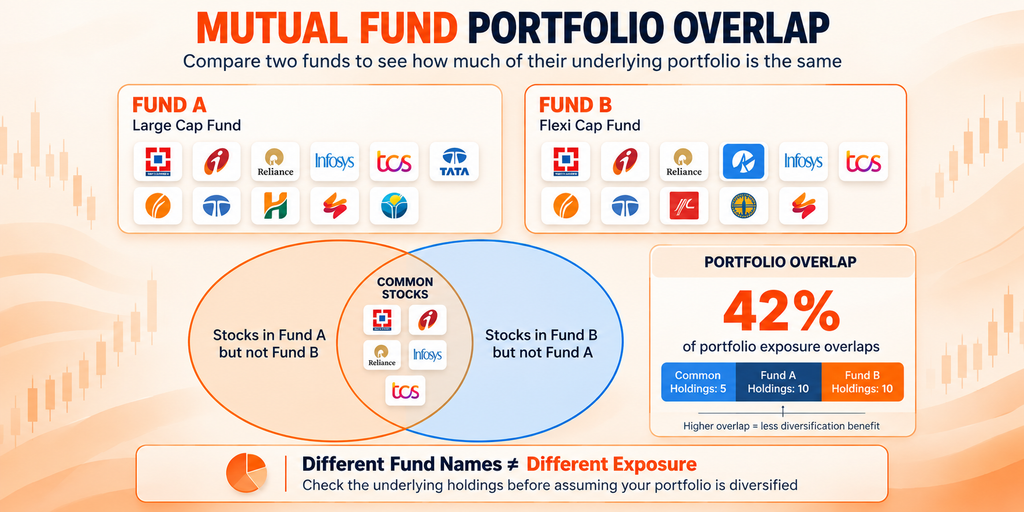
You don’t need to be a portfolio analyst to catch this. A few honest questions do most of the work:
- Do your funds hold the same top 10 companies? Most fund fact sheets list their top holdings. If three of your funds all list the same five or six companies near the top, that’s a real overlap, not a coincidence.
- Are all your funds tilted toward the same sector? A portfolio heavy in IT and banking stocks across every single fund isn’t diversified by sector, no matter how many separate fund names appear on the statement.
- Did everything fall together during a past downturn? Look back at how each investment performed during a known stress period, like March 2020. If every single one dropped by a similar percentage at the same time, that’s the correlation showing itself.
None of these questions require advanced math. They require actual looking; the way flipping over a chip packet requires nothing more than turning it around.
What Real Diversification Actually Looks Like
Genuine diversification isn’t about how many funds sit in your portfolio. It’s about whether they actually respond differently when something happens. Three funds spread across large-cap, mid-cap, and something like gold or debt will usually behave more differently from each other than ten funds that all quietly hold the same large-cap names. Fewer funds, real exposure differences, that beat more funds wearing different labels every time. It can also mean not ending up concentrated in the same sectors or companies across every fund without realising it, which is easy to miss when you’re just counting fund names instead of actually looking inside them.
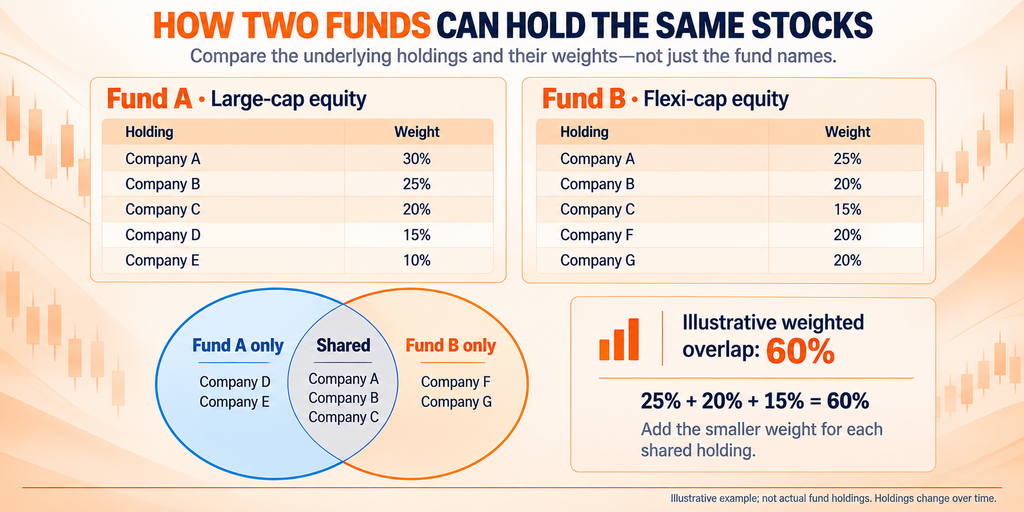
It’s not about holding more things. A portfolio with three genuinely different holdings offers more real protection than one with ten overlapping ones. Quantity was never the point. The difference was.
Where This Leaves the Actual Check
The pantry test still applies here better than most financial jargon does: if you can’t tell your holdings apart once you actually look inside them, past the name on the label, they’re probably not offering the protection you think they are. The label was never the thing that mattered. What’s actually inside always was.
If you want to check what’s genuinely inside your own portfolio rather than assuming, you can explore Rmoney’s investment platform to research individual funds before deciding, so you can run the same top-10-holdings and sector-concentration check yourself: he same flip-the-packet-over logic, just applied to real fund data instead of guesswork.
For more on building a genuinely diversified mutual fund portfolio, Rmoney’s mutual funds blog section covers this in more depth.
Disclaimer: This blog is for educational purposes only and should not be considered financial advice or a recommendation to invest. Portfolio diversification does not guarantee returns or protect fully against loss. Please consult a SEBI-registered investment advisor before making any investment decisions.
Table of content
Categories
Open Demat Account 

Related Posts
-

Preference share – Look for which type is for your portfolio
Preference shares refer to ownership in a listed company that bears higher right on assets and...
-

Top 5 Things to look at in An Income Statement
An income statement also known as a profit and loss statement is the financial statement...
-

How Trading Costs Silently Eat Your Profits: Key Details which every investor needs to know
Every successful trader knows that consistent profits are generated not just from picking winning trades,...
-
How to Identify False Breakouts while Trading?
How to Identify False Breakouts while Trading? In trading, one of the most frustrating situations...





Filing Complaints on SCORES (SEBI) – Easy & Quick
- Register on SCORES Portal (SEBI)
- Mandatory details for filing complaints on SCORES:
- Name, PAN, Address, Mobile Number, E-mail ID
- Benefits:
- Effective Communication
- Speedy redressal of the grieva`nces


IT'S TIME TO HAVE SOME FUN!
Your family deserves this time more than we do.
Share happiness with your family today & come back soon. We will be right here.
Investment to ek bahana hai,
humein to khushiyon ko badhana hai.
E-mail
askus@rmoneyindia.com
Customer Care
+91-9568654321



Trade Endlessly with
RMoney
Deep Discount Brokerage Plan
At 999/Monthly
- Dedicated round the clock Advisory Support
- High performance in depth research
- Save more than ₹10,000 brokerage Per Month
- Ultra fast trading app