 Stock Trading
Now trade in ₹9 Per Order or ₹ 999 Per Month Plans.
 Future & Options
Access F&O contracts with advanced tools for hedging and speculation.
 Currency Trading
Trade in major currency pairs and manage forex exposure efficiently.
 Commodity Trading
Diversify Trading with MCX & NCDEX by Trading in Gold, Silver, Base Metals, Energy, and Agri
Products.
 Margin Trading Funding
Boost your buying power with upto 5X, Buy now Pay Later
 Algo Trading
Back test, Paper Trade your logic & Automate your strategies with low-latency APIs.
 Trading View
Leverage Trading View charts and indicators integrated into your trading platform.
 Advanced Options Trading
Execute multi-leg option strategies with precision and insights.
 Stock Lending & Borrowing
Earn passive income by lending stocks securely through SLB.
 Foreign Portfolio Investment
Enable NRIs and FPIs to invest in Indian markets with ease and compliance.
 IPO
Invest in upcoming IPOs online with real-time tracking and instant allotment updates.
 Direct Mutual Funds
0% Commissions by investing in more than +3500 Direct Mutual Fund Scheme.
 Corporate FDRs
Earn fixed returns with low-risk investments in high-rated corporate fixed deposits.
 Stocks SIPs
Build long-term wealth with systematic investment plans in top-performing stocks.
 Bonds & NCDs
Access secure, fixed-income investments through government and corporate bond offerings.
 Depository Services
Safely hold and manage your securities with seamless Demat and DP services with CDSL.
 RMoney Quick
Fast, hassle-free trading in one tap.
 RMoney Rocket
Power-packed platform for active traders.
 Rocket API
Lightning-fast trading API for developers advanced algo traders.
 XTS Algo
Smart algo trading software for precision trades.
 Journey
Tracing our growth and milestones over time.
 Mission & Vision
Guided by purpose, driven by long-term vision.
 Why RMoney Platform
Smart, reliable platform for all investors' needs.
 Management
Experienced leadership driving strategic financial excellence.
 Credentials
Certified expertise with trusted industry recognition.
 Press Release
Latest company news, updates, and announcements.
 Testimonials
Real client stories sharing their success journeys.
 7 Reasons to Invest
Top benefits that make investing with us smart.
 SEBI Registered Research
Trusted insights backed by SEBI-compliant research.
 Our Technology
Advanced tools enabling efficient online trading.
 Blog
Stay updated with expert insights, market trends, and trading strategies through our
informative blogs.
 Video
Learn visually with easy-to-understand videos covering trading concepts, tips, and market
analysis.
 Podcast
Tune in to insightful discussions and expert opinions anytime, anywhere.
 Telegram Community
Be part of an active trader community sharing ideas, updates, and market opportunities in
real-time.
 WhatsApp Updates
Get instant alerts, key market updates, and important notifications directly on WhatsApp.
 Financial Calculators
Plan your trades, margins, and returns efficiently with our smart calculation tools.
 Marketplace
Discover curated tools, strategies, and services designed to enhance your trading
experience.
 Daily Research Reports
Stay ahead with timely market insights, trends, and actionable analysis delivered every day.
 Dedicated Advisory
Get personalized guidance and expert recommendations tailored to your trading goals.
 Research Team
Backed by experienced analysts delivering data-driven insights and market expertise.
 Research Reports
Access in-depth reports covering stocks, commodities, and market movements to support
informed decisions.
 Feedback
Share your suggestions or concerns to help us improve your experience.
 Downloads
Access important forms, software, and documents in one place.
 Locate Us
Find the nearest RMoney branch or service center quickly.
 Escalation Matrix
Resolve issues faster with our structured support escalation process.
 Back Office
Log in to view trade reports, ledger, and portfolio statements anytime.
 Account Modification
Update personal or bank details linked to your trading account.
 Fund Transfer
Transfer funds instantly online with quick limit updation to your trading account.
 Bank Details
View our registered bank account details for seamless transactions by NEFT, RTGS or IMPS.
 RMoney Rocket Web Version
Experience powerful web-based trading with advanced tools for algo traders.
 Refer & Earn
Invite friends and earn rewards every time they trade with us.


IPO GMP (Grey Market Premium): What It Means and Why It Is Not a Listing Guarantee
By: Social | Date : Nov 18, 26
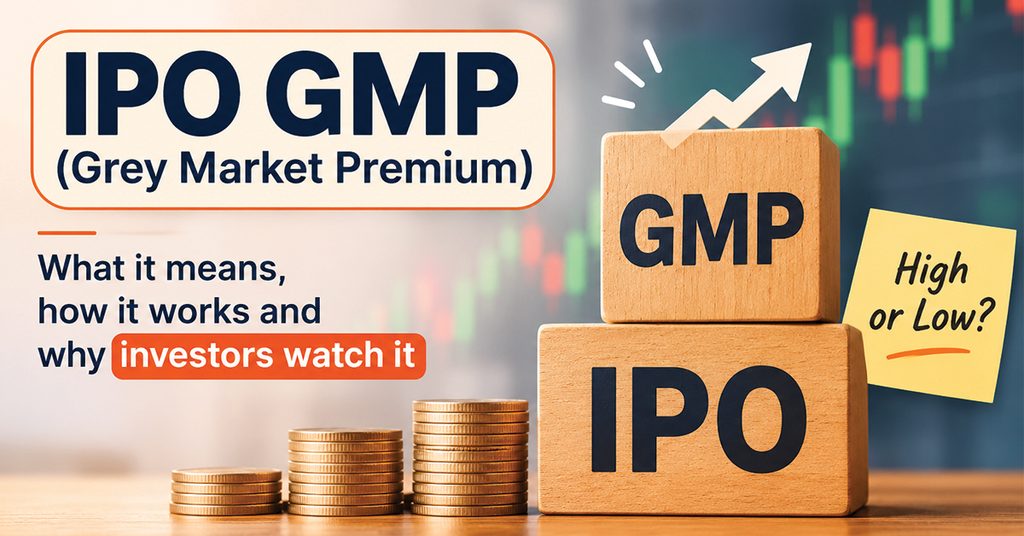
The price at which the initial public offering (IPO) shares are listed on the exchange does not have to be the same as the IPO issue price. However, before the shares are listed, some buyers and sellers quote a different price for the shares in the unofficial market. That difference between the issue price and the investor’s quoted price is called GMP.
GMP is checked by investors to know early market sentiment before the IPO listing. But it is not necessary that GMP will indicate the market accurately. Because the Actual listing price depends on the demand and supply when shares start trading in the market.
IPO GMP Highlights:
| Attribute | Details |
| What is IPO GMP | It is an extra amount over the issue price. |
| Where is it? | It is an unofficial investor group. |
| Regulated by whom | None |
| GMP Formula | Grey market price – Issue price |
| Can it be negative? | Yes |
| Is it a listing guarantee? | No |
To understand more about GMP watch – https://youtube.com/shorts/RkE0v8_hwHI?si=BBUF7g1yMLApqdaa
How Does GMP Work?
The grey market is the group of buyer and sellers who agrees to pay an extra amount over the issue price. It is an unofficial agreement between buyer and seller.
Let’s understand it with an example. Assume the IPO’s issue price is ₹100, and the buyer agrees to pay ₹120 for the IPO share, the difference of ₹20 is the GMP.
How to understand different GMP levels?
GMP can be positive, zero, or negative. While there is no official classification of these levels, investors generally interpret them in the following way:
| GMP Movement | General Market Interpretation |
| High positive GMP | Strong speculative interest |
| Low positive GMP | Limited positive interest |
| Zero GMP | Shows little or no quoted premium |
| Negative GMP | Expectations of listing below the issue price |
These interpretations are only indicative. A high GMP does not guarantee listing gains, just as a negative GMP does not necessarily mean the shares will list at a loss.
Grey Market Stocks vs Grey Market Premium vs IPO Listing
There is a difference between grey market, grey market premium and IPO listing which is explained in the below given table.
| Basis | Grey Market | Grey Market Premium (GMP) | IPO Listing |
| Meaning | Unofficial market for pre-listing transactions | Extra amount quoted over the issue price | First trading of shares on a stock exchange |
| Nature | Informal | Unofficial price indicator | Official |
| Where it happens | Outside recognised exchanges | Quoted by grey market participants | NSE or BSE |
| Price determination | Informal demand and supply | Based on market expectations | Actual exchange demand and supply |
| Regulation | Outside the regular exchange framework | Not an official SEBI metric | Governed by applicable market regulations |
Grey Market Trading in India: What Does SEBI Say?
Grey market trading in India is an unrecognised group of investors that is not regulated by any exchange. However, it is important to understand the difference between unregulated activity and illegal activity. It is not prohibited by SEBI. As it is regulated outside, it does not provide any protection to the traders. Using GMP to manipulate or defraud investors is actionable under the PFUTP (Prohibition of Fraudulent and Unfair Trade Practices) Regulations.
Important developments:
21 January 2025 – The statement was given by the SEBI chairperson, Madhabi Puri Buch, at an Association of Investment Bankers of India event. SEBI was exploring platforms for investors where investors could trade IPO shares between the allotment date and the listing date.
May 2026: SEBI took strict action against veerkrupa jewellers limited cause of misleading and manipulative activities related to GMP. In which SEBI stated that IPO GMP is not regulated by SEBI but if there is any misleading publicity fraud happening then SEBI will take strict action against it.
How Are IPO Shares Traded in the Grey Market?
In the grey market the IPO share traded unofficially. The deals get done between buyer and seller through local dealers.
1. Kostak Rate: It is a fixed amount paid by the buyer in the grey market. Whether the shares get allotted or not.
2. Subject to Sauda: The buyer pays the IPO applicant a certain amount against the shares only if the shares are allotted.
Difference Between GMP, Kostak Rate and Subject to Sauda
GMP is not the only term used in the IPO grey market. There are other commonly used terms, including Kostak Rate and Subject to Sauda. The table below explains the differences between them.
| Basis | GMP | Kostak Rate | Subject to Sauda |
| What is involved? | Expected premium on IPO shares | Entire IPO application | IPO application linked to allotment |
| Payment condition | Depends on the agreed arrangement | Agreed amount regardless of allotment, as per the deal | Payment only if allotment is received |
| Main basis | Per-share premium | Fixed application amount | Conditional application deal |
| Key risk | Listing expectations may change | Counterparty may fail to honour the deal | Allotment may not happen or the counterparty may default |
How to Calculate IPO GMP?
There are a few formulas used to calculate GMP mentioned in the table:
| Metric | Formula |
| GMP | Grey Market Price − IPO Issue Price |
| Expected Listing Price | IPO Issue Price + GMP |
| Expected Listing Gain (%) | (GMP ÷ IPO Issue Price) × 100 |
To calculate GMP, suppose a company launched its IPO at ₹250 per share, and the GMP is ₹50 before listing.
To calculate the estimated listing price, we’ll use the formula IPO issue price + GMP
250 + 50 = 300
Now we’ll calculate the Estimated Listing Gain
(GMP ÷ IPO Issue Price) × 100
(50 ÷ 250) × 100 = 20%
Now, with this calculation, we understand that based on the 50 GMP, the share might list around 300, While indicating a 20% gain on the issue price.
IPO Issue Price vs IPO Listing Price
| Feature | IPO Issue Price | IPO Listing Price |
| Who determines it? | The IPO issue price is decided by the company and its Book Running Lead Manager throughout the IPO price process | Determined by the stock exchange through buy and sell orders. |
| When is it determined? | Before the IPO opens in a fixed-price issue, or after the bidding process in a book-built issue. | On the listing day during the special pre-open session |
| What influences it? | Company valuation, financial performance, business prospects, and investor demand during book-building | Demand and supply based on buy and sell orders placed on the exchange |
What GMP Cannot Tell You
Although GMP provides insights on market sentiments about an IPO, it does not guarantee complete information about the issue and its performance. Few points need to be keep in mind are:
– Guaranteed listing gains: A high GMP does not imply that the IPO will be listed at a premium. In reality, the listing price might be higher or lower than estimated.
– Real demand of the IPO: GMP rules the black market and does not reflect the actual subscription numbers of the IPO from different market participants.
– Financial position of the issuing company: GMP does not show whether the company is profitable, has generated revenue, and what its debt and liquidity situation looks like.
– Long-term performance of the stock: GMP cannot forecast how the stock will be performing after listing and whether it will return money to the investors.
– Price of the IPO: GMP can say nothing about whether the IPO is well-priced or overvalued.
GMP vs IPO Subscription: What is the difference?
| Aspects | Grey Market Premium | IPO Subscription |
| Nature | Unofficial, not regulated by SEBI | Official, Exchange/ SEBI recorded data |
| Source | Small number of grey market dealers | All investors who actually submitted bids |
| What it reflects | Expectations and sentiments for pre-listing performance | Actual demand during the subscription period |
| Who participates | Grey market operators, HNIs, and a small group of retail investors | QIB, NII, Retail, Employees, shareholders |
| Timing | It is not specific; it fluctuates continuously until listing | Collect data daily during the 3-day subscription period, before the final data |
| Relationship with the listing price | Speculation, which can be wrong | It reflects real capital gains’ willingness. |
| Transparency | Not fully transparent, as different sources provide different data | Fully transparent, visible on NSE/BSE exchange |
What Factors Influence IPO GMP?
The Grey Market Premium (GMP) of an initial public offering (IPO) can change multiple times prior to its listing. Various factors affect buyers’ expectations and demand in the grey market mentioned below.
1. Demand for IPO Subscription
IPO subscription is about how many times the investors have bid for that particular share. It is linked with GMP because based on the Investor number of bidding GMP gets decided. There are other factors too that affect GMP.
2. Financial Performance of the Company
Investors are often interested in the company’s earnings growth, profits, debt levels, and business growth.
3. Valuation of the Company
The IPO issue price matters. If investors feel the issue price is fair as per the company’s fundamentals. Then demand will increase. But if the price is unfair, then investors may lose interest in the company.
4. Overall Stock Market Conditions
Overall stock market sentiment also affects the IPO. Suppose the market is bullish; investors will show more interest in a new IPO. In a bearish market, investors will reduce interest.
5. Industry Trends and Growth Prospects
Industries like technology, manufacturing, and renewable energy attract investors as these sectors are fast-growing, which can impact GMP.
6. Grey Market Demand and Supply
GMP can vary based on the demand and supply of grey market participants. When investors are willing to pay it increases GMP, in contrast when investors lose interest that decreases the GMP.
7. IPO Size and Investor Sentiment
The IPO size, brand recognition, and overall market interest can influence investor participation. The well-organised company’s position can also affect the GMP.
How Do Investors Use GMP?
With GMP, investors understand whether the IPO is worth buying based on market sentiment. It helps to understand whether investors are willing to pay for the coming IPO or not.
This is how GMP can be beneficial for investors:
1. Understanding the market sentiment
GMP indicates market sentiment. If GMP is high it indicates the positive market sentiment. If it is negative, it shows a decreasing IPO.
2. To compare market expectations with subscriptions
Investors can check if the movements in GMP are reflected in subscription numbers, such as the participation of QIBs.
3. To spot the changing sentiment
Sometimes when GMP suddenly drops which brings a concern in investors whether the company’s valuation, financial performance and other important details of the IPO were correct or not.
4. For realizing the possible listing price
GMP gives an approximate listing price. However, this information should not be treated as a guaranteed listing price or a guaranteed return on investment.
GMP Is Not a Listing Guarantee
GMP can not be guaranteed, as it only gives an idea of how much investors are willing to pay for the upcoming IPO. It doesn’t guarantee that investors should invest in that particular IPO.
1. Vishal Nirmiti IPO (October 2026)
In the Vishal Nirmiti case the GMP was ₹20 and issue price was ₹220 that was indicating a 9.09% gain. But GMP declined ₹2 before listing. As a result, shares got listed at 215 with a 2.27% discount.
2. NSE IPO (September 2026)
The NSE’s GMP was ₹285 with the issue price ₹1,785. As per this, the expected premium was 16%. However, it declined to around ₹45 before listing. The shares got listed at ₹1,800 with only a 0.84% gain.
In both examples, we can see that the grey market expectation can be different from the actual IPO listing.
Conclusion
GMP provides a good indication of market sentiment about an IPO, but it in no way guarantees a profitable listing. The listing price might be different from the GMP.
Investors are advised to look beyond the premium and calculate the company’s financial results and performance before applying.
GMP can offer a good starting point, but careful consideration is required for the IPO application process.
Frequently Asked Questions
1. Is grey market trading legal in India?
Grey market trading is not illegal. There is no legal protection in it, as it is not regulated by any stock exchange.
2. Is IPO GMP official or SEBI-regulated?
No. GMP is not regulated by any stock market exchange.
3. Can IPO GMP be negative?
Yes, when the investor quotes the GMP price below the issue price. In that situation, the price can be negative.
4. Where can investors check IPO GMP?
There are many platforms available online where investors can find reported GMP figures.
5. What is GMP in an SME IPO?
GMP in an SME IPO follows the same basic concept as in a mainboard IPO. It represents an unofficial premium over the issue price.
6. Is GMP trustworthy for providing a prediction about an IPO listing price?
GMP can help to understand the current outlook of the market, but it is not accurate. It can also change before listing, while the actual price depends on the trading conditions.
7. Can investors make Investment decisions based on GMP?
It is not recommended. Investors need to analyze some important metrics such as the company’s specific financials, the company’s valuation, business model, the possible risks, and subscription data.
8. What is the distinction between the Kostak Rate and Subject to Sauda?
Kostak Rate sets a fixed amount for the total IPO application, no matter how much allotment is made under this agreement. The actual “sauda” is based on the allotment.
9. Does a high GMP mean an IPO will list at a premium?
Not necessarily. A high GMP is an indication that the market participants have positive expectations. There are many other factors that need to be considered, including supply and demand, market factors, and investors’ behaviour.
Disclaimer –This article is for educational purposes only and does not constitute investment advice. Grey market transactions receive no SEBI or exchange investor protection.
Table of content
Categories
Open Demat Account 


Related Posts
-

Common Mistakes Made By A Share Trading Online Beginner
Share trading online, at first instance, seems to be a hassle-free and stress-free process. However,...
-

Why every Indian must have a demat account along with bank account
When was the last time you met someone holding shares certificates of a company in...
-

10 points to know before investing in stocks
Stocks investing is risky, if you do it blindly. Investing itself by no means a...
-

NSE Norms for Safer Participation of Algo Traders: 16 Takeaways
The implementation standards intended to safeguard the interests of retail investors have been dictated by...





Filing Complaints on SCORES (SEBI) – Easy & Quick
- Register on SCORES Portal (SEBI)
- Mandatory details for filing complaints on SCORES:
- Name, PAN, Address, Mobile Number, E-mail ID
- Benefits:
- Effective Communication
- Speedy redressal of the grieva`nces


IT'S TIME TO HAVE SOME FUN!
Your family deserves this time more than we do.
Share happiness with your family today & come back soon. We will be right here.
Investment to ek bahana hai,
humein to khushiyon ko badhana hai.
E-mail
askus@rmoneyindia.com
Customer Care
+91-9568654321



Trade Endlessly with
RMoney
Deep Discount Brokerage Plan
At 999/Monthly
- Dedicated round the clock Advisory Support
- High performance in depth research
- Save more than ₹10,000 brokerage Per Month
- Ultra fast trading app