 Stock Trading
Now trade in ₹9 Per Order or ₹ 999 Per Month Plans.
Stock Trading
Now trade in ₹9 Per Order or ₹ 999 Per Month Plans.
 Future & Options
Access F&O contracts with advanced tools for hedging and speculation.
Future & Options
Access F&O contracts with advanced tools for hedging and speculation.
 Currency Trading
Trade in major currency pairs and manage forex exposure efficiently.
Currency Trading
Trade in major currency pairs and manage forex exposure efficiently.
 Commodity Trading
Diversify Trading with MCX & NCDEX by Trading in Gold, Silver, Base Metals, Energy, and Agri Products.
Commodity Trading
Diversify Trading with MCX & NCDEX by Trading in Gold, Silver, Base Metals, Energy, and Agri Products.
 Margin Trading Funding
Boost your buying power with upto 5X, Buy now Pay Later
Margin Trading Funding
Boost your buying power with upto 5X, Buy now Pay Later
 Algo Trading
Back test, Paper Trade your logic & Automate your strategies with low-latency APIs.
Algo Trading
Back test, Paper Trade your logic & Automate your strategies with low-latency APIs.
 Trading View
Leverage Trading View charts and indicators integrated into your trading platform.
Trading View
Leverage Trading View charts and indicators integrated into your trading platform.
 Advanced Options Trading
Execute multi-leg option strategies with precision and insights.
Advanced Options Trading
Execute multi-leg option strategies with precision and insights.
 Stock Lending & Borrowing
Earn passive income by lending stocks securely through SLB.
Stock Lending & Borrowing
Earn passive income by lending stocks securely through SLB.
 Foreign Portfolio Investment
Enable NRIs and FPIs to invest in Indian markets with ease and compliance.
Foreign Portfolio Investment
Enable NRIs and FPIs to invest in Indian markets with ease and compliance.
 IPO
Invest in upcoming IPOs online with real-time tracking and instant allotment updates.
IPO
Invest in upcoming IPOs online with real-time tracking and instant allotment updates.
 Direct Mutual Funds
0% Commissions by investing in more than +3500 Direct Mutual Fund Scheme.
Direct Mutual Funds
0% Commissions by investing in more than +3500 Direct Mutual Fund Scheme.
 Corporate FDRs
Earn fixed returns with low-risk investments in high-rated corporate fixed deposits.
Corporate FDRs
Earn fixed returns with low-risk investments in high-rated corporate fixed deposits.
 Stocks SIPs
Build long-term wealth with systematic investment plans in top-performing stocks.
Stocks SIPs
Build long-term wealth with systematic investment plans in top-performing stocks.
 Bonds & NCDs
Access secure, fixed-income investments through government and corporate bond offerings.
Bonds & NCDs
Access secure, fixed-income investments through government and corporate bond offerings.
 Depository Services
Safely hold and manage your securities with seamless Demat and DP services with CDSL.
Depository Services
Safely hold and manage your securities with seamless Demat and DP services with CDSL.
 RMoney Quick
Fast, hassle-free trading in one tap.
RMoney Quick
Fast, hassle-free trading in one tap.
 RMoney Rocket
Power-packed platform for active traders.
RMoney Rocket
Power-packed platform for active traders.
 Rocket API
Lightning-fast trading API for developers advanced algo traders.
Rocket API
Lightning-fast trading API for developers advanced algo traders.
 XTS Algo
Smart algo trading software for precision trades.
XTS Algo
Smart algo trading software for precision trades.
 Journey
Tracing our growth and milestones over time.
Journey
Tracing our growth and milestones over time.
 Mission & Vision
Guided by purpose, driven by long-term vision.
Mission & Vision
Guided by purpose, driven by long-term vision.
 Why RMoney Platform
Smart, reliable platform for all investors' needs.
Why RMoney Platform
Smart, reliable platform for all investors' needs.
 Management
Experienced leadership driving strategic financial excellence.
Management
Experienced leadership driving strategic financial excellence.
 Credentials
Certified expertise with trusted industry recognition.
Credentials
Certified expertise with trusted industry recognition.
 Press Release
Latest company news, updates, and announcements.
Press Release
Latest company news, updates, and announcements.
 Testimonials
Real client stories sharing their success journeys.
Testimonials
Real client stories sharing their success journeys.
 7 Reasons to Invest
Top benefits that make investing with us smart.
7 Reasons to Invest
Top benefits that make investing with us smart.
 SEBI Registered Research
Trusted insights backed by SEBI-compliant research.
SEBI Registered Research
Trusted insights backed by SEBI-compliant research.
 Our Technology
Advanced tools enabling efficient online trading.
Our Technology
Advanced tools enabling efficient online trading.
 Blog
Stay updated with expert insights, market trends, and trading strategies through our informative blogs.
Blog
Stay updated with expert insights, market trends, and trading strategies through our informative blogs.
 Video
Learn visually with easy-to-understand videos covering trading concepts, tips, and market analysis.
Video
Learn visually with easy-to-understand videos covering trading concepts, tips, and market analysis.
 Podcast
Tune in to insightful discussions and expert opinions anytime, anywhere.
Podcast
Tune in to insightful discussions and expert opinions anytime, anywhere.
 Telegram Community
Be part of an active trader community sharing ideas, updates, and market opportunities in real-time.
Telegram Community
Be part of an active trader community sharing ideas, updates, and market opportunities in real-time.
 WhatsApp Updates
Get instant alerts, key market updates, and important notifications directly on WhatsApp.
WhatsApp Updates
Get instant alerts, key market updates, and important notifications directly on WhatsApp.
 Financial Calculators
Plan your trades, margins, and returns efficiently with our smart calculation tools.
Financial Calculators
Plan your trades, margins, and returns efficiently with our smart calculation tools.
 Marketplace
Discover curated tools, strategies, and services designed to enhance your trading experience.
Marketplace
Discover curated tools, strategies, and services designed to enhance your trading experience.
 Daily Research Reports
Stay ahead with timely market insights, trends, and actionable analysis delivered every day.
Daily Research Reports
Stay ahead with timely market insights, trends, and actionable analysis delivered every day.
 Dedicated Advisory
Get personalized guidance and expert recommendations tailored to your trading goals.
Dedicated Advisory
Get personalized guidance and expert recommendations tailored to your trading goals.
 Research Team
Backed by experienced analysts delivering data-driven insights and market expertise.
Research Team
Backed by experienced analysts delivering data-driven insights and market expertise.
 Research Reports
Access in-depth reports covering stocks, commodities, and market movements to support informed decisions.
Research Reports
Access in-depth reports covering stocks, commodities, and market movements to support informed decisions.
 Feedback
Share your suggestions or concerns to help us improve your experience.
Feedback
Share your suggestions or concerns to help us improve your experience.
 Downloads
Access important forms, software, and documents in one place.
Downloads
Access important forms, software, and documents in one place.
 Locate Us
Find the nearest RMoney branch or service center quickly.
Locate Us
Find the nearest RMoney branch or service center quickly.
 Escalation Matrix
Resolve issues faster with our structured support escalation process.
Escalation Matrix
Resolve issues faster with our structured support escalation process.
 Back Office
Log in to view trade reports, ledger, and portfolio statements anytime.
Back Office
Log in to view trade reports, ledger, and portfolio statements anytime.
 Account Modification
Update personal or bank details linked to your trading account.
Account Modification
Update personal or bank details linked to your trading account.
 Fund Transfer
Transfer funds instantly online with quick limit updation to your trading account.
Fund Transfer
Transfer funds instantly online with quick limit updation to your trading account.
 Bank Details
View our registered bank account details for seamless transactions by NEFT, RTGS or IMPS.
Bank Details
View our registered bank account details for seamless transactions by NEFT, RTGS or IMPS.
 RMoney Rocket Web Version
Experience powerful web-based trading with advanced tools for algo traders.
RMoney Rocket Web Version
Experience powerful web-based trading with advanced tools for algo traders.
 Refer & Earn
Invite friends and earn rewards every time they trade with us.
Refer & Earn
Invite friends and earn rewards every time they trade with us.



Asset Allocation: Why SIPs and Stocks Complement Each Other
By: Social | Date : Aug 24, 26
Introduction
Many traders spend years learning how to generate alpha but never build a portfolio designed to preserve it. That’s why even consistently profitable traders can struggle to create lasting wealth. Asset allocation is often the missing piece.
Irrespective of the fact that you are an algo trader, an equity trader, an options strategist, or just someone who is working to build their quant investment models, generating returns is only one part of the equation. To keep capital safe and increase wealth, one must have a portfolio that works in line with all possible market conditions.
This is when SIPs and stock investing stop competing and start coexisting.
The debate should no longer be SIPs vs Stocks. The real question is:
How can both work together to create a more resilient portfolio?
“According to AMFI, monthly SIP inflows crossed ₹27,000 crore in 2026, reflecting the growing preference for disciplined investing among Indian investors. While active trading can generate alpha, systematic investing has become an important pillar of long-term wealth creation.”
The Problem Advanced Traders Rarely Talk About
Most experienced traders focus on improving alpha.
They optimize:
- Entry precision
- Exit efficiency
- Position sizing
- Portfolio beta
- Strategy diversification
- Execution speed
But many portfolios still depend heavily on one variable:
The trader’s ability to continuously outperform the market.
That creates several hidden challenges.
Challenge 1: Performance Pressure Never Stops
A profitable quarter creates expectations. A losing month creates frustration. When your entire wealth depends on active trading, every market cycle starts affecting not just returns but also decision-making.
Challenge 2: Different Strategies Have Different Cycles
Drawdowns happen with algo strategies. Sideways markets do not work for momentum strategies. Volatility spikes are a challenge for option sellers. In periods of low volatility, buying options is difficult. There is no one-size-fits-all solution for every market environment.
Challenge 3: Capital Often Remains Underutilized
Numerous investors maintain extra capital in their trading accounts in anticipation of the next high-probability setup. Thus, rather than remaining unutilized, some of this capital can actually be invested through Systematic Investment Plans (SIPs) to generate returns without compromising the liquidity of the trading account.
Why Asset Allocation Matters Even for Professionals
Renowned investor Ray Dalio has consistently pointed out that diversification and asset allocation play a crucial role in managing investment risk over the long haul. In order to invest successfully, one has to do more than get higher returns; it is also about having a portfolio that is fit for different market scenarios.
Professional portfolio managers do not usually depend on one investment strategy but distribute assets in different classes for different aims. For example, one pot will be aimed at making active returns while another one will be aimed at long-term wealth generation. Yet another pot will be to ensure liquidity or stability.
This isn’t about lowering ambition. It’s about building a portfolio that doesn’t depend on a single source of returns.
Stocks Generate Alpha. SIPs Build Consistency.
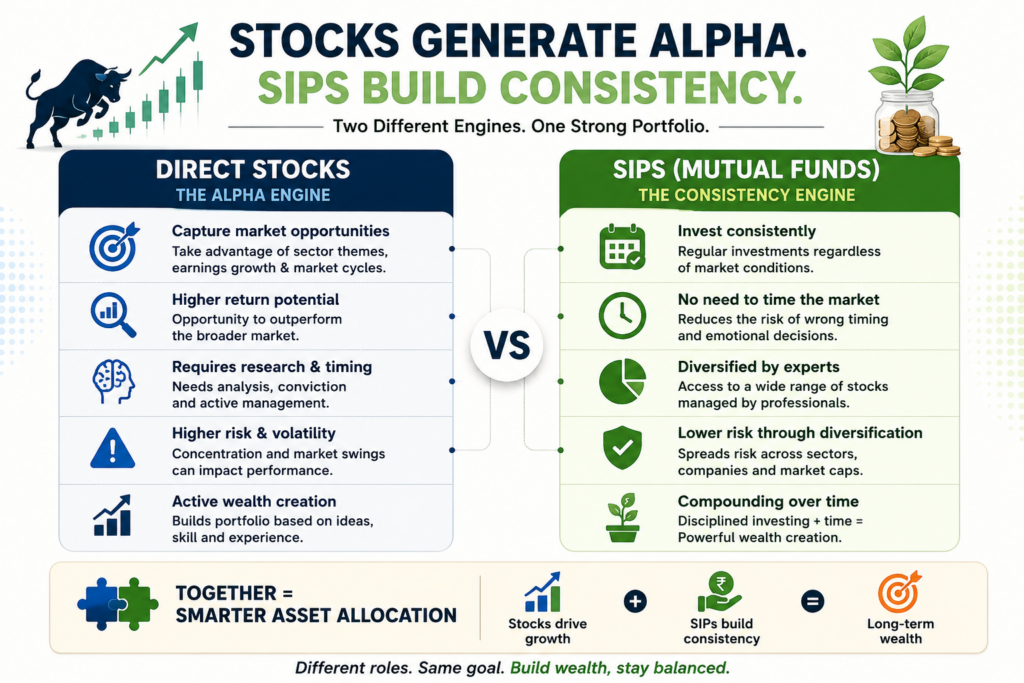
Think of them as two different engines working together.
Benefits of Investing in Direct Stocks
Investing in stocks gives investors a better chance to take charge of their investments and to accumulate wealth through proper stock selection. Investors can achieve the following goals through stocks:
– Seize the best investment opportunities
– Capitalize on thematic trends in sectors
– Build concentrated portfolios
– Participate in the growth of a company
– Achieve above-average returns through research
Experience, knowledge, and belief in what you do lead to value creation.
Benefits of Investing through SIPs
SIPs provide a disciplined way of investing for the long run, instilling a habit of investing regularly irrespective of market activity.
Some of the main benefits for the investors include;
– Investing without keeping an eye on market trends
– Removing the risk of market timing
– Gaining wealth over the years
– Utilizing the power of compounding
– Investing in a rational way
SIPs do not replace equity investment but rather enhance the portfolio overall.
Why Experienced Traders Should Care About SIPs
Many believe SIPs are only for beginners. That assumption overlooks their real value.
1. They Remove Emotional Allocation Decisions
Even experienced traders find it difficult to perfectly time long-term investments. SIPs automate discipline. Rather than asking, “Should I invest this month?” the process continues regardless of market noise.
2. They Create a Parallel Wealth Engine
Trading income can fluctuate. A SIP portfolio keeps growing independently. Over time, this creates another source of wealth without requiring daily monitoring.
3. They Improve Capital Allocation
Profits gained from trading are generally not utilized right after a successful month. Some serious investors, instead of leaving those profits unused or reinvesting them into risky trades, invest them in SIPs. This very habit successfully turns short-term profits into wealth while keeping the integrity of capital.
Let’s say an options trader has earned ₹1 lakh in profit during a highly fruitful month. Instead of reinvesting the whole amount in trading, he invests ₹20,000 in SIPs and ₹30,000 in long-term stocks, keeping the remaining amount as trading capital. Over time, this allows the trader to generate multiple sources of wealth without depending only on trading results.
4. They Reduce Portfolio Concentration
Even diversified stock portfolios remain exposed to equity-specific risks. Adding carefully selected mutual funds through SIPs introduces professional fund management and broader diversification across sectors and companies.
Direct Stocks vs SIPs: A Quick Comparison
| Direct Stocks | SIPs |
|---|---|
| Active investing | Passive investing |
| Requires research | Professionally managed mutual funds |
| Higher return potential | Disciplined wealth creation |
| Needs regular monitoring | Automated investments |
| Suitable for high-conviction ideas | Suitable for long-term consistency |
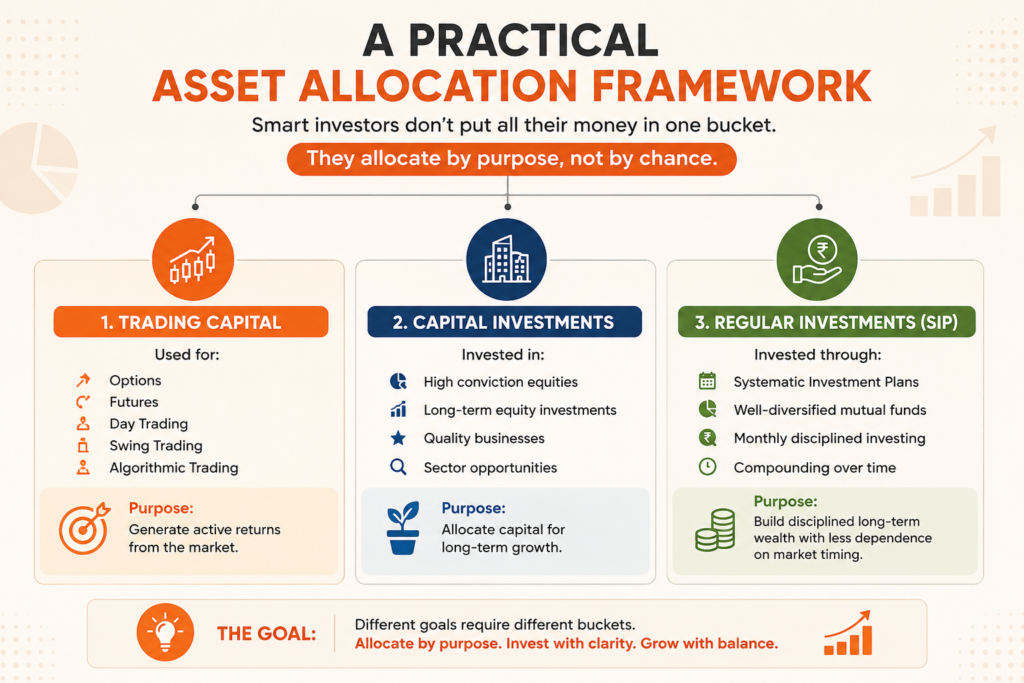
Asset Allocation with SIPs and Stocks: A Practical Framework
This is a basic methodology that lots of seasoned traders have adopted in segregating funds according to their use instead of treating any capital as trading capital.
The perfect investment portfolio for each individual will be different since it depends on their unique criteria like the goal of investment, the risk they can take, the period they will need cash, etc. Most experienced investors, however, opt for the division of investments into various categories.
| Portfolio Bucket | Investment Type | Primary Objective |
| Trading Capital | Options, Futures, Intraday, Algo Trading | Generate active returns |
| Long-Term Stocks | Direct Equity Investments | Wealth creation through ownership |
| SIP Portfolio | Mutual Funds via SIP | Disciplined investing and compounding |
| Emergency/Liquidity Fund | Liquid Funds or Savings | Financial stability and flexibility |
The Compounding Effect Traders Often Underestimate
While many traders concentrate on returns obtained each year, long-term investors emphasize compounding. Although it appears insignificant, the distinction can greatly impact the creation of wealth over time.
Trading returns vary over the years, while compounding does not reward inconsistency during long periods of investment.
For example, one year a trader might have phenomenal returns, while in the following year his returns are much lower. In the case of SIPs, discipline allows compounding to work regardless of the environment in which SIPs operate.
With SIPs, there is no need to constantly monitor the market or try to decide the best timing.
Active income received from trading combined with SIP investing helps keep things adequately balanced.
Common Misconceptions
“If I know how to trade, I don’t need SIPs.”
Trading and investing solve different financial objectives. One seeks active market opportunities. The other builds long-term wealth through disciplined participation. Both can coexist.
“SIPs deliver lower returns.”
Return comparisons usually disregard variations between returns, risk, effort, and consistency. SIP systems are created to promote a disciplined investing practice and not to create the highest returns within a brief timeframe.
The worth of SIP systems lies within their systematic participation mechanisms and long-term compounding.
“I already own stocks.”
Owning individual stocks does not automatically mean your portfolio is well-diversified. The creation of a portfolio of selected stocks combined with certain strategies of mutual funds will help to achieve adequate diversification and limit concentration risks.
Building a Smarter Investing Workflow
Managing different investment approaches becomes uncomplicated when research, execution, and long-term investing can be done from one ecosystem.
Many traders prefer platforms where they can easily switch from one type of opportunity to another without requiring different trading accounts.
For instance, traders who use advanced charts, algorithms, or other financial products can also carry out SIPs and direct equity investments on the same platform and do not have to worry about the complexities of portfolio and order management.
Those traders who want to combine active trading and investing generally prefer platforms that have it all. RMoney provides investors with the opportunity to trade all types of direct stocks, invest in mutual funds through SIPs, get access to advanced charts powered by TradingView, use APIs for algo trading, and manage their portfolios from one platform.
Conclusion
Successful traders know that reliance on one strategy is risky, and for this reason, this concept can be applied to wealth creation. Combining direct stocks with SIP investments allows investors to create a portfolio that can withstand various market conditions and achieve long-term financial objectives.
The same principle applies to wealth creation. Stocks provide conviction. Trading strategies generate opportunities. SIPs introduce discipline.
By opting to invest in both, you can create an investment portfolio that can be more resilient through different market cycles while obtaining the benefit from short-term investment and long-term wealth accumulation.
You should think of whether to invest in SIPs or stocks, but determine instead how both of these investment vehicles can accomplish different things in an individual investment strategy.
Table of content
Categories
Open Demat Account 



Related Posts
-

Budget 2025 Expectations Part 1: What to Expect and How It Could Impact Your Finances
Key Expectations from Union Budget 2025 The upcoming Union Budget 2025 is anticipated to include...
-

DEE Development Engineers Limited IPO – Upcoming IPO in India June 2024
DEE Development Engineers Limited IPO (DEE Piping Systems IPO) Founded in 1988, DEE Development Engineers...
-
What Are Some Safe Investment Instruments in Current Pandemic Scenario
Investors are finding the safe havens instruments to invest their money in a time of...
-

Decoding Market Liquidity: Why Some Prices Move Faster than Others
If you’ve ever tracked two different stocks in the Indian market, you may have noticed...





Filing Complaints on SCORES (SEBI) – Easy & Quick
- Register on SCORES Portal (SEBI)
- Mandatory details for filing complaints on SCORES:
- Name, PAN, Address, Mobile Number, E-mail ID
- Benefits:
- Effective Communication
- Speedy redressal of the grieva`nces


IT'S TIME TO HAVE SOME FUN!
Your family deserves this time more than we do.
Share happiness with your family today & come back soon. We will be right here.
Investment to ek bahana hai,
humein to khushiyon ko badhana hai.
E-mail
askus@rmoneyindia.com
Customer Care
+91-9568654321



Trade Endlessly with
RMoney
Deep Discount Brokerage Plan
At 999/Monthly
- Dedicated round the clock Advisory Support
- High performance in depth research
- Save more than ₹10,000 brokerage Per Month
- Ultra fast trading app