 Stock Trading
Now trade in ₹9 Per Order or ₹ 999 Per Month Plans.
 Future & Options
Access F&O contracts with advanced tools for hedging and speculation.
 Currency Trading
Trade in major currency pairs and manage forex exposure efficiently.
 Commodity Trading
Diversify Trading with MCX & NCDEX by Trading in Gold, Silver, Base Metals, Energy, and Agri
Products.
 Margin Trading Funding
Boost your buying power with upto 5X, Buy now Pay Later
 Algo Trading
Back test, Paper Trade your logic & Automate your strategies with low-latency APIs.
 Trading View
Leverage Trading View charts and indicators integrated into your trading platform.
 Advanced Options Trading
Execute multi-leg option strategies with precision and insights.
 Stock Lending & Borrowing
Earn passive income by lending stocks securely through SLB.
 Foreign Portfolio Investment
Enable NRIs and FPIs to invest in Indian markets with ease and compliance.
 IPO
Invest in upcoming IPOs online with real-time tracking and instant allotment updates.
 Direct Mutual Funds
0% Commissions by investing in more than +3500 Direct Mutual Fund Scheme.
 Corporate FDRs
Earn fixed returns with low-risk investments in high-rated corporate fixed deposits.
 Stocks SIPs
Build long-term wealth with systematic investment plans in top-performing stocks.
 Bonds & NCDs
Access secure, fixed-income investments through government and corporate bond offerings.
 Depository Services
Safely hold and manage your securities with seamless Demat and DP services with CDSL.
 RMoney Quick
Fast, hassle-free trading in one tap.
 RMoney Rocket
Power-packed platform for active traders.
 Rocket API
Lightning-fast trading API for developers advanced algo traders.
 XTS Algo
Smart algo trading software for precision trades.
 Download
Get started with our trading platform today.
 Journey
Tracing our growth and milestones over time.
 Mission & Vision
Guided by purpose, driven by long-term vision.
 Why RMoney Platform
Smart, reliable platform for all investors' needs.
 Management
Experienced leadership driving strategic financial excellence.
 Credentials
Certified expertise with trusted industry recognition.
 Press Release
Latest company news, updates, and announcements.
 Testimonials
Real client stories sharing their success journeys.
 7 Reasons to Invest
Top benefits that make investing with us smart.
 SEBI Registered Research
Trusted insights backed by SEBI-compliant research.
 Our Technology
Advanced tools enabling efficient online trading.
 Blog
Stay updated with expert insights, market trends, and trading strategies through our
informative blogs.
 Video
Learn visually with easy-to-understand videos covering trading concepts, tips, and market
analysis.
 Podcast
Tune in to insightful discussions and expert opinions anytime, anywhere.
 Telegram Community
Be part of an active trader community sharing ideas, updates, and market opportunities in
real-time.
 WhatsApp Updates
Get instant alerts, key market updates, and important notifications directly on WhatsApp.
 Financial Calculators
Plan your trades, margins, and returns efficiently with our smart calculation tools.
 Marketplace
Discover curated tools, strategies, and services designed to enhance your trading
experience.
 Daily Research Reports
Stay ahead with timely market insights, trends, and actionable analysis delivered every day.
 Dedicated Advisory
Get personalized guidance and expert recommendations tailored to your trading goals.
 Research Team
Backed by experienced analysts delivering data-driven insights and market expertise.
 Research Reports
Access in-depth reports covering stocks, commodities, and market movements to support
informed decisions.
 Feedback
Share your suggestions or concerns to help us improve your experience.
 Locate Us
Find the nearest RMoney branch or service center quickly.
 Escalation Matrix
Resolve issues faster with our structured support escalation process.
 Account Modification
Update personal or bank details linked to your trading account.
 Fund Transfer
Transfer funds instantly online with quick limit updation to your trading account.
 Bank Details
View our registered bank account details for seamless transactions by NEFT, RTGS or IMPS.
 Refer & Earn
Invite friends and earn rewards every time they trade with us.
 Daily Margin Files
Download daily margin files.
 Forms & Formats
Download forms and formats
 RMoney Rocket Web Login
Experience powerful web-based trading with advanced tools for algo traders.
 Back Office
Log in to view trade reports, ledger, and portfolio statements anytime.


What Is a GTT Order? How It Works, Uses & Risks
By: Shailly Saxena | Date : Nov 28, 26

I recently came across an order type I had barely heard about before, and honestly, it felt like finding a life jacket when I didn’t know I needed one.
Working in an office means most of my day goes into meetings, deadlines, and never-ending emails. Even finding time for a peaceful walk can be difficult. So, keeping a constant eye on stock prices was never something I could manage comfortably.
I’ve missed a trade this way. My analysis wasn’t necessarily wrong; I simply wasn’t there when the price reached my level. That experience led me to GTT (Good Till Triggered) orders, a tool that can help traders follow a plan without constantly watching the screen.
It started with a missed opportunity.
One morning, I opened the Zomato chart. The company now operates under the name Eternal Ltd (NSE: ETERNAL), and the stock had been attracting attention with considerable trading volume and momentum. What interested me was a pullback towards a support zone.
For anyone unfamiliar with the term, support is a price level where a stock has previously found buying interest and stopped falling. I wanted to enter near that level rather than chase the price higher.
The plan was ready, but my workday had other ideas. A meeting ran late, another one started, and an email conversation seemed to have no end. When I finally returned to the chart, the stock had touched support, bounced on strong volume, and moved well past my intended entry.
My reading of the chart wasn’t the problem. My availability was.
That’s when I started exploring ways to place an order without having to monitor the market constantly.
A regular limit order wasn’t quite the answer. It lets you specify the price at which you’re willing to buy or sell, but a standard day order generally expires when the trading session ends. NSE trading hours are 9:15 AM to 3:30 PM. If your desired price doesn’t arrive during that session, the order disappears.
Indian retail traders generally don’t have access to a true good-till-cancelled order through regular exchange order types. This is where brokers offer facilities such as GTT.
So, what makes a GTT order different?
GTT stands for Good Till Triggered. Think of it as instructing your broker to monitor a specific price level and execute an action once that condition is fulfilled.
Trigger Price vs Limit Price: What’s the Difference?
The trigger price activates your instruction, while the limit price specifies the price you are willing to accept. Until the trigger is reached, the instruction remains with the broker rather than sitting in the exchange’s active order book. Once triggered, the broker sends the limit order to the exchange.
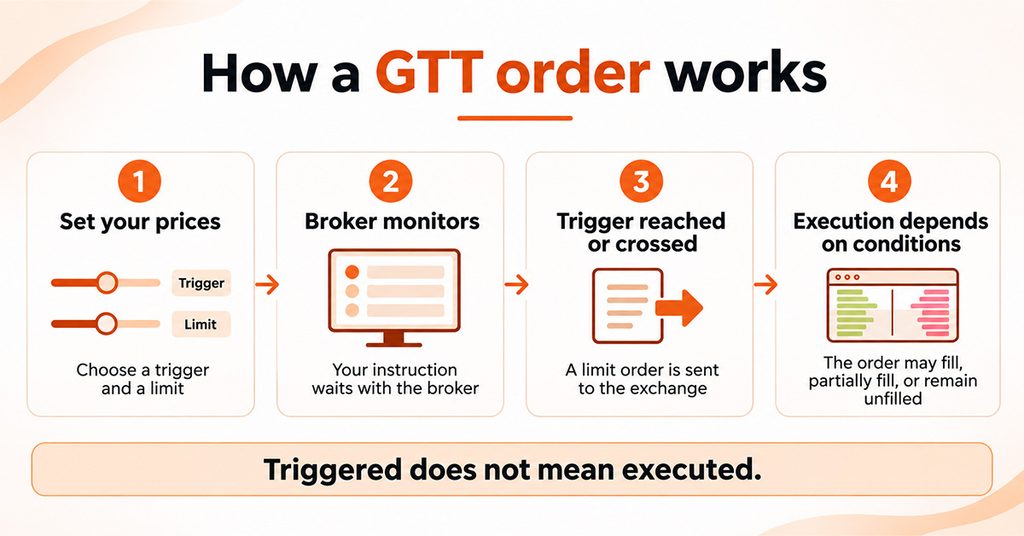
RMoney’s GTT guide explains the facility and its basic workings.
For someone managing a full-time job alongside trading, this is particularly useful. I can identify a price level in the morning, enter my instructions, and get back to work without repeatedly checking the chart.
Consider the same Eternal example. Suppose the stock is approaching support around ₹280. The figures provided are purely hypothetical, do not represent live market prices, and do not constitute investment advice.
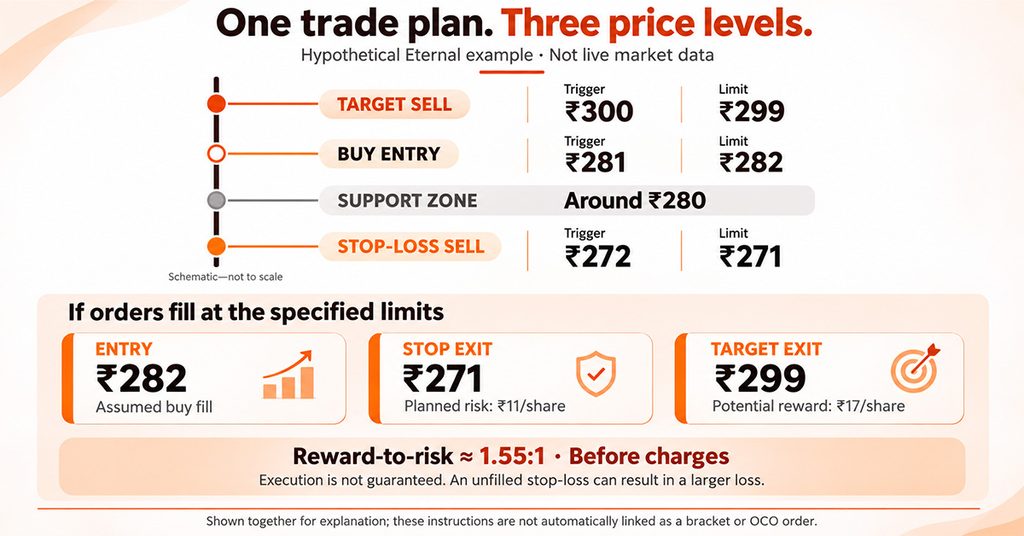
The idea is to plan the entry and exit before the trade begins. The two sell instructions can be used once the purchased shares are available in your demat account, which is where your securities are held electronically.
With a ₹282 entry, the potential downside is ₹10 per share against an ₹18 target. That’s approximately a 1:1.8 reward-to-risk ratio, excluding brokerage and other charges.
The stop-loss is particularly important here. It’s always smart to have a solid exit plan ready for when the market doesn’t go your way, as a reliable backup can keep your losses from getting out of hand. A great way to map this out is by using RMoney’s TradingView integration to pinpoint key support and resistance levels before setting your orders.
A great way to map this out is by using RMoney’s TradingView integration to pinpoint key support and resistance levels before setting your orders.
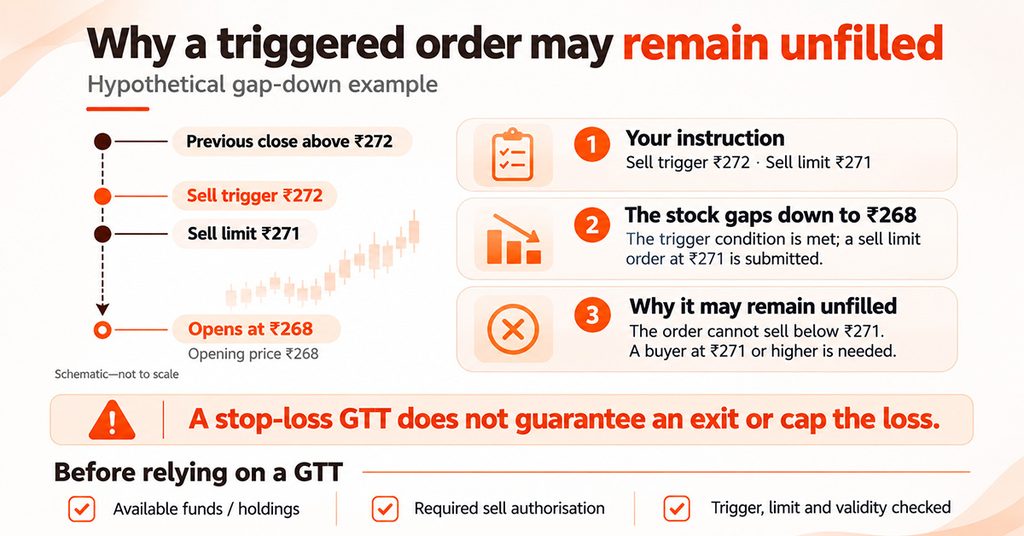
You also want to make sure you actually have the cash ready for buy orders or the shares sitting in your demat account for sell orders, since running short on either is a quick way to cause a failure.
You also want to make sure you actually have the cash ready for buy orders or the shares sitting in your demat account for sell orders, since running short on either is a quick way to cause a failure. Remember that GTT is essentially a single-use tool, meaning you’ll need to set it up again if the order triggers but fails to fill. Since these instructions don’t last forever, keep an eye on RMoney’s current validity windows, and try to avoid constantly tweaking your active orders so you don’t accidentally trigger a rejection or cancellation. If limit-order execution prices seem confusing, RMoney’s explanation of why a limit order executes at a different price can help.
You might also wonder how GTT compares with bracket orders. A bracket order combines an entry, target, and stop-loss in one structure. Another related facility is OCO, or One Cancels Other, where two exit instructions are linked. If one executes, the other is cancelled. Availability varies between brokers, so check which features your RMoney platform currently supports.
Before placing a GTT, I would simply review the chart, calculate potential risk and transaction costs using the brokerage calculator, confirm that funds or shares are available, and double-check the trigger, limit, and validity. Once everything is in place, there’s less reason to keep watching the screen.
If you don’t have an account yet, you can explore opening a demat account with RMoney and access its stock trading platform.
A few common questions about GTT orders
What is a GTT order?
Think of it as a standing instruction that your broker holds onto until the stock hits your specific trigger price, which then pushes a limit order out to the exchange. But don’t assume that means execution is guaranteed. Even after that initial trigger gets tripped, whether your order actually goes through still comes down to whatever market conditions are doing at that exact moment. Sudden price gaps, limited liquidity, an unsuitable limit price or insufficient funds and shares can leave the order unexecuted. That’s why it’s important to review your order details before relying on them.
GTT isn’t restricted to long-term investors either. For me, discovering GTT completely changed how I look at trading—I finally stopped feeling like I had to stress over every single market tick. It is an amazing tool for swing traders who want to map out their entries, stop-losses, and profit targets ahead of time without being glued to their screens all day. That said, it really shines when you use it for multi-day, delivery-based setups. If you are doing same-day intraday trading, you are still better off sticking to standard stop-loss orders to manage your positions. Having a clear entry, exit, and risk-management plan in place can make a difference, particularly when work keeps me occupied. Of course, GTT doesn’t remove market risks or guarantee profits, but it does make following a predefined strategy more convenient.
I’ve come to realise that useful trading tools aren’t necessarily those promising bigger returns. Sometimes, they’re simply the ones that help you stay disciplined without having to sacrifice your entire day watching the screen. If you’d like to understand more about trading, order types, and managing risk, the RMoney Resources Hub is a good place to explore.
Disclaimer: This article is for educational purposes only and isn’t financial advice or a recommendation to buy or sell any security. The Eternal example uses hypothetical prices, not live market data. Trading involves risks, including loss of capital. Order features, validity, and execution conditions vary by broker and may change. Consult a SEBI-registered investment adviser before making trading decisions.
Table of content
Categories
Open Demat Account 



Related Posts
-

Choosing Your Asset: Physical Gold, Gold ETFs, or Nifty 50?
The question among investors in India is a frequently used problem, which is: “Should I...
-

Ceigall India Limited IPO (Ceigall India IPO)
Established in 2002, Ceigall India Limited is a construction business that specializes in specialized structural...
-

The ultimate goal of stocks-investing you need to know first
Future is future, mysteriously unknown and insecure to each one of us. No matter how...
-

5 Mistakes To Avoid During Option Trading
Option trading is popular among traders as it helps them earn a good amount of...





Filing Complaints on SCORES (SEBI) – Easy & Quick
- Register on SCORES Portal (SEBI)
- Mandatory details for filing complaints on SCORES:
- Name, PAN, Address, Mobile Number, E-mail ID
- Benefits:
- Effective Communication
- Speedy redressal of the grieva`nces


IT'S TIME TO HAVE SOME FUN!
Your family deserves this time more than we do.
Share happiness with your family today & come back soon. We will be right here.
Investment to ek bahana hai,
humein to khushiyon ko badhana hai.
E-mail
askus@rmoneyindia.com
Customer Care
+91-9568654321



Trade Endlessly with
RMoney
Deep Discount Brokerage Plan
At 999/Monthly
- Dedicated round the clock Advisory Support
- High performance in depth research
- Save more than ₹10,000 brokerage Per Month
- Ultra fast trading app