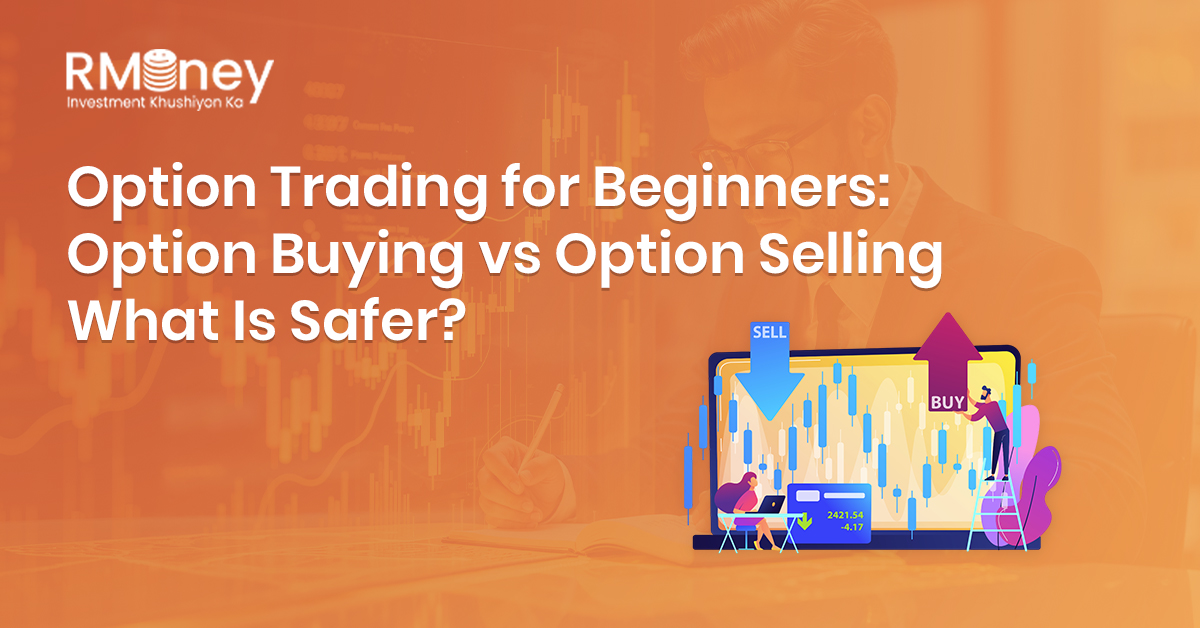
Option Trading for Beginners: Option Buying vs Option Selling – What Is Safer?
Published : December 22, 2025
Option trading for beginners has gained strong traction as derivatives have become one of the most actively traded segments in India’s financial markets. NSE data shows that index options account for the largest share of daily derivatives turnover, reinforcing India’s position as one of the most liquid options markets globally.
While options offer leverage and flexibility, they also carry significant risk if traded without proper understanding. Regulatory findings by SEBI highlight this concern. According to SEBI’s study on profits and losses in the equity futures and options (F&O) segment, over 90% of retail traders incurred net losses over a multi-year period, mainly due to poor risk management, excessive leverage, and lack of strategy.
This raises a key question for new traders: option buying vs option selling – what is safer? In this guide on option trading for beginners, we compare both approaches using real market insights and explain how RMoney supports safer, risk managed trading decisions.
What Are Options?
Options are derivative financial contracts, which means their value depends on another asset, called the underlying. This underlying asset can be a stock, an index like Nifty or Bank Nifty, a commodity, or a currency.
In simple terms, an option is an agreement that gives you a choice, not a compulsion.
An options contract gives the holder:
The right, but not the obligation
To buy or sell an underlying asset
At a fixed price (called the strike price)
On or before a fixed date (called the expiry date)
If the market does not move in your favor, you are not forced to use the option.
Two Sides of an Options Contract
Understanding what an option buyer and an option seller each have to gain or lose is very important because their risk/reward profiles are completely different.
The Option Buyer:
When you buy an option, you pay a premium for it.
As the buyer, you may choose (but are not required) to sell the underlying equity or commodity.
As a buyer, your maximum potential loss is limited to the premium you paid to purchase the option. Therefore, your trade represents a defined risk.
The Option Seller (Writer):
When you sell an option, you receive the premium immediately.
As the seller, you must perform under contract should the buyer decide to exercise his/her option.
As a seller, your maximum potential losses may be large and may be unlimited, depending on the movement of the underlying equity or commodity.
Understanding the difference between the option buyer and option seller enables the option buyer to recognize he/she is taking on limited risk while the option seller earns a consistent premium on his/her positions, but is subject to substantial and occasionally infinite risk. As such, this understanding is critical for new traders.
Option Buying: A Beginner Friendly Approach With Defined Risk
How Option Buying Works
When you buy an option, you pay a premium upfront:
Call Option: You expect the price to rise
Put Option: You expect the price to fall
If the market moves in your favor before expiry, the option gains value. If it doesn’t, the option may expire worthless.
Key point: Your maximum loss is limited to the premium paid.
This clearly defined risk makes option buying more intuitive and safer for most beginners.
Pros of Option Buying for Beginners
1. Limited and Known Risk The worst case scenario is losing the premium paid. There are no surprise losses beyond this amount.
2. No Margin Requirement Option buyers do not need a margin account. This lowers the capital requirement and complexity.
3. High Reward Potential If the market moves strongly in your favor, returns can be multiple times the premium invested.
4. Easier to Understand The logic of price up, call gains; price down, put gains, is simpler for new traders.
Cons of Option Buying
1. Lower Probability of Profit Because the option must move beyond the strike price plus premium before expiry, success rates are lower.
2. Time Decay (Theta Risk) Options lose value as expiry approaches. Even if the market moves slowly in your direction, time decay can eat into profits.
3. Timing Dependency You must be right about:
Direction
Speed of movement
Timing
This makes discipline and planning essential.
Option Selling: Higher Probability, Higher Risk
Option selling, also called option writing, means you are selling an option to someone else and receiving money (called the premium) upfront.
When you sell an option:
You earn the premium immediately
You make money if the option expires without being used
Your profit is usually limited to the premium received
Option sellers do not need to predict a big market move. Instead, they benefit when:
The market stays within a range
Prices do not move sharply
Time passes without major movement
Pros of Option Selling
1. Higher Probability of Profit Many professional traders report probability of profit between 60% and 75%, depending on strategy and market conditions.
2. Time Decay Benefits Sellers As expiry nears, option value erodes, benefiting sellers even if the market does nothing.
3. Consistent Income Potential In range bound markets, selling strategies can generate regular premium income.
Cons of Option Selling
1. Large or Unlimited Loss Potential
Naked call selling can result in theoretically unlimited losses
Naked put selling can cause heavy losses during sharp market falls
2. Margin Requirements Option sellers must maintain margin, increasing capital commitment and risk exposure.
3. Assignment Risk Options can be exercised, forcing sellers to buy or sell at unfavorable prices.
4. Psychological Pressure Large open losses, even if temporary, can test discipline and lead to poor decisions.
Option Buying vs Option Selling: Which is Safer for Beginners?
A Practical Safety Comparison
Strategy
Risk Level
Ease for Beginners
Profit Nature
Best Used When
Option Buying
Limited (Premium only)
Easier
Occasional large wins
Expect strong price movement
Option Selling
High if unhedged
Harder
Frequent small gains
With hedging & experience
The Bottom Line
For option trading for beginners, option buying is generally safer because:
Risk is predefined
Capital requirement is lower
Losses are capped
Option selling can be profitable but requires:
Strong risk management
Higher capital
Emotional control
Hedging strategies
Without these, selling options can be dangerous for beginners.
The Market Reality
Options trading is highly speculative in nature, so it is important to take great care when trading options. According to the research performed by the Securities and Exchange Board of India (SEBI) about the futures and options (F&O) market in India. More than 90% of retail traders lose money through the F&O segment over a multi year time frame. With the majority of those losses greater than the profits earned by the small percentage of traders that do make money trading F&O.
In addition to the high percentage of retail traders losing money, SEBI also discovered that one of the primary factors contributing to the losses of traders is a combination of excessive trading, using excessive amounts of leverage, and poor risk_management practices.
This reality emphasizes that long term success in options trading is based on education, discipline, and effective risk management.
Key Principles for Beginner Success in Options Trading
Regardless of strategy, these principles are non-negotiable:
1. Learn Before You Trade
Understand:
Strike price
Expiry cycles
Intrinsic & time value
Greeks (especially Delta and Theta)
2. Start With Simulations
Paper trading allows beginners to:
Test strategies
Learn without financial risk
Build confidence
3. Focus on Options Risk Management
Predefined risk trades
Stop loss rules
Risk reward planning
Limited risk spreads
4. Avoid Naked Selling Initially
Begin with:
Covered calls
Debit spreads
Credit spreads with hedging
5. Set Capital Allocation Rules
Never risk more than a small portion of your total capital on a single trade.
How RMoney Supports Option Trading for Beginners
At RMoney, trader education and capital protection come first.
What You Get With RMoney
Beginner Focused Education Easy to understand guides on option trading concepts and strategies.
Simulation & Practice Platforms Learn and test trades before risking real money.
Strategy Insights Understand probability, payoff structures, and risk before entering trades.
Risk Management Tools Tools designed to help you control losses, define risk, and trade responsibly.
Whether you are exploring option buying or gradually transitioning to structured option selling strategies, RMoney provides the support you need at every stage.
Final Thoughts
In the option buying vs option selling debate for beginners:
Option buying is safer due to limited and defined risk.
Option selling offers higher probability but carries higher and sometimes unlimited risk without experience and hedging.
Your approach should align with:
Your risk tolerance
Market knowledge
Financial goals
Start slow, prioritize learning, and build consistency over time.
Ready to Trade Smarter?
Start Your Option Trading for Beginners Journey With RMoney Today
Explore expert resources, practice risk free, and trade with confidence using tools designed to protect your capital.
Sign up on RMoney and take your first step toward disciplined options trading.
Disclaimer: Options trading involves risk and is not suitable for all investors. This content is for educational purposes only and should not be considered financial advice. Please do your own research before trading.
I have expertise in simplifying complex concepts around trading and investing into clear, practical insights. At RMoney, I write on trading, equity markets, derivatives, and long-term investing to help readers make informed financial decisions. My writing is focused on delivering clarity and confidence to investors at every stage of their journey.

 Stock Trading
Now trade in ₹9 Per Order or ₹ 999 Per Month Plans.
Stock Trading
Now trade in ₹9 Per Order or ₹ 999 Per Month Plans.
 Future & Options
Access F&O contracts with advanced tools for hedging and speculation.
Future & Options
Access F&O contracts with advanced tools for hedging and speculation.
 Currency Trading
Trade in major currency pairs and manage forex exposure efficiently.
Currency Trading
Trade in major currency pairs and manage forex exposure efficiently.
 Commodity Trading
Diversify Trading with MCX & NCDEX by Trading in Gold, Silver, Base Metals, Energy, and Agri Products.
Commodity Trading
Diversify Trading with MCX & NCDEX by Trading in Gold, Silver, Base Metals, Energy, and Agri Products.
 Margin Trading Funding
Boost your buying power with upto 5X, Buy now Pay Later
Margin Trading Funding
Boost your buying power with upto 5X, Buy now Pay Later
 Algo Trading
Back test, Paper Trade your logic & Automate your strategies with low-latency APIs.
Algo Trading
Back test, Paper Trade your logic & Automate your strategies with low-latency APIs.
 Trading View
Leverage Trading View charts and indicators integrated into your trading platform.
Trading View
Leverage Trading View charts and indicators integrated into your trading platform.
 Advanced Options Trading
Execute multi-leg option strategies with precision and insights.
Advanced Options Trading
Execute multi-leg option strategies with precision and insights.
 Stock Lending & Borrowing
Earn passive income by lending stocks securely through SLB.
Stock Lending & Borrowing
Earn passive income by lending stocks securely through SLB.
 Foreign Portfolio Investment
Enable NRIs and FPIs to invest in Indian markets with ease and compliance.
Foreign Portfolio Investment
Enable NRIs and FPIs to invest in Indian markets with ease and compliance.
 IPO
Invest in upcoming IPOs online with real-time tracking and instant allotment updates.
IPO
Invest in upcoming IPOs online with real-time tracking and instant allotment updates.
 Direct Mutual Funds
0% Commissions by investing in more than +3500 Direct Mutual Fund Scheme.
Direct Mutual Funds
0% Commissions by investing in more than +3500 Direct Mutual Fund Scheme.
 Corporate FDRs
Earn fixed returns with low-risk investments in high-rated corporate fixed deposits.
Corporate FDRs
Earn fixed returns with low-risk investments in high-rated corporate fixed deposits.
 Stocks SIPs
Build long-term wealth with systematic investment plans in top-performing stocks.
Stocks SIPs
Build long-term wealth with systematic investment plans in top-performing stocks.
 Bonds & NCDs
Access secure, fixed-income investments through government and corporate bond offerings.
Bonds & NCDs
Access secure, fixed-income investments through government and corporate bond offerings.
 Depository Services
Safely hold and manage your securities with seamless Demat and DP services with CDSL.
Depository Services
Safely hold and manage your securities with seamless Demat and DP services with CDSL.
 Journey
Tracing our growth and milestones over time.
Journey
Tracing our growth and milestones over time.
 Mission & Vision
Guided by purpose, driven by long-term vision.
Mission & Vision
Guided by purpose, driven by long-term vision.
 Why RMoney Platform
Smart, reliable platform for all investors' needs.
Why RMoney Platform
Smart, reliable platform for all investors' needs.
 Management
Experienced leadership driving strategic financial excellence.
Management
Experienced leadership driving strategic financial excellence.
 Credentials
Certified expertise with trusted industry recognition.
Credentials
Certified expertise with trusted industry recognition.
 Press Release
Latest company news, updates, and announcements.
Press Release
Latest company news, updates, and announcements.
 Testimonials
Real client stories sharing their success journeys.
Testimonials
Real client stories sharing their success journeys.
 7 Reasons to Invest
Top benefits that make investing with us smart.
7 Reasons to Invest
Top benefits that make investing with us smart.
 SEBI Registered Research
Trusted insights backed by SEBI-compliant research.
SEBI Registered Research
Trusted insights backed by SEBI-compliant research.
 Our Technology
Advanced tools enabling efficient online trading.
Our Technology
Advanced tools enabling efficient online trading.
 Calculators
Access a suite of smart tools to plan trades, margins, and returns effectively.
Calculators
Access a suite of smart tools to plan trades, margins, and returns effectively.
 Margin Calculator
Instantly check margin requirements for intraday and delivery trades.
Margin Calculator
Instantly check margin requirements for intraday and delivery trades.
 MTF Calculator
Calculate MTF funding cost upfront to ensure full transparency before placing a trade.
MTF Calculator
Calculate MTF funding cost upfront to ensure full transparency before placing a trade.
 Brokerage Calculator
Know your exact brokerage charges before placing any trade.
Brokerage Calculator
Know your exact brokerage charges before placing any trade.
 Market Place
Explore curated investment products and trading tools in one convenient hub.
Market Place
Explore curated investment products and trading tools in one convenient hub.
 RMoney Gyan
Enhance your market knowledge with expert blogs, videos, and tutorials.
RMoney Gyan
Enhance your market knowledge with expert blogs, videos, and tutorials.
 Performance Tracker
Track our research performance with full transparency using our performance tracker.
Performance Tracker
Track our research performance with full transparency using our performance tracker.
 Feedback
Share your suggestions or concerns to help us improve your experience.
Feedback
Share your suggestions or concerns to help us improve your experience.
 Downloads
Access important forms, software, and documents in one place.
Downloads
Access important forms, software, and documents in one place.
 Locate Us
Find the nearest RMoney branch or service center quickly.
Locate Us
Find the nearest RMoney branch or service center quickly.
 Escalation Matrix
Resolve issues faster with our structured support escalation process.
Escalation Matrix
Resolve issues faster with our structured support escalation process.
 Back Office
Log in to view trade reports, ledger, and portfolio statements anytime.
Back Office
Log in to view trade reports, ledger, and portfolio statements anytime.
 Account Modification
Update personal or bank details linked to your trading account.
Account Modification
Update personal or bank details linked to your trading account.
 Fund Transfer
Transfer funds instantly online with quick limit updation to your trading account.
Fund Transfer
Transfer funds instantly online with quick limit updation to your trading account.
 Bank Details
View our registered bank account details for seamless transactions by NEFT, RTGS or IMPS.
Bank Details
View our registered bank account details for seamless transactions by NEFT, RTGS or IMPS.
 RMoney Quick Mobile App
Trade on-the-go with our all-in-one mobile trading app.
RMoney Quick Mobile App
Trade on-the-go with our all-in-one mobile trading app.
 RMoney Quick login
Quickly access your trading account through the RMoney Quick web-based trading.
RMoney Quick login
Quickly access your trading account through the RMoney Quick web-based trading.
 RMoney Rocket Web Version
Experience powerful web-based trading with advanced tools for algo traders.
RMoney Rocket Web Version
Experience powerful web-based trading with advanced tools for algo traders.
 RMoney Rocket Mobile Version
Trade anytime, anywhere with our feature-rich mobile trading platform.
RMoney Rocket Mobile Version
Trade anytime, anywhere with our feature-rich mobile trading platform.
 Rocket API
Lightning-fast trading API for developers advanced algo traders.
Rocket API
Lightning-fast trading API for developers advanced algo traders.
 XTS Algo
Smart algo trading software for precision trades.
XTS Algo
Smart algo trading software for precision trades.
 Authorised Person Partner with us as an Authorised Person to grow your financial business.
 Refer & Earn
Invite friends and earn rewards every time they trade with us.
Refer & Earn
Invite friends and earn rewards every time they trade with us.